Search


引用和文献 (30)
Invitrogen™
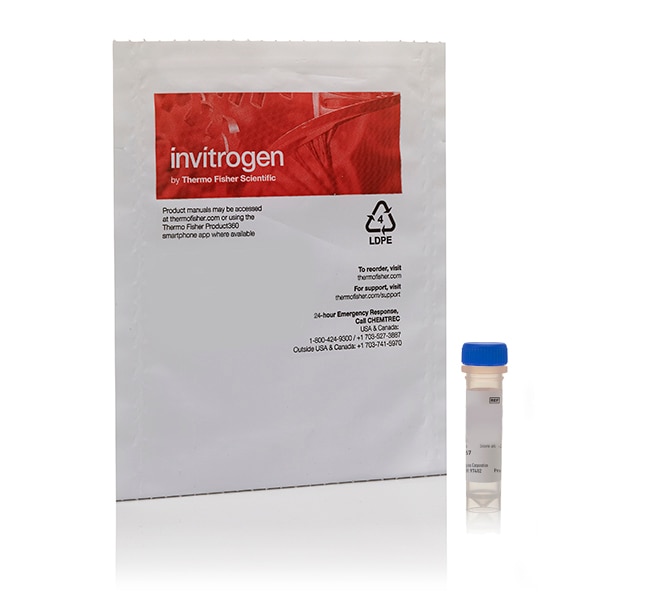
Qtracker™ 655血管标记
Qtracker™ 非靶向量子点被设计为可向小鼠尾静脉注射,以便采用小动物体内成像 (SAIVI) 技术研究血管结构。这些纳米晶体可发出强烈的荧光和红迁移发射信号以提高组织渗透率,并具有专门开发的 PEG 表面涂层,以尽量降低非特异性相互作用的影响,并减少组织的免疫反应。因为 PEG 表面涂层不含活性官能团,Qtracker™了解更多信息
| 货号 | 数量 |
|---|---|
| Q21021MP | 200 μL |
货号 Q21021MP
价格(CNY)
8,570.00
飞享价
Ends: 31-Dec-2026
11,902.00共减 3,332.00 (28%)
Each
数量:
200 μL
价格(CNY)
8,570.00
飞享价
Ends: 31-Dec-2026
11,902.00共减 3,332.00 (28%)
Each
Qtracker™ 非靶向量子点被设计为可向小鼠尾静脉注射,以便采用小动物体内成像 (SAIVI) 技术研究血管结构。这些纳米晶体可发出强烈的荧光和红迁移发射信号以提高组织渗透率,并具有专门开发的 PEG 表面涂层,以尽量降低非特异性相互作用的影响,并减少组织的免疫反应。因为 PEG 表面涂层不含活性官能团,Qtracker™ 非靶向量子点可以保留较长的循环时间,并可以单次注射实现长达 3 小时的成像,或者通过额外注射进行更长时间成像。
是否需要不同的发射光谱或更长时间的追踪?查看我们的其他哺乳动物细胞追踪产品。
重要属性:
•Qtracker™ 655 标签具有激发/发射波长 (405-615/655) nm
• 设计用于小动物体内成像
• 通过尾静脉注射引入,注射后可成像长达 3 小时
• 有四种颜色可用— 565 nm、655 nm、705 nm 或 800 nm 发射
阅读有关 SAIVI 和 Qdot™ 纳米晶体应用的更多信息。
仅供研究使用。不得用于任何动物或人类的治疗或诊断。
是否需要不同的发射光谱或更长时间的追踪?查看我们的其他哺乳动物细胞追踪产品。
重要属性:
•Qtracker™ 655 标签具有激发/发射波长 (405-615/655) nm
• 设计用于小动物体内成像
• 通过尾静脉注射引入,注射后可成像长达 3 小时
• 有四种颜色可用— 565 nm、655 nm、705 nm 或 800 nm 发射
阅读有关 SAIVI 和 Qdot™ 纳米晶体应用的更多信息。
仅供研究使用。不得用于任何动物或人类的治疗或诊断。
仅供科研使用。不可用于诊断程序。
规格
最大浓度2 μM
染料类型Qdot 纳米晶体
产品线QTRACKER、Qdot
数量200 μL
试剂类型血管成像试剂
运输条件室温
技术体内成像
产品类型细胞标记
Unit SizeEach
内容与储存
包含 200 μL Qtracker™ 非靶向量子点(2 μM 溶液,溶于 50 mM 硼酸盐缓冲液 (pH 8.3))。储存在 2–6°C 下。切勿冷冻。可稳定保存至少 6 个月。
常见问题解答 (FAQ)
当我用Qtracker cell labeling reagents进行标记时,我得到一个点状标记图案。我如何让它更均匀?
注射之后多久可以对我的小鼠进行成像检测?
小鼠体内未结合的染料会造成哪些后果?
我应该注入多少量的Qtracker 非靶向试剂来进行血管成像?
我想用核酸染料来追踪我的细胞,比如DAPI或者Hoechst染料。您有什么建议吗?
引用和文献 (30)
引用和文献
Abstract
Intracellular fluid flow in rapidly moving cells.
Journal:Nat Cell Biol
PubMed ID:19767741
'Cytosolic fluid dynamics have been implicated in cell motility because of the hydrodynamic forces they induce and because of their influence on transport of components of the actin machinery to the leading edge. To investigate the existence and the direction of fluid flow in rapidly moving cells, we introduced inert
Circulating Bmp10 acts through endothelial Alk1 to mediate flow-dependent arterial quiescence.
Journal:
PubMed ID:23863480
'Blood flow plays crucial roles in vascular development, remodeling and homeostasis, but the molecular pathways required for transducing flow signals are not well understood. In zebrafish embryos, arterial expression of activin receptor-like kinase 1 (alk1), which encodes a TGFß family type I receptor, is dependent on blood flow, and loss
In vivo diffusion analysis with quantum dots and dextrans predicts the width of brain extracellular space.
Journal:Proc Natl Acad Sci U S A
PubMed ID:16567637
'Diffusion within the extracellular space (ECS) of the brain is necessary for chemical signaling and for neurons and glia to access nutrients and therapeutics; however, the width of the ECS in living tissue remains unknown. We used integrative optical imaging to show that dextrans and water-soluble quantum dots with Stokes-Einstein
Variables influencing interactions of untargeted quantum dot nanoparticles with skin cells and identification of biochemical modulators.
Journal:Nano Lett
PubMed ID:17408303
Skin cells (NHEK) take up untargeted quantum dots (QD) with surface polyethylene glycol (PEG), amines, and carboxylic acids, but the mechanisms are unknown. Time courses of QD-NHEK interactions were determined and effects of QD surface coating, temperature, culture medium supplements and inhibitors of the cell cycle and endocytosis identified. The
Intravital FLIM-FRET imaging reveals dasatinib-induced spatial control of src in pancreatic cancer.
Journal:
PubMed ID:23749641
Cancer invasion and metastasis occur in a complex three-dimensional (3D) environment, with reciprocal feedback from the surrounding host tissue and vasculature-governing behavior. In this study, we used a novel intravital method that revealed spatiotemporal regulation of Src activity in response to the anti-invasive Src inhibitor dasatinib. A fluorescence lifetime imaging