Search


引用和文献 (27)
Invitrogen™
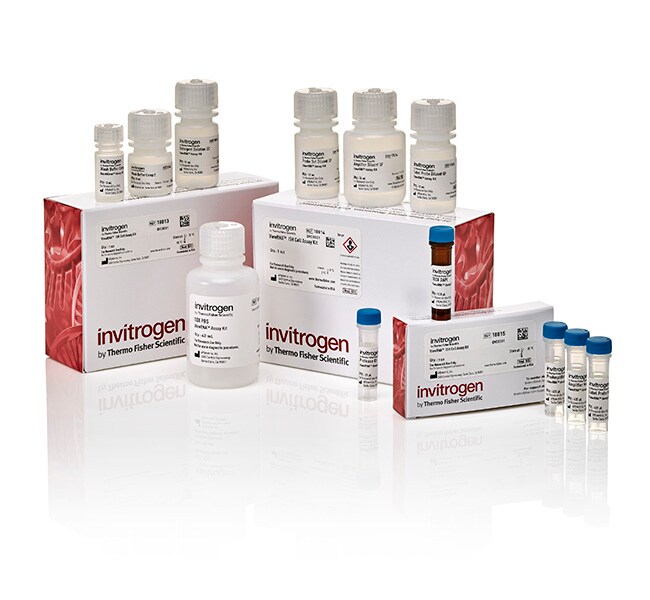
ViewRNA™ ISH Cell Assay Kit
ViewRNA™ ISH Cell Assay 是一种直接的荧光 RNA 原位杂交方法,可使用荧光显微镜或高内涵成像仪以单拷贝灵敏度和单细胞分辨率同时检测 1 至 4了解更多信息
| 货号 | 数量 |
|---|---|
| QVC0001 | 1 kit |
货号 QVC0001
价格(CNY)
21,509.00
Each
数量:
1 kit
价格(CNY)
21,509.00
Each
ViewRNA™ ISH Cell Assay 是一种直接的荧光 RNA 原位杂交方法,可使用荧光显微镜或高内涵成像仪以单拷贝灵敏度和单细胞分辨率同时检测 1 至 4 个 RNA 靶标(mRNA 或非编码 RNA)。与通常受高背景和低灵敏度限制的传统 FISH 技术不同,该检测使用专有化学技术用于靶向特异性探针集(RNA FISH 探针),并使用分支 DNA 信号扩增 (bDNA) 来检测特异性信号。荧光 RNA 原位杂交检测分为四个主要步骤:样品制备、靶标杂交、信号扩增以及检测。该 ViewRNA ISH 分析试剂盒至多可检测 3 个 RNA ,但可以与 ViewRNA™ 740 Module 结合使用,以添加第 4 个探针。
必需的附加组件:
10 X PBS (货号 QVC0508)
ViewRNA™ - Detergent Solution QC(货号 QVC0509)
ViewRNA™ - Wash Buffer Set(货号 QG0507)
ViewRNA™ ISH Cell Accessory Kit(货号 QVC0700)旨在提供试剂盒中未提供的许多必需组分,以进行测定。
ViewRNA™ Probe Sets 不包含在检测中,而是用于 ViewRNA ISH Cell Assay。请访问我们的网站以查看 6,500 多种合成探针集 (Probe Sets) 的完整列表。根据要求,新的探针集 (Probe Sets) 可在不到两周的时间内设计和合成,而不需要附加成本。
添加第 4 个 RNA 探针:
ViewRNA™ ISH Cell 740 Module(货号 QVC0200),旨在与 ViewRNA™ ISH Cell Assay 一同使用,并允许分析 740 通道中的其他 RNA 靶标 (AlexaFluor 750)。请参见包装插页以获取试剂盒中所提供材料的完整列表。
已报告的应用
显微镜检查
必需的附加组件:
10 X PBS (货号 QVC0508)
ViewRNA™ - Detergent Solution QC(货号 QVC0509)
ViewRNA™ - Wash Buffer Set(货号 QG0507)
ViewRNA™ ISH Cell Accessory Kit(货号 QVC0700)旨在提供试剂盒中未提供的许多必需组分,以进行测定。
ViewRNA™ Probe Sets 不包含在检测中,而是用于 ViewRNA ISH Cell Assay。请访问我们的网站以查看 6,500 多种合成探针集 (Probe Sets) 的完整列表。根据要求,新的探针集 (Probe Sets) 可在不到两周的时间内设计和合成,而不需要附加成本。
添加第 4 个 RNA 探针:
ViewRNA™ ISH Cell 740 Module(货号 QVC0200),旨在与 ViewRNA™ ISH Cell Assay 一同使用,并允许分析 740 通道中的其他 RNA 靶标 (AlexaFluor 750)。请参见包装插页以获取试剂盒中所提供材料的完整列表。
已报告的应用
显微镜检查
仅供科研使用。不可用于诊断程序。
规格
数量1 kit
类型ISH 细胞检测试剂盒
Unit SizeEach
内容与储存
对于足以进行 1-plex 到 3-plex(AlexaFluor 488、546 和 647)24-孔板样式(24 份样品)测定的成分,使用盖玻片盖于载玻片上可以进行 96 次测定
常见问题解答 (FAQ)
How do ViewRNA assays compare to RNAScope assays?
How is the signal amplified in ViewRNA assays?
Where can I find general information about ViewRNA ISH Assays?
For ViewRNA assays, can I use the same set of wash solutions for all samples, including the positive and negative controls?
The ViewRNA ISH Cell Assay Kit user manual lists an accessory kit, Cat. No. QVC0700 which has been discontinued. Do you offer or suggest alternatives for the items in the accessory kit that have also been discontinued?
引用和文献 (27)
引用和文献
Abstract
Raphe serotonin neuron-specific oxytocin receptor knockout reduces aggression without affecting anxiety-like behavior in male mice only.
Journal:
PubMed ID:25677455
'Serotonin and oxytocin influence aggressive and anxiety-like behaviors, though it is unclear how the two may interact. That the oxytocin receptor is expressed in the serotonergic raphe nuclei suggests a mechanism by which the two neurotransmitters may cooperatively influence behavior. We hypothesized that oxytocin acts on raphe neurons to influence
Frequent proviral integration of the human betaretrovirus in biliary epithelium of patients with autoimmune and idiopathic liver disease.
Journal:
PubMed ID:25521721
'A human betaretrovirus (HBRV) has been linked with primary biliary cirrhosis (PBC) following the detection of viral particles in biliary epithelium by electron microscopy and cloning of the betaretrovirus genome from biliary epithelium and peri-hepatic lymph nodes. Evidence for viral infection was found in the majority of PBC patients'' peri-hepatic
High-throughput detection of miRNAs and gene-specific mRNA at the single-cell level by flow cytometry.
Journal:
PubMed ID:25472703
Fluorescent in situ hybridization (FISH) is a method that uses fluorescent probes to detect specific nucleic acid sequences at the single-cell level. Here we describe optimized protocols that exploit a highly sensitive FISH method based on branched DNA technology to detect mRNA and miRNA in human leukocytes. This technique can
RNA sequencing of pancreatic circulating tumour cells implicates WNT signalling in metastasis.
Journal:Nature
PubMed ID:22763454
Circulating tumour cells (CTCs) shed into blood from primary cancers include putative precursors that initiate distal metastases. Although these cells are extraordinarily rare, they may identify cellular pathways contributing to the blood-borne dissemination of cancer. Here, we adapted a microfluidic device for efficient capture of CTCs from an endogenous mouse
Urinary Xist is a potential biomarker for membranous nephropathy.
Journal:
PubMed ID:25157805
Membranous nephropathy (MN), a type of glomerular nephritis, is the most common cause of nephrotic syndrome in human adults. Changes in gene expression as a result of epigenetic dysregulation through long noncoding RNAs (lncRNAs) are increasingly being recognized as important factors in disease. Using an experimental MN mouse model, we