Search


引用和文献 (16)
Invitrogen™
Image-iT™ 固定液
Image-iT 固定液是一种即用型溶液,采用各种规格以满足各种研究需求。它们非常适合与荧光蛋白(如 GFP 和 RFP)和其他小分子染料荧光基团配合使用。无需再混合有毒的固定剂粉末,只需将其加入细胞并固定。
Have Questions?
更改视图

| 货号 | 产品类型 | 数量 |
|---|---|---|
| R37814 | 溶于 PBS 的 4% 甲醛固定液(无甲醇) | 5 x 20 mL |
| I28800 | 溶于 0.1M 磷酸盐缓冲液的 4% 多聚甲醛固定液(无甲醇) | 10 x 10 mL |
| I28900 | 溶于 0.1M 二甲胂酸钠缓冲液的 3% 多聚甲醛、0.35% 戊二醛固定液(无甲醇) | 10×10ml |
| I28700 | 3% 乙二醛固定液 | 2 x 50 mL |
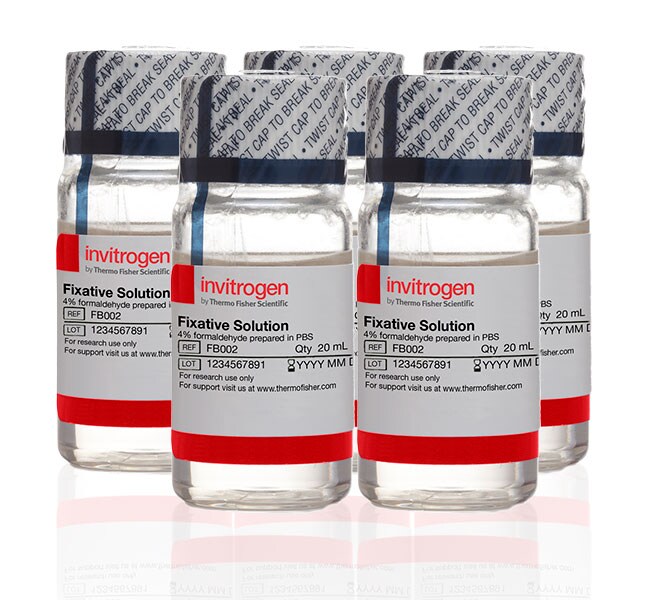
| FB002 | 溶于 PBS 的 4% 甲醛固定液(无甲醇) | 20 mL |
货号 R37814
价格(CNY)
1,627.00
飞享价
Ends: 31-Dec-2026
2,259.00共减 632.00 (28%)
Each
产品类型:
溶于 PBS 的 4% 甲醛固定液(无甲醇)
数量:
5 x 20 mL
价格(CNY)
1,627.00
飞享价
Ends: 31-Dec-2026
2,259.00共减 632.00 (28%)
Each
Image-iT™ 固定液是一种即用型溶液,采用各种规格以满足越来越多的研究需求。
Image-iT 固定液是即用型固定液,有各种规格可供选择,以满足各种研究需求。它们非常适合与荧光蛋白(如 GFP 和 RFP)和其他小分子染料荧光基团配合使用。无需再混合有毒的固定剂粉末或稀释 pH 值不理想的浓缩溶液。 只需将这些固定液加入细胞/组织并在室温下孵育 10-15 分钟。它们非常适合用于基于抗体的任何检测方法,包括免疫细胞化学 (ICC)、免疫荧光 (IF) 和免疫组织化学 (IHC)。
Image-iT 固定液的特点包括:
•即用型
• 高纯度、成像级固定剂,背景信号伪影极少
• 不含甲醇
• 针对二抗标记、固定细胞染料染色和比色 IHC 进行优化
4% 甲醛或多聚甲醛固定液
4% 甲醛和多聚甲醛是免疫细胞化学 (ICC)、免疫荧光 (IF) 和免疫组织化学 (IHC) 中较常用的固定剂。 溶于 pH 7.4 的 0.1M 磷酸盐缓冲液的 Image-IT™ 4% 多聚甲醛(货号:I28800),以一包十瓶的包装形式提供,每瓶 10 mL。溶于 PBS 中的 Image-iT™ 4% 甲醛以 20 mL 规格(货号:FB002)或 5 x 20 mL 规格(货号:R37814)形式提供。溶于 0.1 M 磷酸盐缓冲液时,4% 多聚甲醛/甲醛的渗透压比溶于 PBS 时低 ∼300 mOsm,这有助于在固定剂有机会固定内细胞区室前维持细胞形态。使用溶于 PBS 或磷酸盐缓冲液中的多聚甲醛/甲醛时,只需将固定剂加入细胞,并在室温下孵育 5-10 分钟。孵育完成后,在 PBS 中洗涤细胞,然后进行封闭步骤。
3% 多聚甲醛、0.35% 戊二醛固定液
含 0.35% 戊二醛的 3% 多聚甲醛是一种即用型溶液,以不含甲醇的 0.1 M 二甲胂酸钠缓冲液形式提供。Yuan Qin 等人(1) 发现使用两者的混合物能更好地保持线粒体形态(与单独使用多聚甲醛或戊二醛相比)。
多聚甲醛是一种小分子,可快速渗透细胞/组织,将蛋白和其它分子固定到位。戊二醛是一种大分子,具有两个反应性醛基,可提高固定能力,有助于产生戊二醛长链,从而生成基质。这种能力有助于在线粒体等复杂环境中保留蛋白定位。
如需固定细胞/组织,建议在室温下孵育 5–10 分钟。使用戊二醛时,由于反应性醛基增加,可观察到自发荧光增加。为了帮助减少这种自发荧光,建议在固定后、封闭前使用 0.1M 甘氨酸或新配制的 0.1% (w/v) 硼氢化钠孵育七分钟左右。
3% 乙二醛固定液
乙二醛是一种比甲醛或戊二醛更小的分子。它可快速渗透细胞/组织,固定蛋白,比甲醛更好地保持细胞形态 (2)。3% 乙二醛固定液是一种即用型固定液,分装于两个瓶中提供:组分 A (92 mL)和组分 B (8 mL),含有无水乙醇、乙二醛溶液、乙酸和水。在空瓶中加入溶液 A 和溶液 B,将两种溶液旋晃在一起,然后加入 1M NaOH 使 pH 值为4.5。一旦混合,必须立即使用该溶液。要固定细胞/组织,请将细胞/组织在室温下孵育约10分钟。
参考文献
1:Qin Y, Jiang W, Li A, Gao M, Liu H, Gao Y, Tian X, Gong G. The Combination of Paraformaldehyde and Glutaraldehyde Is a Potential Fixative for Mitochondria.Biomolecules.2021 May 10;11(5):711.
2: Richter KN, et al.Glyoxal as an alternative fixative to formaldehyde in immunostaining and super-resolution microscopy.EMBO J. 2018 Jan 4;37(1):139-159.
规格
最大浓度4% 甲醛,无甲醇
适用于(应用)荧光蛋白、GFP、RFP、其他小分子染料荧光基团
产品线Image-iT
数量5 x 20 mL
产品类型溶于 PBS 的 4% 甲醛固定液(无甲醇)
溶液类型固定剂
Unit SizeEach
常见问题解答 (FAQ)
我应该使用哪种固定剂来固定自己的细胞或组织,从而进行抗体标记?
The Image-iT Fixation/Permeabilization Kit includes Triton X-100 as the permeabilizing reagent. May I substitute other reagents for permeabilizing?
Is the Image-iT Fixative Solution alcohol-free?
Can I add the Image-iT Fixative Solution in with the media?
What fixative should I use to fix my cells or tissues for antibody labeling?
引用和文献 (16)
引用和文献
Abstract
Autophagy is increased in cryptorchid testis resulting in abnormal spermatozoa.
Journal:
PubMed ID:31031333
'Autophagy is involved in spermatogenesis by regulating germ cell maturation. This catabolic process increases with hyperthermic conditions to prevent the accumulation of damaged organelles. Cryptorchidism is associated with impairment of germ cell maturation revealed by the presence of immature forms of sperm cells in ejaculates. The aim of the present
GFP-complementation assay to detect functional CPP and protein delivery into living cells.
Journal:
PubMed ID:26671759
'Efficient cargo uptake is essential for cell-penetrating peptide (CPP) therapeutics, which deliver widely diverse cargoes by exploiting natural cell processes to penetrate the cell''s membranes. Yet most current CPP activity assays are hampered by limitations in assessing uptake, including confounding effects of conjugated fluorophores or ligands, indirect read-outs requiring secondary
BET inhibitor OTX015 targets BRD2 and BRD4 and decreases c-MYC in acute leukemia cells.
Journal:
PubMed ID:25989842
The bromodomain (BRD) and extraterminal (BET) proteins including BRD2, BRD3 and BRD4 have been identified as key targets for leukemia maintenance. A novel oral inhibitor of BRD2/3/4, the thienotriazolodiazepine compound OTX015, suitable for human use, is available. Here we report its biological effects in AML and ALL cell lines and
Hypomyelinating leukodystrophy-associated missense mutation in HSPD1 blunts mitochondrial dynamics.
Journal:
PubMed ID:25957474
Myelin-forming glial cells undergo dynamic morphological changes in order to produce mature myelin sheaths with multiple layers. In the central nervous system (CNS), oligodendrocytes differentiate to insulate neuronal axons with myelin sheaths. Myelin sheaths play a key role in homeostasis of the nervous system, but their related disorders lead not
Age-dependent changes in clock neuron structural plasticity and excitability are associated with a decrease in circadian output behavior and sleep.
Journal:Neurobiol Aging
PubMed ID:30825692
'Aging has significant effects on circadian behavior across a wide variety of species, but the underlying mechanisms are poorly understood. Previous work has demonstrated the age-dependent decline in behavioral output in the model organism Drosophila. We demonstrate that this age-dependent decline in circadian output is combined with changes in daily