Search


引用和文献 (8)
Invitrogen™
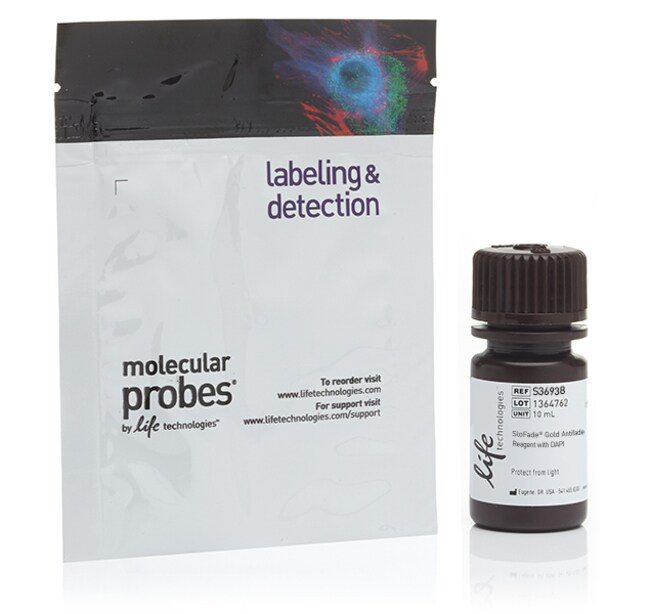
SlowFade™ Gold 抗淬灭封片剂(含 DAPI)
SlowFade Gold 抗淬灭封片剂是一种直接用于显微玻片上荧光标记的细胞或组织样品的液态封片剂。其所含的化学组分可在荧光显微镜实验过程中避免荧光染料淬灭(光漂白)。SlowFade Gold 抗淬灭封片剂基于甘油,无需混合或固化,因此非常适合即时观察样品。即用型—只需滴入样品了解更多信息
Have Questions?
更改视图

| 货号 | 数量 |
|---|---|
| S36938 | 10 mL |
| S36939 | 5 x 2 mL |
| S36942 | 2 mL |
货号 S36938
价格(CNY)
1,773.00
飞享价
Ends: 31-Dec-2026
2,462.00共减 689.00 (28%)
Each
数量:
10 mL
价格(CNY)
1,773.00
飞享价
Ends: 31-Dec-2026
2,462.00共减 689.00 (28%)
Each
SlowFade Gold 抗淬灭封片剂是一种直接用于显微玻片上荧光标记的细胞或组织样品的液态封片剂。其所含的化学组分可在荧光显微镜实验过程中避免荧光染料淬灭(光漂白)。SlowFade Gold 抗淬灭封片剂基于甘油,无需混合或固化,因此非常适合即时观察样品。即用型—只需滴入样品、盖上玻片,随即可成像。其可提供含/不含 DAPI 核染色剂的选择。
主要性质:
•可在成像过程中避免染料淬灭
• 即用型液体,非常适合即时观察样品
• 封片后的样品可稳定保存数周
• 保持荧光信号强度—很少或完全不会淬灭
• 非常适合 Alexa Fluor 染料
根据您的荧光成像需求选择最适合的抗淬灭封片或光学透明化试剂 ›
SlowFade Gold 抗淬灭封片剂不建议用于封片含荧光蛋白(如 GFP)的样品。为对培养细胞或薄组织切片中的荧光蛋白和荧光染料提供出色的抗淬灭保护性能,建议使用 SlowFade Diamond 抗淬灭封片剂。为在 0–500 μm 焦深下实现高分辨率或成像较厚的组织或 3D 细胞培养物,可尝试 SlowFade Glass 抗淬灭封片剂。
根据您的实验需求选择最适合的 SlowFade 抗淬灭试剂›
主要性质:
•可在成像过程中避免染料淬灭
• 即用型液体,非常适合即时观察样品
• 封片后的样品可稳定保存数周
• 保持荧光信号强度—很少或完全不会淬灭
• 非常适合 Alexa Fluor 染料
根据您的荧光成像需求选择最适合的抗淬灭封片或光学透明化试剂 ›
SlowFade Gold 抗淬灭封片剂不建议用于封片含荧光蛋白(如 GFP)的样品。为对培养细胞或薄组织切片中的荧光蛋白和荧光染料提供出色的抗淬灭保护性能,建议使用 SlowFade Diamond 抗淬灭封片剂。为在 0–500 μm 焦深下实现高分辨率或成像较厚的组织或 3D 细胞培养物,可尝试 SlowFade Glass 抗淬灭封片剂。
根据您的实验需求选择最适合的 SlowFade 抗淬灭试剂›
仅供科研使用。不可用于诊断程序。
规格
标签或染料DAPI
产品线SlowFade
数量10 mL
运输条件室温
适用于(设备)显微镜
形式Liquid
产品类型抗淬灭固定剂
溶液类型抗褪色溶液
Unit SizeEach
内容与储存
建议在室温下储存、但也可进行冷冻储存(-5 至 -30°C )。避光。
常见问题解答 (FAQ)
DAPI和Hoechst 染料非常相似,该如何选用?
What is the difference between ProLong and SlowFade antifade reagents?
Some antifade mounting media stay as liquid whereas others harden. What is the benefit of having one that hardens?
Does Slowfade Antifade Mountant require using a nail polish for sealing?
DAPI and Hoechst dyes are quite similar to each other. Why would I choose one over the other?
引用和文献 (8)
引用和文献
Abstract
Alkylation damage causes MMR-dependent chromosomal instability in vertebrate embryos.
Journal:Nucleic Acids Res
PubMed ID:18522974
'S(N)1-type alkylating agents, like N-methyl-N-nitrosourea (MNU) and N-ethyl-N-nitrosourea (ENU), are potent mutagens. Exposure to alkylating agents gives rise to O(6)-alkylguanine, a modified base that is recognized by DNA mismatch repair (MMR) proteins but is not repairable, resulting in replication fork stalling and cell death. We used a somatic mutation detection
Identification of a novel signal in the cytoplasmic tail of the Na+:HCO3- cotransporter NBC1 that mediates basolateral targeting.
Journal:Am J Physiol Renal Physiol
PubMed ID:17182531
'The Na(+):HCO(3)(-) cotransporter NBC1 (SLC4A4, variant A, kidney specific) is located exclusively on the basolateral membrane of epithelial cells, implying that this molecule has acquired specific signals for targeting to the basolateral membrane. A motif with the sequence QQPFLS (positions 1010-1015) in the cytoplasmic tail of NBC1 was recently demonstrated
Reactive oxygen species production via NADPH oxidase mediates TGF-beta-induced cytoskeletal alterations in endothelial cells.
Journal:Am J Physiol Renal Physiol
PubMed ID:16159901
'Cytoskeletal alterations in endothelial cells have been linked to nitric oxide generation and cell-cell interactions. Transforming growth factor (TGF)-beta has been described to affect cytoskeletal rearrangement in numerous cell types; however, the underlying pathway is unclear. In the present study, we found that human umbilical vein endothelial cells (HUVEC) have
Identification and characterization of small molecules that inhibit intracellular toxin transport.
Journal:Infect Immun
PubMed ID:17576758
'Shiga toxin (Stx), cholera toxin (Ctx), and the plant toxin ricin are among several toxins that reach their intracellular destinations via a complex route. Following endocytosis, these toxins travel in a retrograde direction through the endosomal system to the trans-Golgi network, Golgi apparatus, and endoplasmic reticulum (ER). There the toxins
Enhanced innate antiviral gene expression, IFN-a, and cytolytic responses are predictive of mucosal immune recovery during simian immunodeficiency virus infection.
Journal:
PubMed ID:24610016
The mucosa that lines the respiratory and gastrointestinal (GI) tracts is an important portal of entry for pathogens and provides the first line of innate immune defense against infections. Although an abundance of memory CD4(+) T cells at mucosal sites render them highly susceptible to HIV infection, the gut and