Search


引用和文献 (22)
Invitrogen™
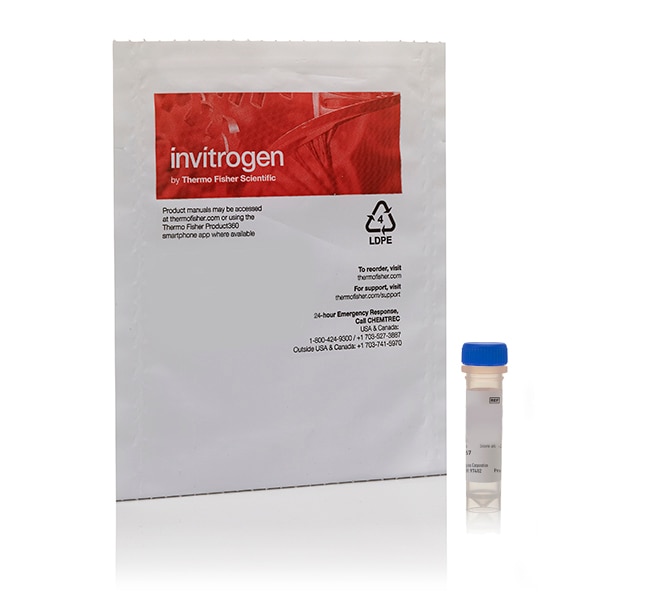
SYTO™ 17红色荧光核酸染色剂 - 5 mM 的 DMSO 溶液
用于荧光显微检测
| 货号 | 数量 |
|---|---|
| S7579 | 250 μL |
货号 S7579
价格(CNY)
3,469.00
飞享价
Ends: 31-Dec-2026
4,818.00共减 1,349.00 (28%)
Each
数量:
250 μL
价格(CNY)
3,469.00
飞享价
Ends: 31-Dec-2026
4,818.00共减 1,349.00 (28%)
Each
细胞通透性 SYTO 17红色荧光核酸染色剂在与核酸结合后,会发出明亮的红色荧光。由于 SYTO 染料在活细胞中的染色模式可能不同,我们提供的 SYTO 红色荧光核酸染色剂采样试剂盒 (S-11340) 可帮助研究人员为其系统找到最合适的红色荧光 SYTO 染色剂。
仅供科研使用。不可用于诊断程序。
规格
颜色红色
描述SYTO™ 17 红色荧光核酸染色剂 - 5 mM 溶液,溶于 DMSO 中
检测方法荧光
染料类型细胞通透性
发射634 nm
激发波长范围621 nm
适用于(设备)荧光显微镜
产品线SYTO
数量250 μL
运输条件室温
容积(公制)250 μL
标签类型荧光
产品类型核酸染色剂
亚细胞定位核酸
Unit SizeEach
内容与储存
在冷柜(-5°C 至 -30°C)中避光储存。
常见问题解答 (FAQ)
这些染料如何与DNA结合?
How do SYTO dyes bind to DNA?
引用和文献 (22)
引用和文献
Abstract
Multiparameter detection of apoptosis using red-excitable SYTO probes.
Journal:Cytometry A
PubMed ID:18431792
'Functional assays allowing phenotypic characterization of different cell death parameters at a single-cell level are important tools for preclinical anticancer drug screening. Currently, the selection of cytometric assays is limited by the availability of fluorescent probes with overlapping spectral characteristics. Following on our earlier reports on green and orange fluorescent
Liver fatty acid-binding protein colocalizes with peroxisome proliferator activated receptor alpha and enhances ligand distribution to nuclei of living cells.
Journal:Biochemistry
PubMed ID:14992586
'Although it is hypothesized that long-chain fatty acyl CoAs (LCFA-CoAs) and long-chain fatty acids (LCFAs) regulate transcription in the nucleus, little is known regarding factors that determine the distribution of these ligands to nuclei of living cells. Immunofluorescence colocalization showed that liver fatty acid-binding protein (L-FABP; binds LCFA-CoA as well
Confocal laser scanning microscopy of urinary bladder after intravesical instillation of a fluorescent dye.
Journal:Urology
PubMed ID:12837458
'OBJECTIVES: To assess the potential of confocal laser scanning microscopy for imaging of the urinary bladder after intravesical instillation of a fluorescent dye. METHODS: The study was performed on the bladder of male Copenhagen rats. For confocal fluorescence microscopy (CFM), a standard confocal laser scanning microscope (Zeiss LSM 410) was
Induction of DNA damage response by the supravital probes of nucleic acids.
Journal:Cytometry A
PubMed ID:19373929
'The aim of this study was to assess the potential DNA damage response (DDR) to four supravitally used biomarkers Hoechst 33342 (Ho 42), DRAQ5, DyeCycle Violet (DCV), and SYTO 17. A549 cells were exposed to these biomarkers at concentrations generally applied to live cells and their effect on histone H2AX
Fiber cell denucleation in the primate lens.
Journal:Invest Ophthalmol Vis Sci
PubMed ID:9286256
'PURPOSE: To determine the morphologic and biochemical events preceding the breakdown of fiber cell nuclei in the primate lens. METHODS: Monkey lens slices were labeled with fluorescent probes and optically sectioned using a confocal microscope. The distribution of nuclear histones was visualized by immunofluorescence. DNA and cellular membranes were imaged