Search


引用和文献 (30)
Invitrogen™
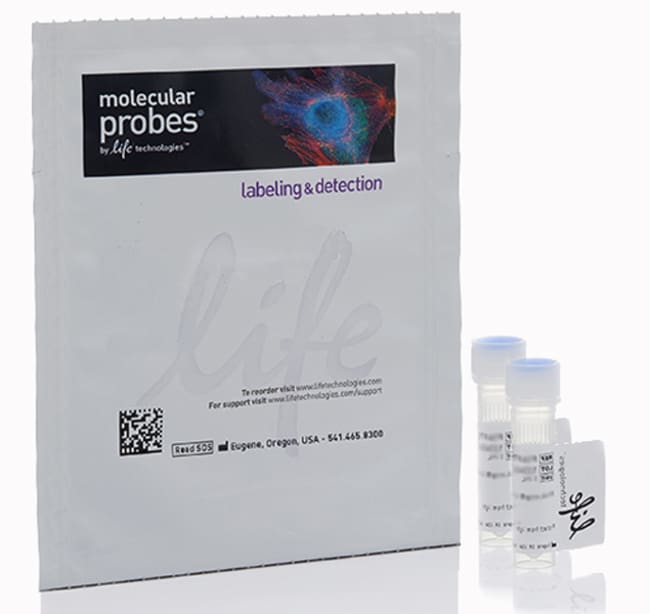
Tubulin Tracker™ Green(Oregon Green™ 488 Taxol,双乙酸酯),用于活细胞成像
Tubulin Tracker™ Green(Oregon Green™ 488 Taxol,双乙酸酯)可对活细胞中聚合的微管蛋白进行绿色荧光染色。Tubulin Tracker™了解更多信息
| 货号 | 数量 |
|---|---|
| T34075 | 1 set |
货号 T34075
价格(CNY)
7,722.00
1 set
数量:
1 set
价格(CNY)
7,722.00
1 set
Tubulin Tracker™ Green(Oregon Green™ 488 Taxol,双乙酸酯)可对活细胞中聚合的微管蛋白进行绿色荧光染色。Tubulin Tracker™ Green 是一种不带电荷、不发荧光的化合物,可轻松穿过活细胞质膜。染料进入细胞后,非特异性酯酶会切割亲脂性封闭基团,形成带电荷的绿色荧光产物。
仅供科研使用。不可用于诊断程序。
规格
染料类型Oregon Green™ 488
产品线Oregon Green
数量1 set
运输条件室温
标签类型经典染料
产品类型Tubulin Tracker
亚细胞定位微管蛋白、细胞骨架, Tubulin
Unit Size1 set
内容与储存
在冷冻冰箱(-5°C 至 -30°C)中避光储存。
常见问题解答 (FAQ)
What is the difference between Tubulin Tracker Green (Cat No. T34078) and Tubulin Tracker Green, for live cell imaging (Cat. No. T34075)?
With Tubulin Tracker Deep Red and Tubulin Tracker Green, can I fix samples after labeling?
How is Docetaxel in Tubulin Tracker Deep Red different from Taxol in Tubulin Tracker Green? Are there any differences in the binding or cytotoxicity between the two reagents?
引用和文献 (30)
引用和文献
Abstract
PKC-induced intracellular trafficking of Ca(V)2 precedes its rapid recruitment to the plasma membrane.
Journal:J Neurosci
PubMed ID:18322103
'Activation of protein kinase C (PKC) potentiates secretion in Aplysia peptidergic neurons, in part by inducing new sites for peptide release at growth cone terminals. The mechanisms by which ion channels are trafficked to such sites are, however, not well understood. We now show that PKC activation rapidly recruits new
Modulation of hippocampal calcium signalling and plasticity by serine/threonine protein phosphatases.
Journal:J Neurochem
PubMed ID:17442047
'Kinases and phosphatases act antagonistically to maintain physiological phosphorylation/dephosphorylation at numerous intracellular sites critical for neuronal signalling. In this study, it was found that inhibition of serine/threonine phosphatases by exposure of hippocampal slices to okadaic acid (OA) or cantharidin (CA; 100 nmol/L) for 2 h resulted in reduced basal synaptic
Redundant mechanisms recruit actin into the contractile ring in silkworm spermatocytes.
Journal:PLoS Biol
PubMed ID:18767903
'Cytokinesis is powered by the contraction of actomyosin filaments within the newly assembled contractile ring. Microtubules are a spindle component that is essential for the induction of cytokinesis. This induction could use central spindle and/or astral microtubules to stimulate cortical contraction around the spindle equator (equatorial stimulation). Alternatively, or in
2-(Naphthalene-1-yl)-6-pyrrolidinyl-4-quinazolinone inhibits skin cancer M21 cell proliferation through aberrant expression of microtubules and the cell cycle.
Journal:J Pharmacol Exp Ther
PubMed ID:21652781
'Microtubules are a proven target for anticancer drug development because they are critical for mitotic spindle formation and the separation of chromosomes at mitosis. 2-(Naphthalene-1-yl)-6-pyrrolidinyl-4-quinazolinone (HL66) induced cell death with the large cells and multiple micronuclei in M21 skin cancer cells. We demonstrated that HL66-induced cell death is caspase-independent and
Metalloprotease meprin beta generates nontoxic N-terminal amyloid precursor protein fragments in vivo.
Journal:J Biol Chem
PubMed ID:21646356
'Identification of physiologically relevant substrates is still the most challenging part in protease research for understanding the biological activity of these enzymes. The zinc-dependent metalloprotease meprin ß is known to be expressed in many tissues with functions in health and disease. Here, we demonstrate unique interactions between meprin ß and