Search


引用和文献 (24)
Invitrogen™
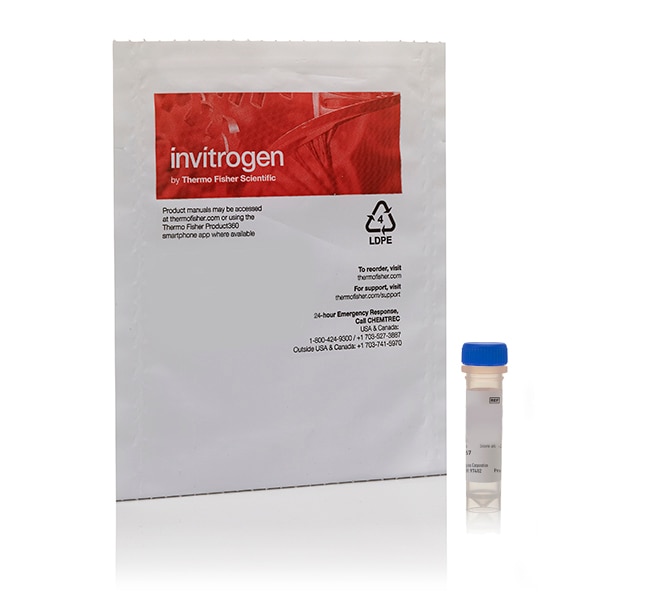
Vybrant™ DiD 细胞标记溶液
Vybrant™ DiD 细胞标记溶液是一种染料递送溶液,可直接添加到正常培养基中,以便均匀标记悬浮或贴壁培养细胞,适用于细胞融合、细胞贴壁和迁移研究应用。了解更多信息
| 货号 | 数量 |
|---|---|
| V22887 | 1 mL |
货号 V22887
价格(CNY)
1,920.00
飞享价
Ends: 31-Dec-2026
2,666.00共减 746.00 (28%)
1 mL
数量:
1 mL
价格(CNY)
1,920.00
飞享价
Ends: 31-Dec-2026
2,666.00共减 746.00 (28%)
1 mL
Vybrant™ DiD 细胞标记溶液是一种染料递送溶液,可直接添加到正常培养基中,以便均匀标记悬浮或贴壁培养细胞,适用于细胞融合、细胞贴壁和迁移研究应用。
仅供科研使用。不可用于诊断程序。
规格
颜色红色
检测方法荧光
适用于(设备)荧光显微镜、流式细胞仪
产品线Vybrant
数量1 mL
运输条件室温
标签类型Fluorescent Dye
产品类型细胞标记溶液
亚细胞定位细胞膜&脂质, Lipids
Unit Size1 mL
内容与储存
室温避光储存。
常见问题解答 (FAQ)
I'm labeling live cells with Vybrant DiI or DiD lipophilic cyanine dyes. DiI gives a nice even membrane labeling, but DiD is more "spotty". What can be done?
I want to perform a cell fusion assay, where one cell line is labeled with one color and the other cell line with another color, and combine with a nucleic acid stain. What do you recommend?
I need to look at live cell morphology deformation over the course of a few hours. What sort of membrane dye would be useful for this?
引用和文献 (24)
引用和文献
Abstract
Gap junction adhesion is necessary for radial migration in the neocortex.
Journal:Nature
PubMed ID:17713529
'Radial glia, the neuronal stem cells of the embryonic cerebral cortex, reside deep within the developing brain and extend radial fibres to the pial surface, along which embryonic neurons migrate to reach the cortical plate. Here we show that the gap junction subunits connexin 26 (Cx26) and connexin 43 (Cx43)
Lethal influenza infection in the absence of the natural killer cell receptor gene Ncr1.
Journal:Nat Immunol
PubMed ID:16565719
The elimination of viruses and tumors by natural killer cells is mediated by specific natural killer cell receptors. To study the in vivo function of a principal activating natural killer cell receptor, NCR1 (NKp46 in humans), we replaced the gene encoding this receptor (Ncr1) with a green fluorescent protein reporter
Cell tracking with optical imaging.
Journal:Eur Radiol
PubMed ID:18506449
Adaptability, sensitivity, resolution and non-invasiveness are the attributes that have contributed to the longstanding use of light as an investigational tool and form the basis of optical imaging (OI). OI, which encompasses numerous techniques and methods, is rapid (<5 min), inexpensive, noninvasive, nontoxic (no radiation) and has molecular (single-cell) sensitivity,
Vertical silicon nanowires as a universal platform for delivering biomolecules into living cells.
Journal:Proc Natl Acad Sci U S A
PubMed ID:20080678
A generalized platform for introducing a diverse range of biomolecules into living cells in high-throughput could transform how complex cellular processes are probed and analyzed. Here, we demonstrate spatially localized, efficient, and universal delivery of biomolecules into immortalized and primary mammalian cells using surface-modified vertical silicon nanowires. The method relies
Lipid products of PI(3)Ks maintain persistent cell polarity and directed motility in neutrophils.
Journal:Nat Cell Biol
PubMed ID:12080345
In gradients of external chemo-attractant, mammalian neutrophilic leukocytes (neutrophils) and Dictyostelium discoideum amoebae adopt a polarized morphology and selectively accumulate lipid products of phosphatidylinositol-3-OH kinases (PI(3)Ks), including PtdIns(3,4,5)P(3), at their up-gradient edges; the internal PtdIns(3,4,5)P(3) gradient substantially exceeds that of the external attractant. An accompanying report presents evidence for a