Search


引用和文献 (6)
Invitrogen™
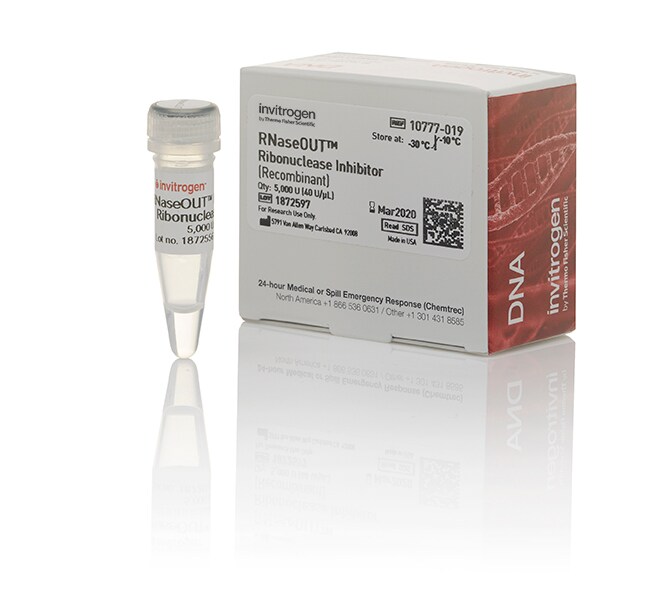
RNaseOUT™ 重组核糖核酸酶抑制剂
RNaseOUT™ 重组核糖核酸酶抑制剂是胰腺型核糖核酸酶(如 RNase A)的强效非竞争性抑制剂,在多种应用中用于避免 RNA 降解。RNaseOUT™ 重组核糖核酸酶抑制剂是一种酸性蛋白,分子量为了解更多信息
| 货号 | 数量 |
|---|---|
| 10777019 | 5000 Units |
货号 10777019
价格(CNY)
1,249.00
Online exclusive
Ends: 31-Dec-2026
2,323.00共减 1,074.00 (46%)
Each
数量:
5000 Units
价格(CNY)
1,249.00
Online exclusive
Ends: 31-Dec-2026
2,323.00共减 1,074.00 (46%)
Each
RNaseOUT™ 重组核糖核酸酶抑制剂是胰腺型核糖核酸酶(如 RNase A)的强效非竞争性抑制剂,在多种应用中用于避免 RNA 降解。RNaseOUT™ 重组核糖核酸酶抑制剂是一种酸性蛋白,分子量为 ∼52 kDa。RNaseOUT™ 可抑制 RNase A、RNase B 和 RNase C。
应用
cDNA 合成、RT-PCR 以及体外转录和翻译
来源
通过亲和色谱从表达克隆猪基因的大肠杆菌中纯化
性能和质量检测
SDS-PAGE 纯度、脱氧核糖核酸内切酶检测、蛋白浓度、比活度、通过 RT-PCR 评估的性能
单位定义
使用胞苷 2´, 3´ 环单磷酸 (cCMP) 作为底物,一单位可抑制 5 ng RNase A 的 50% 活性
单位反应条件
100 mM Tris-醋酸盐(pH 值 6.5)、1 mM EDTA、0.2 mM cCMP、2 µg RNase A,1 mL,25°C 下 0 至 10 min
应用
cDNA 合成、RT-PCR 以及体外转录和翻译
来源
通过亲和色谱从表达克隆猪基因的大肠杆菌中纯化
性能和质量检测
SDS-PAGE 纯度、脱氧核糖核酸内切酶检测、蛋白浓度、比活度、通过 RT-PCR 评估的性能
单位定义
使用胞苷 2´, 3´ 环单磷酸 (cCMP) 作为底物,一单位可抑制 5 ng RNase A 的 50% 活性
单位反应条件
100 mM Tris-醋酸盐(pH 值 6.5)、1 mM EDTA、0.2 mM cCMP、2 µg RNase A,1 mL,25°C 下 0 至 10 min
仅供科研使用。不可用于诊断程序。
规格
最大浓度100 mM
产品线RNaseOUT
数量5000 Units
Unit SizeEach
内容与储存
在 -20°C 下储存。避免产品暴露于频繁的温度变化。RNaseOUT™ 核糖核酸酶抑制剂需要 1 mM DTT 来维持活性。
除非产品文件中另有说明,否则产品可保证自购买日期起 6 个月内质量合格。
除非产品文件中另有说明,否则产品可保证自购买日期起 6 个月内质量合格。
常见问题解答 (FAQ)
RNaseOUT 重组RNase抑制剂有什么作用?
Which components of the SuperScript III First Strand Synthesis System for RT-PCR are available for purchase separately?
What does RNaseOUT Recombinant RNase Inhibitor do?
What is the concentration of RNaseOUT Recombinant Ribonuclease Inhibitor in Units/microL?
What is the temperature limitation of RNaseOUT Recombinant Ribonuclease Inhibitor (Cat. No. 10777019)?
引用和文献 (6)
引用和文献
Abstract
The catalytic domain of RNase E shows inherent 3' to 5' directionality in cleavage site selection.
Journal:Proc Natl Acad Sci U S A
PubMed ID:12417756
'RNase E, a multifunctional endoribonuclease of Escherichia coli, attacks substrates at highly specific sites. By using synthetic oligoribonucleotides containing repeats of identical target sequences protected from cleavage by 2''-O-methylated nucleotide substitutions at specific positions, we investigated how RNase E identifies its cleavage sites. We found that the RNase E catalytic
Cloning and functional characterization of HDAC11, a novel member of the human histone deacetylase family.
Journal:J Biol Chem
PubMed ID:11948178
'We have cloned and characterized a human cDNA that belongs to the histone deacetylase family, which we designate as HDAC11. The predicted HDAC11 amino acid sequence reveals an open reading frame of 347 residues with a corresponding molecular mass of 39 kDa. Sequence analyses of the putative HDAC11 protein indicate
Development of reverse transcription (RT)-PCR and real-time RT-PCR assays for rapid detection and quantification of viable yeasts and molds contaminating yogurts and pasteurized food products.
Journal:Appl Environ Microbiol
PubMed ID:12839789
Reverse transcriptase PCR (RT-PCR) and real-time RT-PCR assays have been used to detect and quantify actin mRNA from yeasts and molds. Universal primers were designed based on the available fungal actin sequences, and by RT-PCR they amplified a specific 353-bp fragment from fungal species involved in food spoilage. From experiments
Regulation of H-ras splice variant expression by cross talk between the p53 and nonsense-mediated mRNA decay pathways.
Journal:Mol Cell Biol
PubMed ID:17709397
When cells are exposed to a genotoxic stress, a DNA surveillance pathway that involves p53 is activated, allowing DNA repair. Eukaryotic cells have also evolved a mechanism called mRNA surveillance that controls the quality of mRNAs. Indeed, mutant mRNAs carrying premature translation termination codons (PTCs) are selectively degraded by the
Biochemistry of mitochondrial nitric-oxide synthase.
Journal:J Biol Chem
PubMed ID:12154090
We reported that the generation of nitric oxide by mitochondria is catalyzed by a constitutive, mitochondrial nitric-oxide synthase (mtNOS). Given that this production may establish the basis for a novel regulatory pathway of energy metabolism, oxygen consumption, and oxygen free radical production, it becomes imperative to identify unequivocally and characterize