Search


引用和文献 (5)
Gibco™
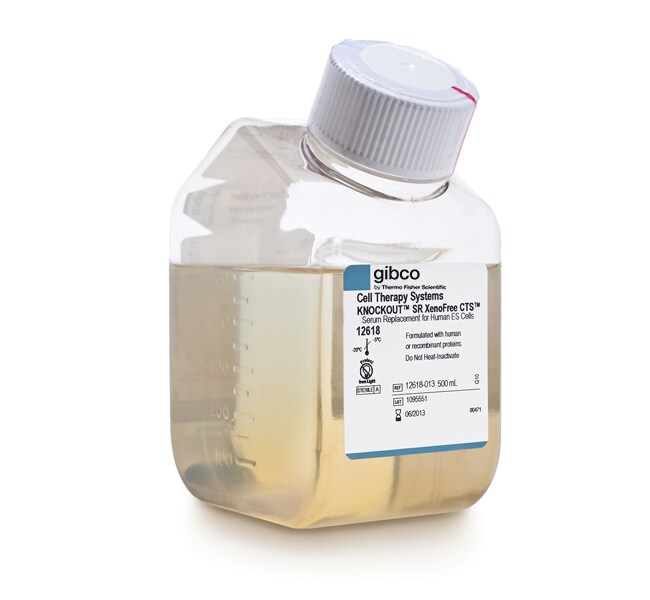
CTS™ KnockOut™ SR XenoFree 培养基
Gibco CTS KnockOut SR XenoFree 培养基(配制为完全培养基时)能够在仅含人源性蛋白或人重组蛋白的细胞培养基中支持人胚胎干细胞 (hESC) 和人诱导性多能干细胞了解更多信息
Have Questions?
更改视图

| 货号 | 数量 |
|---|---|
| 12618013 | 500 mL |
| 12618012 | 100 mL |
货号 12618013
价格(CNY)
11,915.00
Each
数量:
500 mL
价格(CNY)
11,915.00
Each
Gibco CTS KnockOut SR XenoFree 培养基(配制为完全培养基时)能够在仅含人源性蛋白或人重组蛋白的细胞培养基中支持人胚胎干细胞 (hESC) 和人诱导性多能干细胞 (hiPSC) 的生长和扩增,有助于 hESC 和 hiPSC 研究从实验台向临床过渡。
在从研究应用向临床应用过渡时,CTS 产品系列能够减少试剂验证方面的负担。
CTS KnockOut SR XenoFree 培养基不含牛或其他非人动物源性组分。除多能干细胞培养物扩增和维持培养外,CTS KnockOut SR XenoFree 培养基还可用于 hESC⁄hiPSC 冻存、衍生化和分化研究。
Gibco CTS 产品质量较高,并附有相应的证明文件,如分析证书、原产地证书,还可获取药物主文件授权书(如适用)。
在从研究应用向临床应用过渡时,CTS 产品系列能够减少试剂验证方面的负担。
CTS KnockOut SR XenoFree 培养基不含牛或其他非人动物源性组分。除多能干细胞培养物扩增和维持培养外,CTS KnockOut SR XenoFree 培养基还可用于 hESC⁄hiPSC 冻存、衍生化和分化研究。
Gibco CTS 产品质量较高,并附有相应的证明文件,如分析证书、原产地证书,还可获取药物主文件授权书(如适用)。
用于研究或生产基于细胞、基因或者组织的产品。注意:不可直接作用于人类或动物给药。
规格
细胞类型胚胎干细胞 (ESC)、诱导型多能干细胞 (iPSC)
适用于(应用)细胞和基因治疗研究,开发和生产
产品规格瓶装
生产质量ISO 13485、21 CFR 820
产品类型干细胞培养基
数量500 mL
运输条件干冰
分类无异种成分
形式液体
血清水平无血清
无菌无菌过滤
Unit SizeEach
内容与储存
在 -5 至 -20°C 下避光储存
常见问题解答 (FAQ)
我应如何鉴定人胚胎干(ES)细胞?
人胚胎干(ES)细胞是怎么获得的?
何为胚胎干(ES)细胞?
What is CTS?
Do you offer a medical device–grade of CTS KnockOut SR XenoFree Medium?
引用和文献 (5)
引用和文献
Abstract
CD133-enriched Xeno-Free human embryonic-derived neural stem cells expand rapidly in culture and do not form teratomas in immunodeficient mice.
Journal:
PubMed ID:25082219
'Common methods for the generation of human embryonic-derived neural stem cells (hNSCs) result in cells with potentially compromised safety profiles due to maintenance of cells in conditions containing non-human proteins (e.g. in bovine serum or on mouse fibroblast feeders). Additionally, sufficient expansion of resulting hNSCs for scaling out or up
An ECM-based culture system for the generation and maintenance of xeno-free human iPS cells.
Journal:Biomaterials
PubMed ID:23153417
'Pluripotent stem cells (PSCs) including induced pluripotent stem cells (iPSCs) and embryonic stem cells (ESCs) have emerged as a promising source for treating incurable diseases. Problems that urgently need to be resolved before the clinical application include avoiding potential xenopathogenic transmission and immune rejection that may be caused by the
Concise Review: Manufacturing of Pancreatic Endoderm Cells for Clinical Trials in Type 1 Diabetes.
Journal:
PubMed ID:26062982
'The cellular component of ViaCyte''s VC-01 combination product for type 1 diabetes, pancreatic endoderm cells (PEC-01) derived from CyT49 human embryonic stem cells, matures after transplantation and functions to regulate blood glucose in rodent models. The aims in manufacturing PEC-01 at scale are to generate a consistent and robust transplantable
Generation of human-induced pluripotent stem cells by a nonintegrating RNA Sendai virus vector in feeder-free or xeno-free conditions.
Journal:Stem Cells Int
PubMed ID:22550511
The generation of induced pluripotent stem cells (iPSCs) from somatic cells has enabled the possibility of providing unprecedented access to patient-specific iPSC cells for drug screening, disease modeling, and cell therapy applications. However, a major obstacle to the use of iPSC for therapeutic applications is the potential of genomic modifications
cGMP production of patient-specific iPSCs and photoreceptor precursor cells to treat retinal degenerative blindness.
Journal:Sci Rep
PubMed ID:27471043
'Immunologically-matched, induced pluripotent stem cell (iPSC)-derived photoreceptor precursor cells have the potential to restore vision to patients with retinal degenerative diseases like retinitis pigmentosa. The purpose of this study was to develop clinically-compatible methods for manufacturing photoreceptor precursor cells from adult skin in a non-profit cGMP environment. Biopsies were obtained