Search


引用和文献 (25)
Invitrogen™
用于 cDNA 末端快速扩增的 5' RACE 系统(版本 2.0)
用于 cDNA 末端快速扩增的 5´ RACE 系统(版本 2.0)适用于 mRNA了解更多信息
| 货号 | 数量 |
|---|---|
| 18374058 | 10 次反应 |
货号 18374058
价格(CNY)
10,246.00
飞享价
Ends: 31-Dec-2026
14,637.00共减 4,391.00 (30%)
Each
数量:
10 次反应
价格(CNY)
10,246.00
飞享价
Ends: 31-Dec-2026
14,637.00共减 4,391.00 (30%)
Each
用于 cDNA 末端快速扩增的 5´ RACE 系统(版本 2.0)适用于 mRNA 中规定点与 5´ 末端之间的 cDNA 末端快速扩增 (RACE)。5' RACE 系统提供了一组通过资格预审的试剂,用于合成第一链 cDNA、纯化第一链产物、均聚物加尾和制备靶标 cDNA,用于后续 PCR 扩增。提供对照 RNA、DNA 和引物用于监测系统性能。该系统可用于扩增可获得很少序列信息的稀有信息,以及捕获 mRNA 的 5´ 末端信息。5´ RACE 系统:
•使用 SuperScript™ II RNase H- RT 的高级功能获得更高的第一链 cDNA 得率和更长的 cDNA 长度
• 在一个反应中,从多达 1 µg 总 RNA 或 poly(A)+ RNA 制备特定 cDNA
• 提供改进的第一链 cDNA 纯化程序,该程序可生成适合加尾的 cDNA
• 在 PCR 兼容缓冲液中使用具有优化反应条件的重组 TdT,为 PCR 提供有效的引物退火位点
•使用 SuperScript™ II RNase H- RT 的高级功能获得更高的第一链 cDNA 得率和更长的 cDNA 长度
• 在一个反应中,从多达 1 µg 总 RNA 或 poly(A)+ RNA 制备特定 cDNA
• 提供改进的第一链 cDNA 纯化程序,该程序可生成适合加尾的 cDNA
• 在 PCR 兼容缓冲液中使用具有优化反应条件的重组 TdT,为 PCR 提供有效的引物退火位点
仅供科研使用。不可用于诊断程序。
规格
适用于(应用)cDNA 文库和文库构建
产品类型cDNA 文库
数量10 次反应
Unit SizeEach
内容与储存
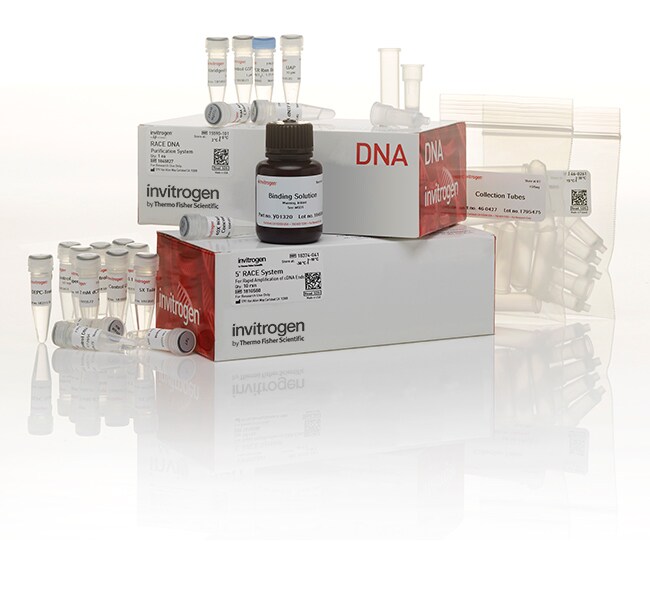
5´ RACE 系统配有表 1 中列出的组成部分。将试剂储存在 -20°C 下,将 DNA 纯化组分储存在 +4°C 下。
常见问题解答 (FAQ)
我的5′ RACE实验得到了PCR产物,但它们都不是全长cDNA。我该怎么改善?
在我的GeneRacer实验中,观察到了RACE PCR假象。我在哪个环节出错了?
在对我扩增的RT-PCR产物进行电泳分析后,我看到了意料之外的条带。对此您有何建议?
在对我扩增的RT-PCR产物进行电泳分析后,我并未看到条带。您能告诉我一些小技巧吗?
3′端RACE系统的工作原理是什么?
引用和文献 (25)
引用和文献
Abstract
Identification and characterization of RPK118, a novel sphingosine kinase-1-binding protein.
Journal:J Biol Chem
PubMed ID:12077123
'Sphingosine kinase (SPHK) is a key enzyme catalyzing the formation of sphingosine 1 phosphate (SPP), a lipid messenger that is implicated in the regulation of a wide variety of important cellular events through intracellular as well as extracellular mechanisms. However, the molecular mechanism of the intracellular actions of SPP remains
Modulation of mouse Paneth cell alpha-defensin secretion by mIKCa1, a Ca2+-activated, intermediate conductance potassium channel.
Journal:J Biol Chem
PubMed ID:11724775
'Paneth cells in small intestinal crypts secrete microbicidal alpha-defensins in response to bacteria and bacterial antigens (Ayabe, T., Satchell, D. P., Wilson, C. L., Parks, W. C., Selsted, M. E., and Ouellette, A. J. (2000) Nat. Immunol. 1, 113- 38). We now report that the Ca(2+)-activated K(+) channel mIKCa1 modulates
The cathepsin B of Toxoplasma gondii, toxopain-1, is critical for parasite invasion and rhoptry protein processing.
Journal:J Biol Chem
PubMed ID:12000756
'Cysteine proteinases play a major role in invasion and intracellular survival of a number of pathogenic parasites. We cloned a single copy gene, tgcp1, from Toxoplasma gondii and refolded recombinant enzyme to yield active proteinase. Substrate specificity of the enzyme and homology modeling identified the proteinase as a cathepsin B.
Misexpression of the eyes absent family triggers the apoptotic program.
Journal:J Biol Chem
PubMed ID:11700312
'Genetic studies in Drosophila and mice have shown that eyes absent (eya) is an important and conserved transcriptional regulator of development. Along with eyeless/Pax6, sine oculis, and dachshund, eya genes function as master regulators in eye development and can induce ectopic eye formation. Furthermore, the loss-of-function mutants of these genes
A novel zinc finger transcription factor with two isoforms that are differentially repressed by estrogen receptor-alpha.
Journal:J Biol Chem
PubMed ID:11779858
'Estrogen receptor-alpha (ERalpha) can induce the expression of genes in response to estrogen by binding to estrogen response elements in the promoters of target genes. There is growing evidence that ERalpha can alter patterns of gene expression in response to ligand by regulating the activity of other factors through a