Search


引用和文献 (15)
Thermo Scientific™
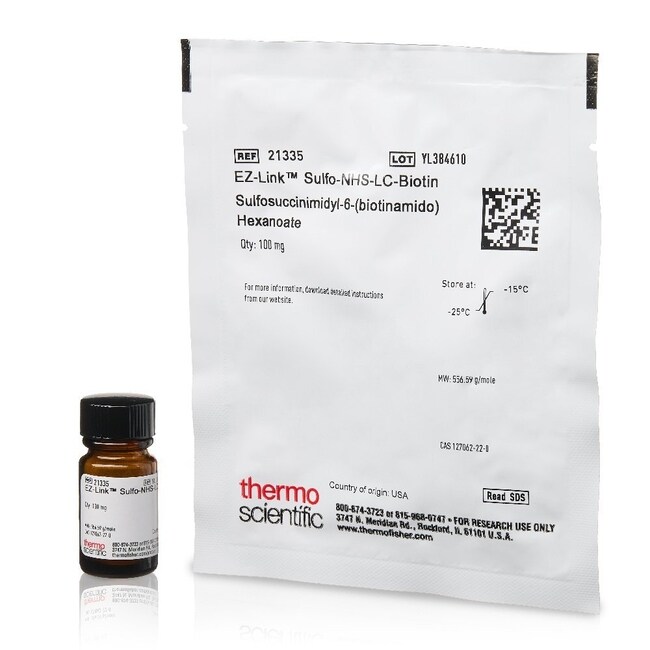
EZ-Link™ Sulfo-NHS-LC-生物素
Thermo Scientific EZ-Link Sulfo-NHS-LC-生物素是一种中等长度的水溶性生物素化试剂,可用于标记具有伯胺的抗体、蛋白和其他分子。EZ-Link Sulfo-NHS-LC-生物素的特点:•蛋白标记—生物素化抗体便于使用链霉素亲和素树脂或探针进行固定、纯化或检测• 细胞表面标记—仅对全细胞的表面蛋白进行生物素化,因为带负电荷的试剂不会渗透细胞膜• 胺反应性—与伯胺了解更多信息
Have Questions?
更改视图

| 货号 | 数量 |
|---|---|
| 21335 | 100 mg |
| A39257 | 10 x 1 mg |
货号 21335
价格(CNY)
3,766.00
飞享价
Ends: 31-Dec-2026
5,088.00共减 1,322.00 (26%)
Each
数量:
100 mg
价格(CNY)
3,766.00
飞享价
Ends: 31-Dec-2026
5,088.00共减 1,322.00 (26%)
Each
Thermo Scientific EZ-Link Sulfo-NHS-LC-生物素是一种中等长度的水溶性生物素化试剂,可用于标记具有伯胺的抗体、蛋白和其他分子。
EZ-Link Sulfo-NHS-LC-生物素的特点:
•蛋白标记—生物素化抗体便于使用链霉素亲和素树脂或探针进行固定、纯化或检测
• 细胞表面标记—仅对全细胞的表面蛋白进行生物素化,因为带负电荷的试剂不会渗透细胞膜
• 胺反应性—与伯胺 (-NH2)(如赖氨酸侧链或多肽的氨基末端)发生反应
• 可溶性—与普通 NHS 酯化合物相比带电荷的 sulfo-NHS 基团可提高试剂的水溶性
• 不可逆—形成永久酰胺键;间隔臂不可切割
• 中等长度—间隔臂(添加至靶标的总长度)为 22.4 埃;可在足够长度(生物素结合的空间位阻极小)与适当质量之间提供出色平衡
Sulfo-NHS-LC-生物素是三种非常相似的 EZ-Link 试剂中一种,该等试剂具有水溶性,不可切割,且在溶液中可实现抗体、蛋白和任何其他含伯胺大分子的简单高效生物素化。对于这些独特的水溶性、膜不渗透性试剂,细胞表面蛋白的特异性标记是另一种常见应用。只有间隔臂长度不同,三种 Sulfo-NHS 酯试剂可优化标记和检测实验,实验中生物素结合的空间位阻是重要因素。Sulfo-NHS-LC-生物素以多种包装规格和全套蛋白标记试剂盒形式提供。
我们生产生物素试剂,以确保尽可能使预期研究应用的总体产品完整性、一致性和性能达到较高水平。
生物素 N-羟基磺基琥珀酰亚胺 (NHS) 酯是广泛采用的生物素化试剂类型。NHS-活化生物素在碱性缓冲液中与伯胺基 (-NH2) 高效反应,形成稳定的酰胺键。蛋白(如抗体)通常有几种可作为标记靶标的伯胺,包括赖氨酸 (K) 残基的侧链和每个多肽的 N-末端。
生物素各种 NHS 酯试剂在长度、溶解度、细胞通透性和可切割性方面有所不同。非磺化 NHS-生物素具有细胞渗透性,但必须在有机溶剂(如 DMSO 或 DMF)中溶解。Sulfo-NHS 生物素(和带有聚乙二醇化间隔的生物素)可以直接溶解在水中,但无膜渗透性。含二硫键的各种类型可使用还原剂进行切割,从而使生物素基团与标记蛋白分离。
相关产品
EZ-Link™ Sulfo-NHS-LC-生物素化试剂盒
EZ-Link™ 微型 Sulfo-NHS-LC-生物素化试剂盒
Pierce™ 优级 Sulfo-NHS-LC-生物素
EZ-Link Sulfo-NHS-LC-生物素的特点:
•蛋白标记—生物素化抗体便于使用链霉素亲和素树脂或探针进行固定、纯化或检测
• 细胞表面标记—仅对全细胞的表面蛋白进行生物素化,因为带负电荷的试剂不会渗透细胞膜
• 胺反应性—与伯胺 (-NH2)(如赖氨酸侧链或多肽的氨基末端)发生反应
• 可溶性—与普通 NHS 酯化合物相比带电荷的 sulfo-NHS 基团可提高试剂的水溶性
• 不可逆—形成永久酰胺键;间隔臂不可切割
• 中等长度—间隔臂(添加至靶标的总长度)为 22.4 埃;可在足够长度(生物素结合的空间位阻极小)与适当质量之间提供出色平衡
Sulfo-NHS-LC-生物素是三种非常相似的 EZ-Link 试剂中一种,该等试剂具有水溶性,不可切割,且在溶液中可实现抗体、蛋白和任何其他含伯胺大分子的简单高效生物素化。对于这些独特的水溶性、膜不渗透性试剂,细胞表面蛋白的特异性标记是另一种常见应用。只有间隔臂长度不同,三种 Sulfo-NHS 酯试剂可优化标记和检测实验,实验中生物素结合的空间位阻是重要因素。Sulfo-NHS-LC-生物素以多种包装规格和全套蛋白标记试剂盒形式提供。
我们生产生物素试剂,以确保尽可能使预期研究应用的总体产品完整性、一致性和性能达到较高水平。
生物素 N-羟基磺基琥珀酰亚胺 (NHS) 酯是广泛采用的生物素化试剂类型。NHS-活化生物素在碱性缓冲液中与伯胺基 (-NH2) 高效反应,形成稳定的酰胺键。蛋白(如抗体)通常有几种可作为标记靶标的伯胺,包括赖氨酸 (K) 残基的侧链和每个多肽的 N-末端。
生物素各种 NHS 酯试剂在长度、溶解度、细胞通透性和可切割性方面有所不同。非磺化 NHS-生物素具有细胞渗透性,但必须在有机溶剂(如 DMSO 或 DMF)中溶解。Sulfo-NHS 生物素(和带有聚乙二醇化间隔的生物素)可以直接溶解在水中,但无膜渗透性。含二硫键的各种类型可使用还原剂进行切割,从而使生物素基团与标记蛋白分离。
相关产品
EZ-Link™ Sulfo-NHS-LC-生物素化试剂盒
EZ-Link™ 微型 Sulfo-NHS-LC-生物素化试剂盒
Pierce™ 优级 Sulfo-NHS-LC-生物素
仅供科研使用。不可用于诊断程序。
规格
细胞渗透性Cell-Impermeant
描述EZ-Link Sulfo-NHS-LC-Biotin
标签类型Biotin & Analogs
产品线EZ-Link
产品类型Sulfo-NHS-LC-生物素
数量100 mg
反应一部分Active Ester, Succinimidyl Ester, Sulfo-NHS Ester
化学反应性Amine
标签或染料Biotin
溶解度DMF(二甲基甲酰胺), DMSO(二甲亚砜), 水
间隔子Mid-length
Unit SizeEach
内容与储存
Store desiccated at -20°C. Shipped at ambient temperature.
常见问题解答 (FAQ)
Can I make a Sulfo-NHS-LC-Biotin stock solution to use later?
Can Sulfo-NHS-LC-Biotin be used in cell surface biotinylation?
Why can't I perform biotinylation reactions in Tris buffer with Sulfo-NHS-LC-Biotin?
What molar excess of Sulfo-NHS-LC-Biotin should I use to label antibodies and other proteins?
Can I dissolve the EZ-Link Sulfo-NHS-LC-Biotin, No-Weigh Format (Cat. No. A39257, 21335) in water for storage?
引用和文献 (15)
引用和文献
Abstract
Mechanisms of tethering and cargo transfer during epididymosome-sperm interactions.
Journal:BMC Biol
PubMed ID:30999907
'The mammalian epididymis is responsible for the provision of a highly specialized environment in which spermatozoa acquire functional maturity and are subsequently stored in preparation for ejaculation. Making important contributions to both processes are epididymosomes, small extracellular vesicles released from the epididymal soma via an apocrine secretory pathway. While considerable
Molecular determinants in Frizzled, Reck, and Wnt7a for ligand-specific signaling in neurovascular development.
Journal:Elife
PubMed ID:31225798
'The molecular basis of Wnt-Frizzled specificity is a central question in developmental biology. Reck, a multi-domain and multi-functional glycosylphosphatidylinositol-anchored protein, specifically enhances beta-catenin signaling by Wnt7a and Wnt7b in cooperation with the 7-transmembrane protein Gpr124. Among amino acids that distinguish Wnt7a and Wnt7b from other Wnts, two clusters are essential
Norrin-induced Frizzled4 endocytosis and endo-lysosomal trafficking control retinal angiogenesis and barrier function.
Journal:Nat Commun
PubMed ID:28675177
Angiogenesis and blood-brain barrier formation are required for normal central nervous system (CNS) function. Both processes are controlled by Wnt or Norrin (NDP) ligands, Frizzled (FZD) receptors, and ß-catenin-dependent signalling in vascular endothelial cells. In the retina, FZD4 and the ligand NDP are critical mediators of signalling and are mutated
USP48 restrains resection by site-specific cleavage of the BRCA1 ubiquitin mark from H2A.
Journal:Nat Commun
PubMed ID:29335415
BRCA1-BARD1-catalyzed ubiquitination of histone H2A is an important regulator of the DNA damage response, priming chromatin for repair by homologous recombination. However, no specific deubiquitinating enzymes (DUBs) are known to antagonize this function. Here we identify ubiquitin specific protease-48 (USP48) as a H2A DUB, specific for the C-terminal BRCA1 ubiquitination
The IgCAM CLMP regulates expression of Connexin43 and Connexin45 in intestinal and ureteral smooth muscle contraction in mice.
Journal:Dis Model Mech
PubMed ID:29361518
CAR-like membrane protein (CLMP), an immunoglobulin cell adhesion molecule (IgCAM), has been implicated in congenital short-bowel syndrome in humans, a condition with high mortality for which there is currently no cure. We therefore studied the function of CLMP in a