Search


引用和文献 (6)
Gibco™
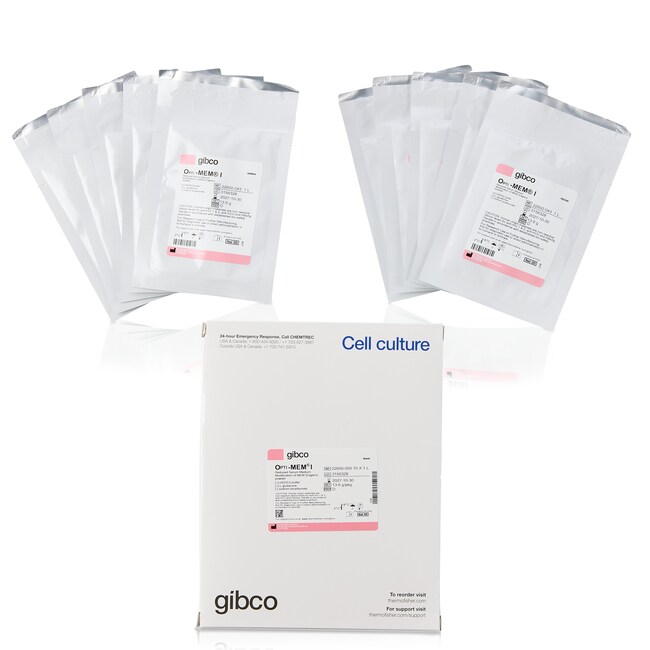
Opti-MEM™ 减血清培养基,粉末
Opti-MEM™ 减血清培养基是一种经过改良的 Minimal Essential Medium (MEM),能够使胎牛血清添加量减少至少 50%,而生长速率或形态无变化。还推荐 Opti-MEM™ 与阳离子脂质体转染试剂了解更多信息
Have Questions?
更改视图

| 货号 | 数量 |
|---|---|
| 22600050 | 10 x 1 L |
| 22600134 | 10 L |
货号 22600050
价格(CNY)
4,579.00
Each
数量:
10 x 1 L
价格(CNY)
4,579.00
Each
Opti-MEM™ 减血清培养基是一种经过改良的 Minimal Essential Medium (MEM),能够使胎牛血清添加量减少至少 50%,而生长速率或形态无变化。还推荐 Opti-MEM™ 与阳离子脂质体转染试剂(如 Lipofectamine™ 试剂)配套使用。Opti-MEM™ 可用于各种悬浮和贴壁的哺乳动物细胞,包括 Sp2、AE-1、CHO、BHK-21、HEK 和原代成纤维细胞。针对广泛的细胞培养应用,提供了多种组分的 Gibco™ Opti-MEM™ 改良培养基。
完整配方保密。有关更多信息,请联系技术服务部。
Gibco™ Opti-MEM™ 是一种内含胰岛素、转铁蛋白、次黄嘌呤、胸苷和微量元素的独特培养基。这些附加组分可使血清添加量减少至少 50%。
cGMP 生产和质量体系
为确保供应链的稳定,我们同时在位于纽约格兰德岛和英国苏格兰的两家独立工厂生产 Gibco™ Opti-MEM™。两家工厂均符合 cGMP 生产要求,并通过 ISO 13485 认证,是在 FDA 注册的医疗器械生产商。
Gibco™ Opti-MEM™ 使用碳酸氢钠缓冲系统 (2.4 g/L),因此需要 5-10% CO2 环境来维持生理 pH 值。
粉末形式的 Gibco™ 细胞培养基在配制时需要补充碳酸氢钠、调节 pH 值并过滤(有关详细信息,参见方案)。
这种 Opti-MEM™ 的改良方式如下:
| 包含 |
| •L-谷氨酰胺 |
| • 酚红 |
完整配方保密。有关更多信息,请联系技术服务部。
Gibco™ Opti-MEM™ 是一种内含胰岛素、转铁蛋白、次黄嘌呤、胸苷和微量元素的独特培养基。这些附加组分可使血清添加量减少至少 50%。
cGMP 生产和质量体系
为确保供应链的稳定,我们同时在位于纽约格兰德岛和英国苏格兰的两家独立工厂生产 Gibco™ Opti-MEM™。两家工厂均符合 cGMP 生产要求,并通过 ISO 13485 认证,是在 FDA 注册的医疗器械生产商。
Gibco™ Opti-MEM™ 使用碳酸氢钠缓冲系统 (2.4 g/L),因此需要 5-10% CO2 环境来维持生理 pH 值。
粉末形式的 Gibco™ 细胞培养基在配制时需要补充碳酸氢钠、调节 pH 值并过滤(有关详细信息,参见方案)。
不可用于人类或动物的治疗。除产品用途之外的使用,可能违反当地法规。用于体外诊断。
规格
细胞系Sp2、AE-1、CHO、BHK-21 和 HEK
细胞类型原代成纤维细胞
生产质量cGMP-compliant under the ISO 13485 standard
产品线Gibco、Opti-MEM
产品类型Opti-MEM I
数量10 x 1 L
有效期自生产之日起 30 个月
运输条件室温
分类动物来源
形式粉末
无菌无菌过滤
加有添加剂谷氨酰胺, 酚红
Unit SizeEach
内容与储存
储存条件:2-8° C
运输条件:环境
有效期:自生产之日起30个月
运输条件:环境
有效期:自生产之日起30个月
常见问题解答 (FAQ)
我的粉末培养基一经溶解,其保质期有多久?
加入血清后的培养基可以使用多久?
我的培养基是室温条件下运送来的,但注明应保存于冷藏条件下。这会有影响么?
我该如何去除细胞培养基中的支原体污染?
我发现培养物的生长速率变缓。我该如何处理?
引用和文献 (6)
引用和文献
Abstract
Folding of the striated muscle myosin motor domain.
Journal:J Biol Chem
PubMed ID:12110670
'We have investigated the folding of the myosin motor domain using a chimera of an embryonic striated muscle myosin II motor domain fused on its COOH terminus to a thermal stable, fast folding variant of green fluorescent protein (GFP). In in vitro expression assays, the GFP domain of the chimeric
Role of the E1A Rb-binding domain in repression of the NF-kappa B-dependent defense against tumor necrosis factor-alpha.
Journal:Proc Natl Acad Sci U S A
PubMed ID:12119420
'The adenoviral E1A oncogene sensitizes mammalian cells to tumor necrosis factor-alpha (TNF-alpha), in part by repressing the nuclear factor-kappa B (NF-kappa B)-dependent defense against this cytokine. Other E1A activities involve binding to either p300/cyclic AMP response element-binding protein (CBP) or retinoblastoma (Rb)-family proteins, but the roles of E1A interactions with
Induction of bacterial lipoprotein tolerance is associated with suppression of toll-like receptor 2 expression.
Journal:J Biol Chem
PubMed ID:12133836
'Tolerance to bacterial cell wall components including lipopolysaccharide (LPS) may represent an essential regulatory mechanism during bacterial infection. Two members of the Toll-like receptor (TLR) family, TLR2 and TLR4, recognize the specific pattern of bacterial cell wall components. TLR4 has been found to be responsible for LPS tolerance. However, the
Hepatitis C virus subgenomic replicons in the human embryonic kidney 293 cell line.
Journal:J Virol
PubMed ID:14671129
'Hepatitis C virus (HCV) infects liver cells and its replication in other cells is incompletely defined. Human hepatoma Huh-7 cells harboring subgenomic HCV replicons were used in somatic cell fusion experiments with human embryonic kidney 293 cells as a means of examining the permissiveness of 293 cells for HCV subgenomic
c-Myc sensitizes cells to tumor necrosis factor-mediated apoptosis by inhibiting nuclear factor kappa B transactivation.
Journal:J Biol Chem
PubMed ID:12149248
Nuclear factor kappaB (NF-kappaB) plays a key role in suppression of tumor necrosis factor (TNF)-mediated apoptosis by inducing a variety of anti-apoptotic genes. Expression of c-Myc has been shown to sensitize cells to TNF-mediated apoptosis by inhibiting NF-kappaB activation. However, the precise step in the NF-kappaB signaling pathway and apoptosis