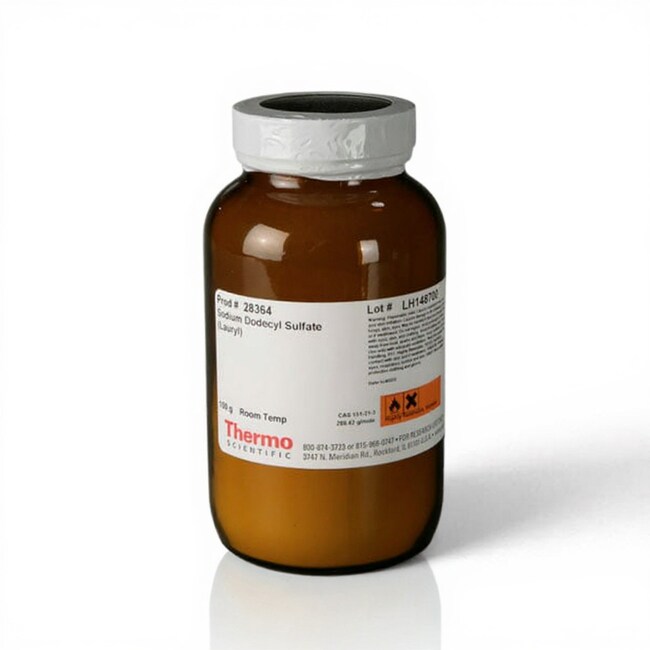
Why is LDS (lithium dodecyl sulfate) used in the 4X NuPAGE sample buffer instead of SDS?
SDS in a 4X sample buffer concentrate tends to precipitate from solution and to make the solution viscous and difficult to pipette. The LDS is much more soluble.
Find additional tips, troubleshooting help, and resources within our Protein Gel 1D Electrophoresis Support Center.
Are detergents denaturing or non-denaturing with respect to protein structure?
Ionic detergents, or those that carry a charge, are the most likely to be denaturing to proteins. Denaturing detergents can be anionic such as sodium dodecyl sulfate (SDS) or cationic such as ethyl trimethyl ammonium bromide. These detergents totally disrupt membranes and denature proteins by breaking protein-protein interactions through changes in the three-dimensional structure of the proteins. Nondenaturing detergents can be divided into nonionic detergents (i.e., Triton X-100), bile salts (i.e., cholate), and zwitterionic detergents (i.e., CHAPS).
Find additional tips, troubleshooting help, and resources within our Protein Purification and Isolation Support Center.
What are detergents?
Detergents are amphipathic molecules containing both a nonpolar “tail” having aliphatic or aromatic character, and a polar “head”. The ionic character of the polar head group forms the basis for broad classification of detergents as ionic, nonionic, or zwitterionic.
Find additional tips, troubleshooting help, and resources within our Protein Purification and Isolation Support Center.
How does detergent-based cell lysis work?
Detergents are amphipathic molecules, meaning they contain both a nonpolar “tail” having aliphatic or aromatic character and a polar “head”. Like the components of biological membranes, detergents have hydrophobic-associating properties as a result of their nonpolar tail groups. Nevertheless, detergents are themselves water soluble.
Consequently, detergent molecules allow the dispersion (miscibility) of water-insoluble, hydrophobic compounds into aqueous media, including the extraction and solubilization of membrane proteins. Detergent monomers solubilize membrane proteins by partitioning into the membrane bilayer. With increasing amounts of detergents, membranes undergo various stages of solubilization.
Find additional tips, troubleshooting help, and resources within our Protein Purification and Isolation Support Center.
What types of detergents are available for cell lysis?
Detergents can be denaturing or non-denaturing with respect to protein structure. Denaturing detergents can be anionic such as sodium dodecyl sulfate (SDS) or cationic such as ethyl trimethyl ammonium bromide. These detergents totally disrupt membranes and denature proteins by breaking proteinprotein interaction. These detergents are considered harsh. Non-denaturing detergents can be divided into nonionic detergents (i.e., Triton X-100), bile salts (i.e., cholate), and zwitterionic detergents (i.e., CHAPS). These detergents do not denature proteins and do not break protein-protein interactions. These detergents are considered mild.
Find additional tips, troubleshooting help, and resources within our Protein Purification and Isolation Support Center.