Search


引用和文献 (23)
Gibco™
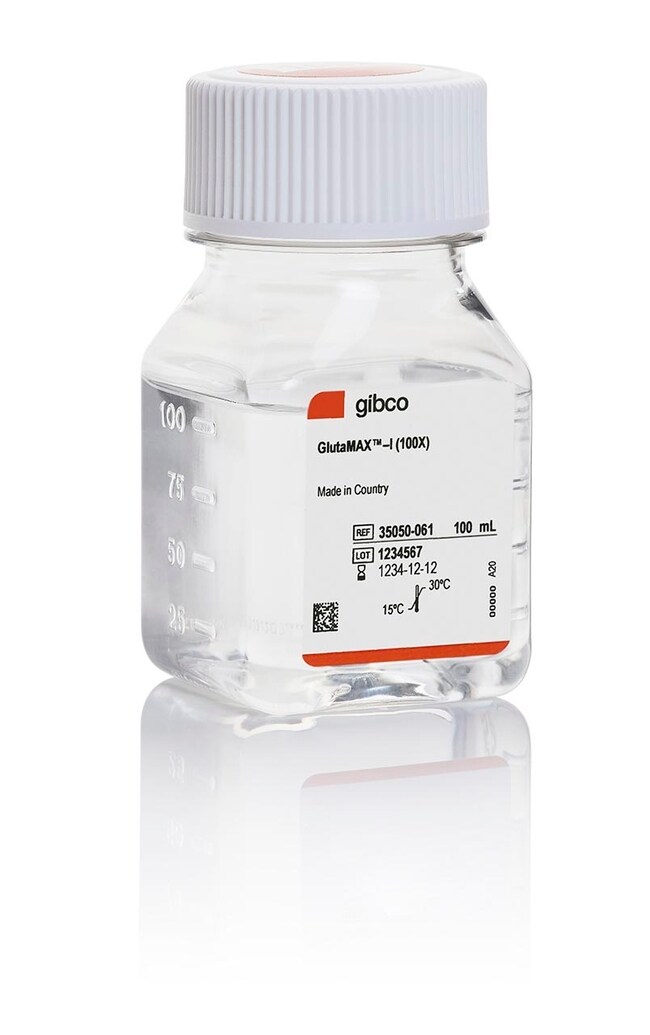
GlutaMAX™ 补充剂
Gibco™ GlutaMAX™ 添加剂是 L-谷氨酰胺的替代品,具有更好的稳定性,可改善细胞健康。GlutaMAX™ 添加剂适合于哺乳动物细胞的贴壁和悬浮培养,而且无需适应。GlutaMAX™ 补充剂以 200 mM了解更多信息
Have Questions?
更改视图

| 货号 | 数量 |
|---|---|
| 35050061 | 100 mL |
| 35050079 | 20 x 100 mL |
货号 35050061
价格(CNY)
617.00
飞享价
Ends: 31-Dec-2026
822.00共减 205.00 (25%)
Each
数量:
100 mL
价格(CNY)
617.00
飞享价
Ends: 31-Dec-2026
822.00共减 205.00 (25%)
Each
Gibco™ GlutaMAX™ 添加剂是 L-谷氨酰胺的替代品,具有更好的稳定性,可改善细胞健康。GlutaMAX™ 添加剂适合于哺乳动物细胞的贴壁和悬浮培养,而且无需适应。GlutaMAX™ 补充剂以 200 mM L-丙氨酰-L-谷氨酰胺二肽形式供货,溶剂为 0.85% NaCl。GlutaMAX™ 添加剂也包括在各种培养基配方中。与 L-谷氨酰胺相比,GlutaMAX™ 添加剂:
•可显著减少有毒氨的积累
•改善细胞活力和生长情况
•在很宽的温度范围内保持稳定
可显著减少有毒氨的积累
与 L-谷氨酰胺不同,GlutaMAX™ 添加剂不会自发分解,因此不会形成氨。相反,细胞会根据需要裂解二肽键以释放 L-谷氨酰胺。该系统可以防止废物的积累并在长期培养过程中维持 L-谷氨酰胺的新鲜供应
改善细胞活力和生长情况
氨含量较低的培养物显示出更高的细胞活力。此外,由于 GlutaMAX™ 添加剂具有一致的浓度,因此培养条件更易控制,而使用 L-谷氨酰胺时不可能实现这一点
在很宽的温度范围内保持稳定
GlutaMAX™ 添加剂在室温下稳定并且为即用型。GlutaMAX™ 补充剂可在室温、2 至 8°C 或 -5 至 -30°C 下保留完整功能长达 24 个月,方便储存和处理。GlutaMAX™ 补充剂可在 37°C 下稳定放置一周或更长时间。
cGMP 生产和质量体系
Gibco™ GlutaMAX™ 补充剂在位于纽约格兰德岛的符合 cGMP 要求的工厂内生产。该工厂是在FDA登记的医疗器械生产商,且通过ISO 13485标准认证。为确保供应链的稳定,我们同时提供由我们的苏格兰工厂生产的相同 Gibco™ PBS 产品 (35050-087)。该工厂也是在 FDA 注册的医疗器械生产商,且通过 ISO 13485 标准认证。
•可显著减少有毒氨的积累
•改善细胞活力和生长情况
•在很宽的温度范围内保持稳定
可显著减少有毒氨的积累
与 L-谷氨酰胺不同,GlutaMAX™ 添加剂不会自发分解,因此不会形成氨。相反,细胞会根据需要裂解二肽键以释放 L-谷氨酰胺。该系统可以防止废物的积累并在长期培养过程中维持 L-谷氨酰胺的新鲜供应
改善细胞活力和生长情况
氨含量较低的培养物显示出更高的细胞活力。此外,由于 GlutaMAX™ 添加剂具有一致的浓度,因此培养条件更易控制,而使用 L-谷氨酰胺时不可能实现这一点
在很宽的温度范围内保持稳定
GlutaMAX™ 添加剂在室温下稳定并且为即用型。GlutaMAX™ 补充剂可在室温、2 至 8°C 或 -5 至 -30°C 下保留完整功能长达 24 个月,方便储存和处理。GlutaMAX™ 补充剂可在 37°C 下稳定放置一周或更长时间。
cGMP 生产和质量体系
Gibco™ GlutaMAX™ 补充剂在位于纽约格兰德岛的符合 cGMP 要求的工厂内生产。该工厂是在FDA登记的医疗器械生产商,且通过ISO 13485标准认证。为确保供应链的稳定,我们同时提供由我们的苏格兰工厂生产的相同 Gibco™ PBS 产品 (35050-087)。该工厂也是在 FDA 注册的医疗器械生产商,且通过 ISO 13485 标准认证。
规格
细胞类型哺乳动物细胞
最大浓度100 X
培养类型哺乳动物细胞培养
适用于(应用)临床研究、转化研究
生产质量cGMP-compliant under the ISO 13485 standard
渗透压430 - 490 mOsm/kg
产品线Gibco,GlutaMAX
数量100 mL
有效期24 个月
运输条件室温
来源非动物来源
分类无动物来源
形式液体
产品类型GlutaMax
无菌无菌过滤
灭菌方法Sterile-filtered
pH5 – 6
Unit SizeEach
内容与储存
储存条件:15°C 至 30°C
可选储存条件:-5°C 至 -20°C 和 2°C 至 8°C
运输条件:室温
有效期:自生产之日起24个月
可选储存条件:-5°C 至 -20°C 和 2°C 至 8°C
运输条件:室温
有效期:自生产之日起24个月
常见问题解答 (FAQ)
清除,缺少或降解谷氨酰胺或生长因子等促生长的基本成份会对培养物的生长速率造成影响么?
配方中含有Gibco GlutaMAX添加剂会改变L-谷氨酰胺的含量么?
Gibco GlutaMAX与谷氨酰胺添加剂之间的区别是什么?
Why is GlutaMAX Supplement (Cat. Nos. 35050061, 35050079) recommended over L-glutamine when reconstituting Geltrex Reduced Growth Factor Basement Membrane Matrix?
Does Dynamis AGT Medium (Cat. Nos. A2617501, A2617502, A2617503, A2617504) require supplementation for use?
引用和文献 (23)
引用和文献
Abstract
A comparison between different human hepatocyte models reveals profound differences in net glucose production, lipid composition and metabolism in vitro.
Journal:Experimental cell research
PubMed ID:38499143
Effects of an indole derivative on cell proliferation, transfection, and alternative splicing in production of lentiviral vectors by transient co-transfection.
Journal:PloS one
PubMed ID:38833479
Lentiviral vectors derived from human immunodeficiency virus type I are widely used to deliver functional gene copies to mammalian cells for research and gene therapies. Post-transcriptional splicing of lentiviral vector transgene in transduced host and transfected producer cells presents barriers to widespread application of lentiviral vector-based therapies. The present study
Point mutations identified in Lec8 Chinese hamster ovary glycosylation mutants that inactivate both the UDP-galactose and CMP-sialic acid transporters.
Journal:J Biol Chem
PubMed ID:11319223
'Nucleotide-sugar transporters (NSTs) are critical components of glycosylation pathways in eukaryotes. The identification of structural elements that are involved in NST functions provides an important task. Chinese hamster ovary glycosylation mutants defective in nucleotide-sugar transport provide access to inactive transporters that can define such structure/function relationships. In this study, we
The generation of rhythmic activity in dissociated cultures of rat spinal cord.
Journal:Eur J Neurosci
PubMed ID:11553272
'Locomotion in vertebrates is controlled by central pattern generators in the spinal cord. The roles of specific network architecture and neuronal properties in rhythm generation by such spinal networks are not fully understood. We were able to induce similar patterns of rhythmic activity in dissociated cultures as in slice
Production, concentration and titration of pseudotyped HIV-1-based lentiviral vectors.
Journal:Nat Protoc
PubMed ID:19300443
'Over the past decade, lentiviral vectors have emerged as powerful tools for transgene delivery. The use of lentiviral vectors has become commonplace and applications in the fields of neuroscience, hematology, developmental biology, stem cell biology and transgenesis are rapidly emerging. Also, lentiviral vectors are at present being explored in the