Search

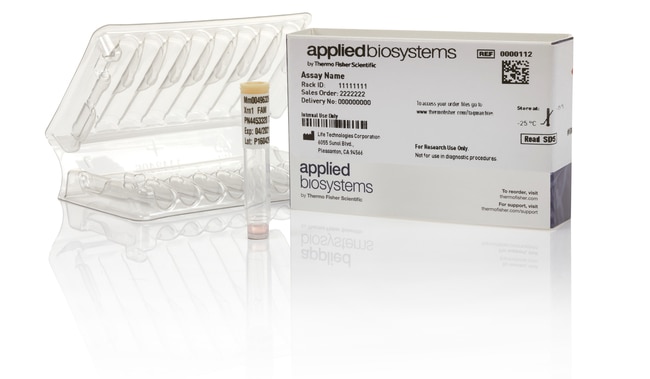
Applied Biosystems™
Custom Plus TaqMan ™RNA 测定,FAM
Applied Biosystems Custom Plus TaqMan RNA Assay是我们用于实时荧光定量 PCR 的预设计 TaqMan了解更多信息
Have Questions?
更改视图

| 货号 | 数量 |
|---|---|
| 4441114 | S (360 reactions), made to order |
| 4441118 | L (2900 reactions), made to order |
| 4441117 | M (750 reactions), made to order |
货号 4441114
价格(CNY)
4,229.00
Each
数量:
S (360 reactions), made to order
Applied Biosystems Custom Plus TaqMan RNA Assay是我们用于实时荧光定量 PCR 的预设计 TaqMan Assay的个性化定制版本。Custom Plus TaqMan RNA Assay包括一对未标记的 PCR 引物和 5’ 端染色标记 (FAM) 的 TaqMan 探针,以及 3’ 端小沟结合物 (MGB) 和非荧光淬灭剂 (NFQ)。
特点包括:
•易于使用—仅添加 cDNA 和预混液运行 qPCR—无需熔点曲线
•特异性—TaqMan 分析使用专利含 MGB 的探针,该探针比非 MGB 探针少 15 个碱基,提高了检测的特异性。
•灵敏性—TaqMan 分析是测量低表达水平或低丰度目标的理想方法
•准确性—识别小倍数变化病具有高准确性定量
•定制含量—设计易于检测超过 20 个物种
•订制设计T基于强大的生信能力和专业算法,生成数百万个Assay,并被视为业内 qPCR 设计的基准
大致运输时间
定制:4–6欧洲 6–10 天
TaqMan 基因表达Assay是实时荧光定量 PCR 基因表达研究中的金标准,建立在超过 20 年经验的基础上。每种Assay均包括目标引物和序列特异性探针(已经过优化从而获得较佳的功能表现)。无需额外设计、优化或熔解曲线分析。可提供多种形式和种属,不断增加新的Assay以满足您的研究需求。TaqMan Assay已被超过 40,000 篇出版物引用,并且获得超过 350 项专利的支持。
推荐的预混液:TaqMan Fast Advanced预混液
特点包括:
•易于使用—仅添加 cDNA 和预混液运行 qPCR—无需熔点曲线
•特异性—TaqMan 分析使用专利含 MGB 的探针,该探针比非 MGB 探针少 15 个碱基,提高了检测的特异性。
•灵敏性—TaqMan 分析是测量低表达水平或低丰度目标的理想方法
•准确性—识别小倍数变化病具有高准确性定量
•定制含量—设计易于检测超过 20 个物种
•订制设计T基于强大的生信能力和专业算法,生成数百万个Assay,并被视为业内 qPCR 设计的基准
大致运输时间
定制:4–6欧洲 6–10 天
TaqMan 基因表达Assay是实时荧光定量 PCR 基因表达研究中的金标准,建立在超过 20 年经验的基础上。每种Assay均包括目标引物和序列特异性探针(已经过优化从而获得较佳的功能表现)。无需额外设计、优化或熔解曲线分析。可提供多种形式和种属,不断增加新的Assay以满足您的研究需求。TaqMan Assay已被超过 40,000 篇出版物引用,并且获得超过 350 项专利的支持。
推荐的预混液:TaqMan Fast Advanced预混液
仅供科研使用。不可用于诊断程序。
规格
适用于(设备)7500 系统、7500 Fast 系统、7900HT 系统、StepOne™、StepOnePlus™、ViiA™ 7 系统、QuantStudio™ 3、QuantStudio™ 5、QuantStudio™ 6 Flex、QuantStudio™ 7 Flex、QuantStudio 6 Pro、QuantStudio 7 Pro、QuantStudio™ 12k Flex
反应次数360 reactions, made to order
产品线TaqMan
产品类型Custom TaqMan 基因表达
数量S (360 reactions), made to order
运输条件室温
最大浓度20X
Unit SizeEach
内容与储存
1 个含 20X(S 和 M 规格)或 60X(L 规格)预配制检测试剂(1 种探针和 2 种引物)混合物的管。
在 -15 至 -25°C 下储存。
在 -15 至 -25°C 下储存。