Search

Thermo Scientific™
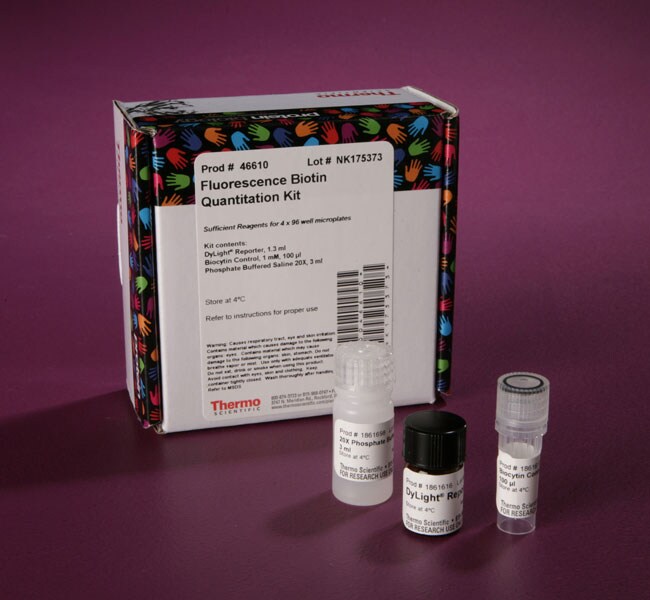
Pierce™ 荧光生物素定量试剂盒
Thermo Scientific Pierce 荧光生物素定量试剂盒仅需 10 微升样品即可准确测量标记抗体和其他生物分子的生物素化水平。荧光生物素定量试剂盒的特点:•快速—仅需 5 分钟孵育• 经济—仅需了解更多信息
| 货号 | 数量 |
|---|---|
| 46610 | 1 kit |
货号 46610
价格(CNY)
4,706.00
Each
数量:
1 kit
价格(CNY)
4,706.00
Each
Thermo Scientific Pierce 荧光生物素定量试剂盒仅需 10 微升样品即可准确测量标记抗体和其他生物分子的生物素化水平。
荧光生物素定量试剂盒的特点:
•快速—仅需 5 分钟孵育
• 经济—仅需 10 μL 样品(约 750 ng 生物素化 IgG)
• 灵敏—10 至 60 皮摩尔生物素的线性工作范围
通过向生物素化样品和稀释的生物胞素标准品中添加提供的荧光报告基因,可轻松执行这种基于微孔板的生物素测定。当弱相互作用的 HABA(4'-羟基偶氮苯-2-羧酸)被生物素取代时,亲和素发出荧光。通过将样品的荧光与生物胞素标准曲线进行比较,测定生物素的量。与微孔板比色 HABA 测定相比,该测定需要更少的样品体积,且灵敏度更高。
包括
测定缓冲液、HABA-亲和素荧光报告基因溶液和生物胞素对照品
需要
黑色不透明 96 孔微孔板和荧光板读数仪(激发 494 nm;发射 520 nm)
亲和素或链霉素亲和素与生物素的高度特异性相互作用是许多纯化和检测系统的基础。对生物素化程度进行定量是评估生物素标记程序是否成功以及生物素化分子在某一特定应用中的用量所必需的操作。
HABA(4'-羟基偶氮苯-2-羧酸)是一种与亲和素发生弱相互作用的染料,通常用于在比色测定中快速估计生物素-蛋白比值。荧光生物素定量试剂盒还使用 HABA 染料,但灵敏度和精确度更高。将荧光亲和素与 HABA (DyLight Reporter) 预混液添加到含生物素化样品的溶液中。由于对亲和素的亲和力较高,生物素会取代 HABA,使亲和素发出荧光。通过将荧光与生物胞素标准曲线进行比较,在微孔板中测定生物素的量。
荧光生物素定量试剂盒仅需 10 μL 样品。相比之下,传统的比色法需要 100 μL 样品,而另一领先供应商的荧光检测试剂盒需要 50 μL 样品。与其他供应商的荧光生物素测定(品牌 I)相比,我们的试剂盒更准确。
荧光生物素定量试剂盒的特点:
•快速—仅需 5 分钟孵育
• 经济—仅需 10 μL 样品(约 750 ng 生物素化 IgG)
• 灵敏—10 至 60 皮摩尔生物素的线性工作范围
通过向生物素化样品和稀释的生物胞素标准品中添加提供的荧光报告基因,可轻松执行这种基于微孔板的生物素测定。当弱相互作用的 HABA(4'-羟基偶氮苯-2-羧酸)被生物素取代时,亲和素发出荧光。通过将样品的荧光与生物胞素标准曲线进行比较,测定生物素的量。与微孔板比色 HABA 测定相比,该测定需要更少的样品体积,且灵敏度更高。
包括
测定缓冲液、HABA-亲和素荧光报告基因溶液和生物胞素对照品
需要
黑色不透明 96 孔微孔板和荧光板读数仪(激发 494 nm;发射 520 nm)
亲和素或链霉素亲和素与生物素的高度特异性相互作用是许多纯化和检测系统的基础。对生物素化程度进行定量是评估生物素标记程序是否成功以及生物素化分子在某一特定应用中的用量所必需的操作。
HABA(4'-羟基偶氮苯-2-羧酸)是一种与亲和素发生弱相互作用的染料,通常用于在比色测定中快速估计生物素-蛋白比值。荧光生物素定量试剂盒还使用 HABA 染料,但灵敏度和精确度更高。将荧光亲和素与 HABA (DyLight Reporter) 预混液添加到含生物素化样品的溶液中。由于对亲和素的亲和力较高,生物素会取代 HABA,使亲和素发出荧光。通过将荧光与生物胞素标准曲线进行比较,在微孔板中测定生物素的量。
荧光生物素定量试剂盒仅需 10 μL 样品。相比之下,传统的比色法需要 100 μL 样品,而另一领先供应商的荧光检测试剂盒需要 50 μL 样品。与其他供应商的荧光生物素测定(品牌 I)相比,我们的试剂盒更准确。
仅供科研使用。不可用于诊断程序。
规格
产品线Pierce
产品类型荧光生物素定量试剂盒
数量1 kit
标记目标抗体, 蛋白
标签或染料生物素
Unit SizeEach
内容与储存
足以处理微孔板形式的 216 份样品
• 磷酸盐缓冲盐水 (20X),3 mL
• DyLight Reporter,1.3 mL
• 1 mM 生物胞素对照品,0.1 mL
在 4°C 下储存。
• 磷酸盐缓冲盐水 (20X),3 mL
• DyLight Reporter,1.3 mL
• 1 mM 生物胞素对照品,0.1 mL
在 4°C 下储存。