Search


引用和文献 (6)
Invitrogen™
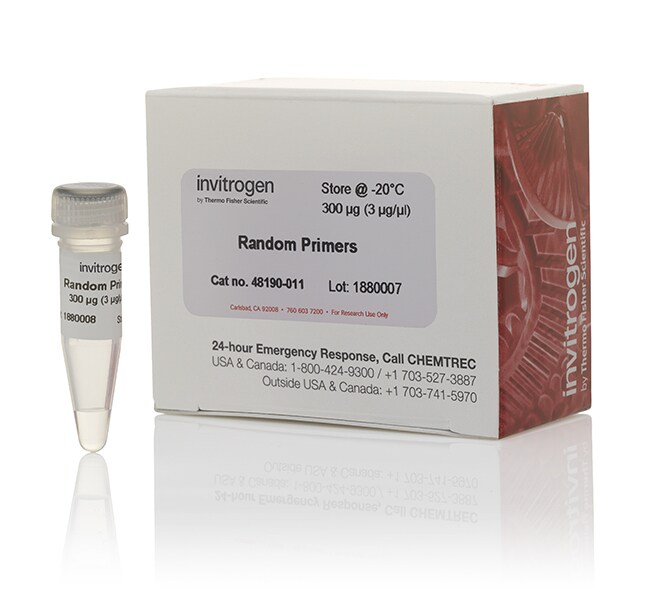
随机引物
真正的随机引物,适用于使用含有 DNA 模板的 Klenow 片段进行 DNA 合成,或者使用含有 mRNA 模板的逆转录酶进行 cDNA 合成
| 货号 | 数量 |
|---|---|
| 48190011 | 1 管 100µL,浓度为 9 个 A260 单位 |
货号 48190011
价格(CNY)
1,208.00
飞享价
Ends: 31-Dec-2026
1,562.00共减 354.00 (23%)
Each
数量:
1 管 100µL,浓度为 9 个 A260 单位
价格(CNY)
1,208.00
飞享价
Ends: 31-Dec-2026
1,562.00共减 354.00 (23%)
Each
随机引物为寡脱氧核糖核苷酸(多数为六聚体),用于从模板制备标记的 DNA 探针,以便进行过滤器杂交或原位杂交,并用于在使用或不使用 poly(A) 的情况下启动 mRNA,从而进行 cDNA 合成。这些引物是真正随机的引物,适用于使用含有 DNA 模板的 Klenow 片段进行 DNA 合成,或者使用含有 mRNA 模板的逆转录酶进行 cDNA 合成。为避免储存缓冲液干扰,随机引物以低盐浓度缓冲液形式提供。
性能和质量检测:
在随机引物标记反应中使用对照 DNA 确认放射性标记核苷酸的掺入。
性能和质量检测:
在随机引物标记反应中使用对照 DNA 确认放射性标记核苷酸的掺入。
仅供科研使用。不可用于诊断程序。
规格
适用于(应用)cDNA 合成
形式液体
产品类型引物
数量1 管 100µL,浓度为 9 个 A260 单位
运输条件经批准可置于湿冰或干冰上运输
最大浓度3 μg/μL
引物随机
Unit SizeEach
内容与储存
100 µL 随机引物以浓度为 3 µg/µL 的 3 mM Tris-HCl(pH 值 7.0)、0.2 mM EDTA 的形式提供。在 -20°C 下储存。妥善储存时,可保证稳定储存 6 个月。
常见问题解答 (FAQ)
Can I purchase Random Primers separately?
Which components of the SuperScript III First Strand Synthesis System for RT-PCR are available for purchase separately?
What is the concentration of Random Primers (Cat. No. 48190011)?
引用和文献 (6)
引用和文献
Abstract
Global Expression Profiling of Acetate-grown Escherichia coli.
Journal:J Biol Chem
PubMed ID:11815613
'This study characterized the transcript profile of Escherichia coli in acetate cultures using DNA microarray on glass slides. Glucose-grown cultures were used as a reference. At the 95% confidence level, 354 genes were up-regulated in acetate, while 370 genes were down-regulated compared with the glucose-grown culture. Generally, more metabolic genes
RasGRP, a Ras guanyl nucleotide- releasing protein with calcium- and diacylglycerol-binding motifs.
Journal:Science
PubMed ID:9582122
RasGRP, a guanyl nucleotide-releasing protein for the small guanosine triphosphatase Ras, was characterized. Besides the catalytic domain, RasGRP has an atypical pair of EF hands that bind calcium and a diacylglycerol (DAG)-binding domain. RasGRP activated Ras and caused transformation in fibroblasts. A DAG analog caused sustained activation of Ras-Erk signaling
Class II histone deacetylases act as signal-responsive repressors of cardiac hypertrophy.
Journal:Cell
PubMed ID:12202037
The heart responds to stress signals by hypertrophic growth, which is accompanied by activation of the MEF2 transcription factor and reprogramming of cardiac gene expression. We show here that class II histone deacetylases (HDACs), which repress MEF2 activity, are substrates for a stress-responsive kinase specific for conserved serines that regulate
Improvements in siRNA properties mediated by 2'-deoxy-2'-fluoro-beta-D-arabinonucleic acid (FANA).
Journal:Nucleic Acids Res
PubMed ID:16554553
RNA interference (RNAi) has emerged recently as an efficient mechanism for specific gene silencing. Short double-stranded small interfering RNAs (siRNAs) are now widely used for cellular or drug target validation; however, their use for silencing clinically relevant genes in a therapeutic setting remains problematic because of their unfavourable metabolic stability
Use of an in vivo reporter assay to test for transcriptional and translational fidelity in yeast.
Journal:J Biol Chem
PubMed ID:12006589
Eukaryotic RNA polymerase II and Escherichia coli RNA polymerase possess an intrinsic ribonuclease activity that is stimulated by the polymerase-binding proteins SII and GreB, respectively. This factor-activated hydrolysis of nascent RNA has been postulated to be involved in transcription elongation as well as removal of incorrect bases misincorporated into RNA.