Search


引用和文献 (7)
Thermo Scientific™
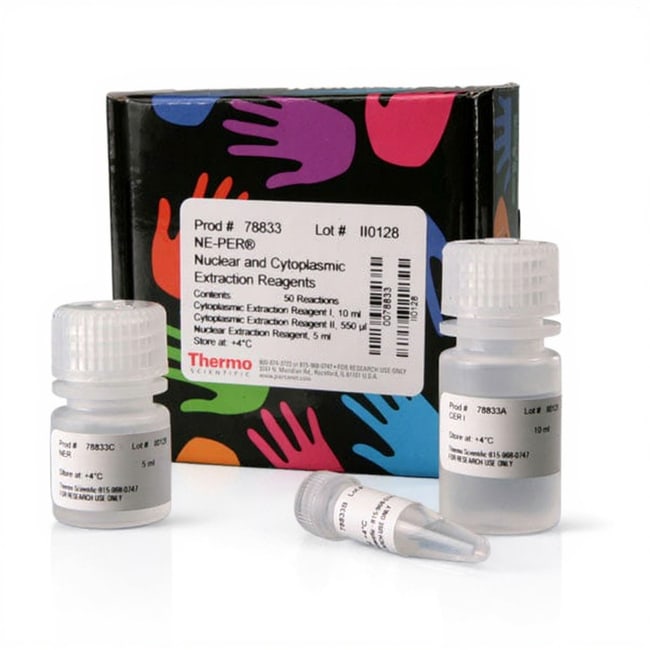
NE-PER™ 细胞核和细胞质提取试剂
Thermo Scientific NE-PER 细胞核和细胞质提取试剂盒可在不到两小时内高效裂解细胞并提取单独的细胞质和细胞核蛋白组分。NE-PER 细胞核和细胞质提取试剂盒的特点:•快速 — 可在不到两小时内获得细胞核和细胞质组分•经验证 — NE-PER了解更多信息
Have Questions?
更改视图

| 货号 | 数量 |
|---|---|
| 78833 | 15 mL |
| 78835 | 75 mL |
货号 78833
价格(CNY)
2,342.00
飞享价
Ends: 31-Dec-2026
3,330.00共减 988.00 (30%)
Each
数量:
15 mL
价格(CNY)
2,342.00
飞享价
Ends: 31-Dec-2026
3,330.00共减 988.00 (30%)
Each
Thermo Scientific NE-PER 细胞核和细胞质提取试剂盒可在不到两小时内高效裂解细胞并提取单独的细胞质和细胞核蛋白组分。
NE-PER 细胞核和细胞质提取试剂盒的特点:
•快速 — 可在不到两小时内获得细胞核和细胞质组分
•经验证 — NE-PER 试剂盒已在超过950种知名出版物中引用
•通用 – 来自培养细胞或组织的细胞核蛋白(仅适用于新鲜样品)
•可扩展 — 具有两种试剂盒规格,用于从细胞和组织中生成提取物
•便利 — 指示简单,无需梯度超速离心
•可兼容 — 可用于下游测定,包括 Western 免疫印迹、凝胶迁移率测定、蛋白测定、报告基因测定和酶活性测定
NE-PER 试剂盒是一种核蛋白提取方法,涉及简单、逐步裂解细胞并离心分离细胞核和细胞质蛋白组分。只需要使用台式微量离心机、试管和移液器工具。NE-PER 试剂可将各种细胞质和细胞核蛋白高效溶解并分离为小份,使基因组 DNA 和 mRNA 的交叉污染或干扰极少。脱盐或稀释后,分离的蛋白可用于进行免疫检测以及蛋白相互作用实验,如迁移率变动分析 (EMSA)、免疫共沉淀 (Co-IP) 和沉淀分析。
有多种方法可用于分离细胞核并制备细胞核蛋白提取物。大多数制备细胞核提取物的方法都是繁琐的流程,需要可能影响细胞核蛋白完整性的机械均质化、冻/融循环、广泛的离心或透析步骤。NE-PER 细胞核和细胞质提取试剂盒是一种基于试剂的方案,可逐步裂解细胞、从完整的细胞核中分离细胞质,然后从基因组 DNA 和 mRNA 中提取出细胞核蛋白。在使用培养细胞时,这一温和的流程只需不到两小时并且只需要一台标准的台式离心机。此外,可以从同一细胞培养或组织样品中回收活性细胞核蛋白和细胞质蛋白。
该试剂盒通常可从200万个细胞中产生 200-500 µg 细胞质蛋白和 100-200 µg 细胞核蛋白(浓度为 1 mg/mL)。细胞溶质和细胞核部分间的典型交叉污染率为大约 10%。该方法主要从细胞核中回收可溶性蛋白,而不是在染色质中结合的蛋白或细胞核包膜的整合膜蛋白。细胞核提取物的蛋白浓度可通过在提取中采用不同体积的细胞核提取试剂 (NER) 很容易的进行控制,提取效率不会有任何重大损失。从细胞中特定提取各种细胞核蛋白对于很多基因调控研究的成功非常重要。尽管有多种方法可用于分离细胞核并制备细胞核蛋白提取物,但这些方法的大多数都很繁琐,需要采用可能影响很多脆弱细胞核蛋白完整性的机械均质化、冻/融循环、广泛的离心或透析步骤。NE-PER 试剂盒克服了这些问题,可为 EMSA 和其他分析技术提供高质量、浓缩的细胞核蛋白提取物。
相关产品
用于培养细胞的亚细胞蛋白分离试剂盒
用于组织的亚细胞蛋白分离试剂盒台式离心机
NE-PER 细胞核和细胞质提取试剂盒的特点:
•快速 — 可在不到两小时内获得细胞核和细胞质组分
•经验证 — NE-PER 试剂盒已在超过950种知名出版物中引用
•通用 – 来自培养细胞或组织的细胞核蛋白(仅适用于新鲜样品)
•可扩展 — 具有两种试剂盒规格,用于从细胞和组织中生成提取物
•便利 — 指示简单,无需梯度超速离心
•可兼容 — 可用于下游测定,包括 Western 免疫印迹、凝胶迁移率测定、蛋白测定、报告基因测定和酶活性测定
NE-PER 试剂盒是一种核蛋白提取方法,涉及简单、逐步裂解细胞并离心分离细胞核和细胞质蛋白组分。只需要使用台式微量离心机、试管和移液器工具。NE-PER 试剂可将各种细胞质和细胞核蛋白高效溶解并分离为小份,使基因组 DNA 和 mRNA 的交叉污染或干扰极少。脱盐或稀释后,分离的蛋白可用于进行免疫检测以及蛋白相互作用实验,如迁移率变动分析 (EMSA)、免疫共沉淀 (Co-IP) 和沉淀分析。
有多种方法可用于分离细胞核并制备细胞核蛋白提取物。大多数制备细胞核提取物的方法都是繁琐的流程,需要可能影响细胞核蛋白完整性的机械均质化、冻/融循环、广泛的离心或透析步骤。NE-PER 细胞核和细胞质提取试剂盒是一种基于试剂的方案,可逐步裂解细胞、从完整的细胞核中分离细胞质,然后从基因组 DNA 和 mRNA 中提取出细胞核蛋白。在使用培养细胞时,这一温和的流程只需不到两小时并且只需要一台标准的台式离心机。此外,可以从同一细胞培养或组织样品中回收活性细胞核蛋白和细胞质蛋白。
该试剂盒通常可从200万个细胞中产生 200-500 µg 细胞质蛋白和 100-200 µg 细胞核蛋白(浓度为 1 mg/mL)。细胞溶质和细胞核部分间的典型交叉污染率为大约 10%。该方法主要从细胞核中回收可溶性蛋白,而不是在染色质中结合的蛋白或细胞核包膜的整合膜蛋白。细胞核提取物的蛋白浓度可通过在提取中采用不同体积的细胞核提取试剂 (NER) 很容易的进行控制,提取效率不会有任何重大损失。从细胞中特定提取各种细胞核蛋白对于很多基因调控研究的成功非常重要。尽管有多种方法可用于分离细胞核并制备细胞核蛋白提取物,但这些方法的大多数都很繁琐,需要采用可能影响很多脆弱细胞核蛋白完整性的机械均质化、冻/融循环、广泛的离心或透析步骤。NE-PER 试剂盒克服了这些问题,可为 EMSA 和其他分析技术提供高质量、浓缩的细胞核蛋白提取物。
相关产品
用于培养细胞的亚细胞蛋白分离试剂盒
用于组织的亚细胞蛋白分离试剂盒台式离心机
仅供科研使用。不可用于诊断程序。
规格
缓冲液裂解缓冲液
数量15 mL
试剂类型细胞裂解缓冲液、去污剂溶液、亚细胞分离
运输条件环境
形式液体
产品线NE-PER
产品类型细胞核和细胞质提取试剂
Unit SizeEach
内容与储存
接收后,试剂盒组分在 4°C 下储存。
常见问题解答 (FAQ)
How long does it take to complete the NE-PER Extraction reagents protocol?
After protein extraction using the NE-PER Extraction reagents, where is the genomic DNA located?
Are there any considerations when adding protease inhibitors to the CER I and NER Reagents?
Have the NE-PER Reagents been tested with plant tissue or yeast cells?
Is the final soluble nuclear fraction dialyzable when using the NE-PER Extraction reagents?
引用和文献 (7)
引用和文献
Abstract
FOXO1 modulates osteoblast differentiation.
Journal:Bone
PubMed ID:21281751
Forkhead box O1 (FOXO1) is upregulated during bone formation and in response to stimulation by bone morphogenetic proteins. Studies presented here examined the functional role of FOXO1 in a well defined culture system in which pre-osteoblastic cells undergo terminal differentiation in vitro. Mineralizing cultures of MC3T3-E1 cells were examined with
Correlation between S100A11 and the TGF-β(1)/SMAD4 pathway and its effects on the proliferation and apoptosis of pancreatic cancer cell line PANC-1.
Journal:Molecular and cellular biochemistry
PubMed ID:29922945
S100A11 as a S100 protein family member has been documented to play dual-direction regulation over cancer cell proliferation. We explored the role of S100A11 in the proliferation and apoptosis of pancreatic cancer cell line PANC-1 and the potential mechanisms involving the TGF-β(1)/SMAD4/p21 pathway. S100A11 and TGF-β(1) protein expressions in 30
An improved cell nuclear isolation method.
Journal:Biology methods & protocols
PubMed ID:39925781
Nuclear isolation is crucial for studying gene expression and regulatory mechanisms in eukaryotic cells. This study aimed to improve nuclear isolation and compare the yield, purity, and efficiency of several methods. Human umbilical vein endothelial cells were used to evaluate four different techniques: sucrose centrifugation, a simplified method, homogenization, and
Conformation-Crooking CXCL4 to Unravel Autoimmune Heparin-Induced Thrombocytopenia.
Journal:Thrombosis and haemostasis
PubMed ID:33385179
Human bile salt export pump promoter is transactivated by the farnesoid X receptor/bile acid receptor.
Journal:J Biol Chem
PubMed ID:11387316
'The bile salt excretory pump (BSEP, ABCb11) is critical for ATP-dependent transport of bile acids across the hepatocyte canalicular membrane and for generation of bile acid-dependent bile secretion. Recent studies have demonstrated that the expression of this transporter is sensitive to the flux of bile acids through the hepatocyte, possibly