Search


引用和文献 (9)
Invitrogen™
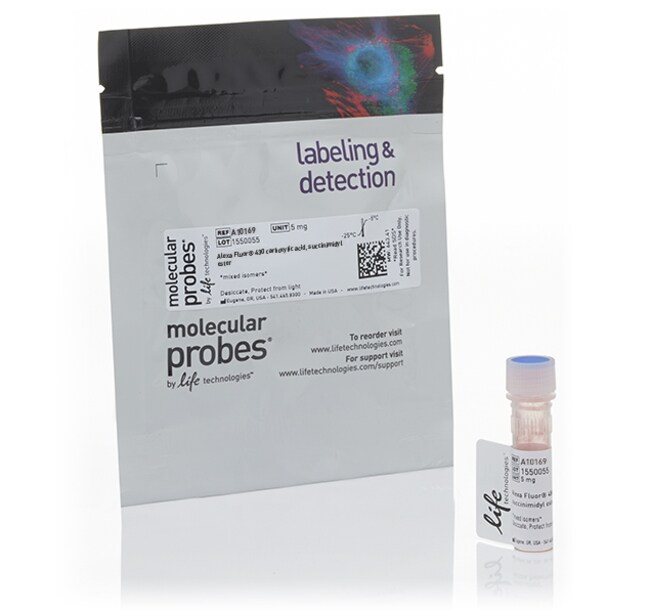
Alexa Fluor™430 NHS 酯(琥珀酰亚胺酯)
Alexa Fluor™ 430 是一种明亮的绿色荧光染料。Alexa Fluor™ 430 染料用于成像和流式细胞分析中稳定信号的生成,具有水溶性和 pH 值不敏感性了解更多信息
| 货号 | 数量 |
|---|---|
| A10169 | 5 mg |
货号 A10169
价格(CNY)
5,111.00
Each
数量:
5 mg
价格(CNY)
5,111.00
Each
Alexa Fluor™ 430 是一种明亮的绿色荧光染料。Alexa Fluor™ 430 染料用于成像和流式细胞分析中稳定信号的生成,具有水溶性和 pH 值不敏感性(pH 值 4 至 pH 值 10)。除反应性染料配方外,我们还提供可与多种抗体、肽、蛋白、示踪剂和扩增底物偶联并且针对细胞标记和检测进行优化的 Alexa Fluor™ 430 染料。
Alexa Fluor™ 430 的 NHS 酯(或琥珀酰亚胺酯)是将该染料与蛋白或抗体偶联的广受欢迎的工具。NHS 酯可用于标记蛋白、胺修饰的寡核苷酸和其他含胺分子的伯胺 (R-NH2)。所得 Alexa Fluor™ 偶联物将显示出比其他光谱相似荧光基团的偶联物更亮的荧光和更高的光稳定性。
关于该 AlexaFluor™ NHS 酯的详细信息:
荧光基团标记:Alexa Fluor™ 430 染料
反应性基团:NHS 酯
反应性:蛋白和配体、胺修饰的寡核苷酸上的伯胺
偶联物的 Ex/Em:430/545 nm
消光系数:15,000 cm-1M-1
分子量:701.8
典型的偶联反应
您可以将偶联物胺反应性试剂与几乎任何蛋白或肽结合(所提供的方案优化用于 IgG 抗体)。您可以针对任何量的蛋白按比例缩放反应,但为了获得最佳结果,蛋白的浓度应至少为 2 mg/mL。我们建议使用三种不同的反应性试剂/蛋白摩尔比进行三种不同程度的标记。
Alexa Fluor™ NHS 酯通常溶于高质量的无水二甲基甲酰胺 (DMF) 或二甲亚砜 (DMSO) (D12345) 中,并在 0.1–0.2 M 碳酸氢钠缓冲液(pH 值 8.3)中于室温下进行反应,持续 1 小时。由于末端胺的 pKa 低于赖氨酸 ε-氨基基团的 pKa,您可以使用接近中性 pH 值的缓冲液对胺末端进行更具选择性的标记。
偶联物纯化
通常使用凝胶过滤柱(如 Sephadex™ G-25、BioGel™ P-30 或等效柱)将标记抗体与游离 Alexa Fluor™ 染料分离。对于更大或更小的蛋白,选择具有适当分子量滤除点的凝胶过滤介质或通过透析纯化。我们提供了多种优化的纯化试剂盒,可用于不同量抗体偶联物:
0.5-1 mg 用抗体偶联物纯化试剂盒 (A33086)
20-50 µg 用抗体偶联物纯化试剂盒 (A33087)
50-100 µg 用抗体偶联物纯化试剂盒 (A33088)
了解关于蛋白和抗体标记的更多信息
我们提供一系列 Molecular Probes™ 抗体和蛋白标记试剂盒,旨在满足您的起始材料和实验设置需求。参见我们的抗体标记试剂盒或使用我们的标记化学选择工具进行其他选择。欲了解有关我们标记试剂盒的更多信息,请参阅 Molecular Probes™ 手册中第 1.2 节—蛋白和核酸标记试剂盒。
我们还’可为您定制偶联物
如果您’无法在我们的在线目录中找到’想要的产品,我们还’可为您定制抗体或蛋白偶联物。我们的定制偶联服务是高效和保密的,我们保证我们的工作质量。我们经过ISO 9001:2000认证。
Alexa Fluor™ 430 的 NHS 酯(或琥珀酰亚胺酯)是将该染料与蛋白或抗体偶联的广受欢迎的工具。NHS 酯可用于标记蛋白、胺修饰的寡核苷酸和其他含胺分子的伯胺 (R-NH2)。所得 Alexa Fluor™ 偶联物将显示出比其他光谱相似荧光基团的偶联物更亮的荧光和更高的光稳定性。
关于该 AlexaFluor™ NHS 酯的详细信息:
荧光基团标记:Alexa Fluor™ 430 染料
反应性基团:NHS 酯
反应性:蛋白和配体、胺修饰的寡核苷酸上的伯胺
偶联物的 Ex/Em:430/545 nm
消光系数:15,000 cm-1M-1
分子量:701.8
典型的偶联反应
您可以将偶联物胺反应性试剂与几乎任何蛋白或肽结合(所提供的方案优化用于 IgG 抗体)。您可以针对任何量的蛋白按比例缩放反应,但为了获得最佳结果,蛋白的浓度应至少为 2 mg/mL。我们建议使用三种不同的反应性试剂/蛋白摩尔比进行三种不同程度的标记。
Alexa Fluor™ NHS 酯通常溶于高质量的无水二甲基甲酰胺 (DMF) 或二甲亚砜 (DMSO) (D12345) 中,并在 0.1–0.2 M 碳酸氢钠缓冲液(pH 值 8.3)中于室温下进行反应,持续 1 小时。由于末端胺的 pKa 低于赖氨酸 ε-氨基基团的 pKa,您可以使用接近中性 pH 值的缓冲液对胺末端进行更具选择性的标记。
偶联物纯化
通常使用凝胶过滤柱(如 Sephadex™ G-25、BioGel™ P-30 或等效柱)将标记抗体与游离 Alexa Fluor™ 染料分离。对于更大或更小的蛋白,选择具有适当分子量滤除点的凝胶过滤介质或通过透析纯化。我们提供了多种优化的纯化试剂盒,可用于不同量抗体偶联物:
0.5-1 mg 用抗体偶联物纯化试剂盒 (A33086)
20-50 µg 用抗体偶联物纯化试剂盒 (A33087)
50-100 µg 用抗体偶联物纯化试剂盒 (A33088)
了解关于蛋白和抗体标记的更多信息
我们提供一系列 Molecular Probes™ 抗体和蛋白标记试剂盒,旨在满足您的起始材料和实验设置需求。参见我们的抗体标记试剂盒或使用我们的标记化学选择工具进行其他选择。欲了解有关我们标记试剂盒的更多信息,请参阅 Molecular Probes™ 手册中第 1.2 节—蛋白和核酸标记试剂盒。
我们还’可为您定制偶联物
如果您’无法在我们的在线目录中找到’想要的产品,我们还’可为您定制抗体或蛋白偶联物。我们的定制偶联服务是高效和保密的,我们保证我们的工作质量。我们经过ISO 9001:2000认证。
仅供科研使用。不可用于诊断程序。
规格
化学反应性胺
标签或染料Alexa Fluor™ 430
数量5 mg
反应一部分活性酯、琥珀酰亚胺酯
运输条件室温
标签类型Alexa Fluor 染料
产品线Alexa Fluor
Unit SizeEach
内容与储存
储存在冰箱(-5 至 -30°C)中并避光。
常见问题解答 (FAQ)
I am labeling a protein with Alexa Fluor 488 SDP ester. The manual recommends using a sodium bicarbonate buffer at pH 8.3. Can I use a different buffer instead?
I am not going to use all of my Alexa Fluor succinimidyl ester reactive dye. Can I just make it up in DMSO and store aliquots at -20 degrees C?
引用和文献 (9)
引用和文献
Abstract
Small heat shock protein Hsp16.3 modulates its chaperone activity by adjusting the rate of oligomeric dissociation.
Journal:Biochem Biophys Res Commun
PubMed ID:14521926
'Small heat shock proteins usually exist as oligomers and appear to undergo dynamic dissociation/reassociation, with oligomeric dissociation being a prerequisite for their chaperone activities. However, contradictory cases were also reported that chaperone activities could be enhanced with no change or even increase in oligomeric sizes. Using Hsp16.3 as a model
Detection and quantification of biotinylated proteins using the Storm 840 Optical Scanner.
Journal:J Nutr Biochem
PubMed ID:12770643
'The use of the avidin-biotin interaction is becoming an increasingly common method for the detection of proteins. The use of fluorescence detection with avidin-biotin systems has the potential to greatly increase both the sensitivity and linearity of this type of analysis. In this report, three fluorescent systems were tested for
In vivo blockade of the programmed cell death-1 pathway using soluble recombinant PD-1-Fc enhances CD4+ and CD8+ T cell responses but has limited clinical benefit.
Journal:
PubMed ID:24227774
'The programmed cell death-1 (PD-1)/programmed cell death ligand-1 pathway has been shown to limit cell-mediated effector functions during chronic viral infections impeding clearance of pathogens. As a strategy to reverse this exhaustion and increase T cell polyfunctionality, PD-1 ligands were blocked in vivo using a recombinant macaque PD-1 fused to
Platelets support a protective immune response to LCMV by preventing splenic necrosis.
Journal:Blood
PubMed ID:22566603
Severe arenaviral infections in humans are characterized by clinical findings common to other viral hemorrhagic fevers (VHFs), including thrombocytopenia, leukopenia, skin and internal organ hemorrhages, high viral replication, splenic necrosis, and death. Host responses, rather than direct damage by the arenaviral replication, account for most of the observed pathology, but
Plasmacytoid dendritic cells are recruited to the colorectum and contribute to immune activation during pathogenic SIV infection in rhesus macaques.
Journal:Blood
PubMed ID:21693759
In SIV/HIV infection, the gastrointestinal tissue dominates as an important site because of the impact of massive mucosal CD4 depletion and immune activation-induced tissue pathology. Unlike AIDS-susceptible rhesus macaques, natural hosts do not progress to AIDS and resolve immune activation earlier. Here, we examine the role of dendritic cells (DCs)