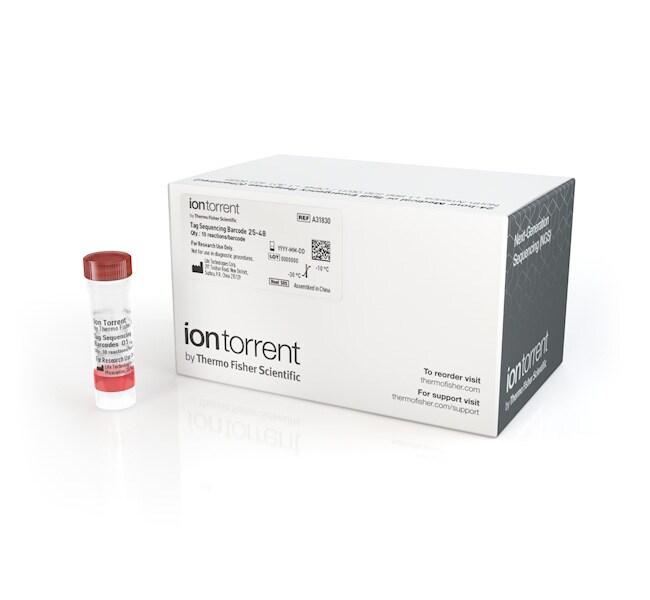
标记测序条形码集 25-48
标记测序条形码集 25-48
Ion Torrent™

标记测序条形码集 25-48

标记测序条形码集 25-48 提供了一组 24 个唯一的条形码适配体,专门设计用于在 Oncomine™ cfDNA 检测中提供极佳性能。这些条形码适配体兼容 Ion了解更多信息
Have Questions?
货号数量
A318471 套
货号 A31847
价格(CNY)
-
数量:
1 套
标记测序条形码集 25-48 提供了一组 24 个唯一的条形码适配体,专门设计用于在 Oncomine™ cfDNA 检测中提供极佳性能。这些条形码适配体兼容 Ion S5™、Ion PGM™ 和 Ion Proton™ 测序系统。当与采用标记测序技术的试剂盒联合使用时,该条形码集可让用户混合最多 24 个扩增子文库以及开展下一代测序 (NGS) 分析,减少每份样品的测序成本。

关键产品特性:
•使用强大的分子条形码,支持在单个测序芯片上对大量扩增子文库样品进行多通路分析
• 序列和流式经过优化,以便在池中平等显示所有条形码且以更经济的方式进行多通路测序运行
• 与采用标记测序技术的文库构建试剂盒兼容

采用条形码适配体的多通路操作可实现更高通量
采用条形码文库的多通路操作可实现每次运行多达 24 份样品(或更多样品,如果结合标记测序 BC 集 1-24,Cat.号 A31830),从而获得更具成本效益的运行,显著降低了测序的成本和处理要求。每个条形码经过单独测试以尽可能降低代表性偏倚。

序列和流式经过优化以提高性能和效率
条形码适配体包含经过优化的序列,以在引物池中平等显示所有条形码;其仅需极低数量的流量就能实现更经济的多通路测序运行。

仅供科研使用。不可用于诊断程序。
规格
产品类型寡核苷酸引物
数量1 套
运输条件干冰
引物定制引物
Unit SizeEach
内容与储存
各 10 μL 标记测序条形码 24 至 48,10 次反应/条形码

在冰柜(-5 至 -30°C)中储存。

常见问题解答 (FAQ)

For the Oncomine Lung Cell-Free Total Nucleic Acid Research Assay, what are the analysis workflows in Ion Reporter Software?

There are two analysis workflows available:

1. Oncomine TagSeq Lung v2 Liquid Biopsy - w2.0 - Single Sample: Detects and annotates low-frequency variants including SNPs/Indels (down to 0.1% limit of detection), Fusions, and CNVs from targeted nucleic acid libraries (DNA & RNA) from the Oncomine Lung Cell‑Free Total Nucleic Acid Research Assay. This is compatible with DNA & RNA purified from cell-free total nucleic acids.

2. Oncomine TagSeq Lung v2 Tumor - w2.0 - Single Sample: Detects and annotates low-frequency variants including SNPs/Indels (down to 0.5% limit of detection), fusions, and CNVs from targeted nucleic acid libraries (DNA & RNA) from the Oncomine Lung Cell-Free Total Nucleic Acid Research Assay. Due to deamination events caused by the FFPE process, the minimum alternative allele frequency is set to 0.3%. This makes it compatible with DNA & RNA purified from FFPE tumor tissue as well as fresh frozen tumor tissue.

Are there any BED files for the Oncomine Lung Cell-Free Total Nucleic Acid Research Assay?

Yes, there is a specific BED file and Hotspot file for the Oncomine Lung Cell-Free Total Nucleic Acid Research Assay. Please contact your local Field Application Specialist (FAS) or Clinical Application Consultant (CAC) to request the BED files.

What is the LOD (limit of detection) for the Oncomine Lung Cell-Free Total Nucleic Acid (cfNA) Research Assay?

Through the use of Tag Sequencing technology, low limits of detection (LOD) can be achieved for different variant types*:

- For SNVs/short indels, an LOD of 0.1% can be achieved with sensitivity of ˜90% and specificity of >99%
- For fusions & MET exon skipping, an LOD of 1% can be achieved with sensitivity of >90% and specificity of >99%
- For MET CNV target, detection as low as 1.2-fold amplification can be achieved with sensitivity of >90% and specificity of >99%

*Sensitivity and specificity for each variant type were determined using a collection of contrived positive samples and cfNA isolated from normal healthy donors.

Does the Oncomine Lung Cell-Free Total Nucleic Acid Research Assay use AmpliSeq technology?

No, this assay uses Tag Sequencing technology. Cell-free DNA (cfDNA) and cell-free RNA (cfRNA) are found at extremely low concentrations in the plasma fraction of whole blood. Because of this low prevalence, Taq Sequencing technology is utilized in this assay. The technology attaches unique molecular tags to the gene-specific primers. After amplification, the tagged molecules are grouped based on the tags. Groups containing the same mutant variant 80% of the time or greater will be called positive. Using the Tag technology, groups that contain random errors generated through the library construction/sequencing process are removed.

Which kit should I use to isolate cell-free total nucleic acid (cfNA) for the Oncomine Lung Cell-Free Total Nucleic Acid Research Assay?

Use cell-free total nucleic acid (cfNA) extracted using a method optimized for cfNA isolation from plasma. We recommend the MagMAX Cell Free Total Nucleic Acid Isolation Kit (Cat. No. A36716). You can expect 5-50 ng of cfDNA and 5-100 pg of cfRNA from 10 mL blood research sample collected in a K2 EDTA blood collection tube (Cat. No. ??)