Search

Applied Biosystems™
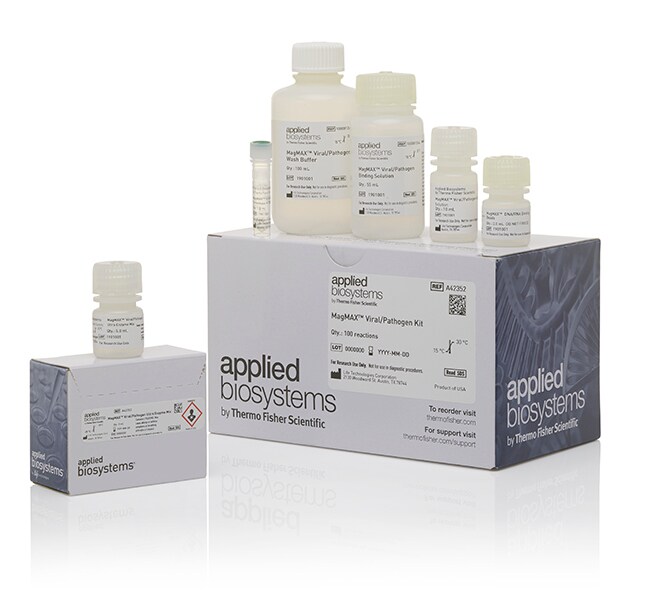
MagMAX™ 病毒/病原体 Ultra 核酸分离试剂盒
MagMAX 病毒/病原体 Ultra 核酸分离试剂盒包含与标准 MagMAX 病毒/病原体核酸分离试剂盒(货号 A42352)相同的试剂,因此,与该试剂盒一样,可回收病毒颗粒和革兰氏阴性细菌中的核酸。然而,MagMAX了解更多信息
| 货号 | 数量 |
|---|---|
| A42356 | 100 preps |
货号 A42356
价格(CNY)
2,893.00
飞享价
Ends: 31-Dec-2026
3,963.00共减 1,070.00 (27%)
Each
数量:
100 preps
价格(CNY)
2,893.00
飞享价
Ends: 31-Dec-2026
3,963.00共减 1,070.00 (27%)
Each
MagMAX 病毒/病原体 Ultra 核酸分离试剂盒包含与标准 MagMAX 病毒/病原体核酸分离试剂盒(货号 A42352)相同的试剂,因此,与该试剂盒一样,可回收病毒颗粒和革兰氏阴性细菌中的核酸。然而,MagMAX 病毒/病原体 Ultra 试剂盒也包括一种专有的酶混合物,可以裂解破壁较难的病原体(如革兰氏阳性菌、酵母菌和真菌)并回收核酸。MagMAX 病毒/病原体 Ultra 试剂盒采用与优化试剂结合使用的该酶混合物,可实现全面的病原体裂解以及 RNA 和 DNA 的回收。
该试剂盒采用 MagMAX 磁珠技术,可确保以可重现的方式回收与多种应用(包括实时荧光定量 PCR、数字 PCR 和下一代测序)兼容的高质量核酸。
MagMAX 病毒/病原体 Ultra 核酸分离试剂盒的特点包括:
•为 KingFisher Flex 和 KingFisher Duo Prime 系统设计的自动化预制方案
• 快速程序可在 60 分钟内处理 96 份样品
•灵活的方案可容纳 200 μL 至 2 mL 血液、尿液、拭子、灌洗液和各种转移培养基(如通用病毒转移培养基)和 ThinPrep 和 Eswab 防腐液的样品体积起始量
•与支气管肺泡灌洗液和其他呼吸系统样品兼容
•无需载体 RNA
•洗脱体积范围为 50 至 100 μL
96孔深孔或 24 孔深孔板形式的较大限度样品起始量
MagMAX 病毒/病原体 Ultra 试剂盒中包括的试剂和酶混合物可较大限度提高样品起始量,从而增加 RNA 和/或 DNA 从破壁较难病原体中的回收量。在 KingFisher 96 孔深孔板中,每孔可处理多达 400 μL 的样品。对于更大的样品量,可采用 KingFisher 24 孔深孔板,每孔可处理多达 2 mL 样品。
经验证可与 TaqMan 微生物群阵列板配合使用
确保核酸提取试剂盒将与下游应用配合使用,并从 Thermo Fisher Scientific 处获得完整的解决方案。
使用 MagMAX 病毒/病原体 Ultra 试剂盒提取的核酸经以下 TaqMan 微生物群检测试剂盒组检测:
•尿路微生物群
•呼吸道微生物群
•阴道微生物群
MagMAX 磁珠法纯化的优势
与其他分离核酸的技术相比,磁珠具备许多优势。与玻璃纤维过滤柱相比,磁珠可更高效地结合 DNA,从而获得更高且更一致的产量。此外,由于未使用过滤柱和真空歧管,不存在样品中的细胞颗粒堵塞过滤柱的风险。这种堵塞问题对于经常用于感染性疾病研究的富含蛋白的大量样品(如血浆)特别严重。
MagMAX 病毒/病原体 Ultra 核酸分离试剂盒中的 Dynabeads MyOne Silane 具有经过优化的类硅胶表面化学结构和高比表面积,可实现高效动力学和高灵敏度核酸捕获。上述特性使 Dynabeads MyOne Silane 成为回收体液中低浓度病毒 RNA 和 DNA 的理想选择。一旦捕获,这些核酸即可在低至 50 μL 洗脱缓冲液中洗脱,用于下游应用。
该试剂盒采用 MagMAX 磁珠技术,可确保以可重现的方式回收与多种应用(包括实时荧光定量 PCR、数字 PCR 和下一代测序)兼容的高质量核酸。
MagMAX 病毒/病原体 Ultra 核酸分离试剂盒的特点包括:
•为 KingFisher Flex 和 KingFisher Duo Prime 系统设计的自动化预制方案
• 快速程序可在 60 分钟内处理 96 份样品
•灵活的方案可容纳 200 μL 至 2 mL 血液、尿液、拭子、灌洗液和各种转移培养基(如通用病毒转移培养基)和 ThinPrep 和 Eswab 防腐液的样品体积起始量
•与支气管肺泡灌洗液和其他呼吸系统样品兼容
•无需载体 RNA
•洗脱体积范围为 50 至 100 μL
96孔深孔或 24 孔深孔板形式的较大限度样品起始量
MagMAX 病毒/病原体 Ultra 试剂盒中包括的试剂和酶混合物可较大限度提高样品起始量,从而增加 RNA 和/或 DNA 从破壁较难病原体中的回收量。在 KingFisher 96 孔深孔板中,每孔可处理多达 400 μL 的样品。对于更大的样品量,可采用 KingFisher 24 孔深孔板,每孔可处理多达 2 mL 样品。
经验证可与 TaqMan 微生物群阵列板配合使用
确保核酸提取试剂盒将与下游应用配合使用,并从 Thermo Fisher Scientific 处获得完整的解决方案。
使用 MagMAX 病毒/病原体 Ultra 试剂盒提取的核酸经以下 TaqMan 微生物群检测试剂盒组检测:
•尿路微生物群
•呼吸道微生物群
•阴道微生物群
MagMAX 磁珠法纯化的优势
与其他分离核酸的技术相比,磁珠具备许多优势。与玻璃纤维过滤柱相比,磁珠可更高效地结合 DNA,从而获得更高且更一致的产量。此外,由于未使用过滤柱和真空歧管,不存在样品中的细胞颗粒堵塞过滤柱的风险。这种堵塞问题对于经常用于感染性疾病研究的富含蛋白的大量样品(如血浆)特别严重。
MagMAX 病毒/病原体 Ultra 核酸分离试剂盒中的 Dynabeads MyOne Silane 具有经过优化的类硅胶表面化学结构和高比表面积,可实现高效动力学和高灵敏度核酸捕获。上述特性使 Dynabeads MyOne Silane 成为回收体液中低浓度病毒 RNA 和 DNA 的理想选择。一旦捕获,这些核酸即可在低至 50 μL 洗脱缓冲液中洗脱,用于下游应用。
仅供科研使用。不可用于诊断程序。
规格
产品线MagMAX
纯化时间60 min。
数量100 preps
运输条件经批准可在室温下或者干冰上运输
产品规格96孔深孔板, 24孔深孔板
Unit SizeEach
内容与储存
•55 mL 结合溶液(在室温下储存)
•100 mL 洗涤液(在室温下储存)
•10 mL 洗脱溶液(在室温下储存)
•1 mL 蛋白酶 K(在室温下储存)
•2 mL DNA/RNA 结合珠(在室温下储存)
• 5 mL 酶混合物(在 -5 至 -30°C 下储存)
•100 mL 洗涤液(在室温下储存)
•10 mL 洗脱溶液(在室温下储存)
•1 mL 蛋白酶 K(在室温下储存)
•2 mL DNA/RNA 结合珠(在室温下储存)
• 5 mL 酶混合物(在 -5 至 -30°C 下储存)