Search


引用和文献 (95)
Invitrogen™
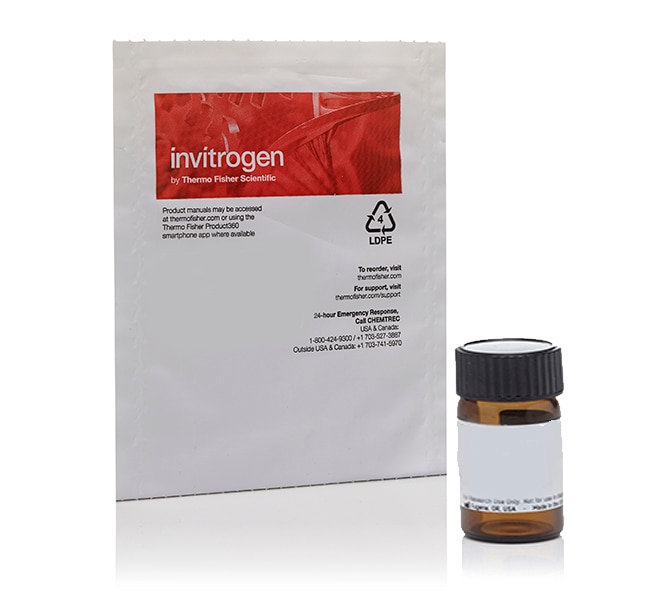
羧基-H2DCFDA(通用氧化应激指示剂)
6-羧基-2',7'-二氯二氢荧光素二乙酸酯是一种化学还原型、乙酰化形式的荧光素,可用作细胞中活性氧 (ROS) 的指示剂。这种非荧光分子在细胞内容易被酯酶分解和 ROS 氧化,使乙酸酯基团脱去,转化为绿色荧光形式。我们提供了在生理 pH 值环境下带两个负电荷的羧基化了解更多信息
| 货号 | 数量 |
|---|---|
| C400 | 25 mg |
货号 C400
价格(CNY)
4,888.00
Each
数量:
25 mg
价格(CNY)
4,888.00
Each
6-羧基-2',7'-二氯二氢荧光素二乙酸酯是一种化学还原型、乙酰化形式的荧光素,可用作细胞中活性氧 (ROS) 的指示剂。这种非荧光分子在细胞内容易被酯酶分解和 ROS 氧化,使乙酸酯基团脱去,转化为绿色荧光形式。我们提供了在生理 pH 值环境下带两个负电荷的羧基化 H2DCFDA 类似物(羧基-H2DCFDA,C400),以及其二(乙酰氧甲基酯) 形式 (C2938)。细胞内酯酶裂解乙酸酯和酯基团并氧化后,两种类似物均形成羧基二氯荧光素 (C368),并带有额外的负电荷,阻碍其渗出细胞。
ROS 指示剂质量标准:
• Ex/Em:∼492–495/517–527 nm
• 产品对空气敏感,应储存在干燥的氩气或氮气中
• 产品可溶于 DMSO、DMF 或乙醇中使用
• 指示剂可渗透细胞(细胞上样方案见文献)
• 可使用流式细胞仪、荧光计、微孔板读数仪或荧光显微镜(配有适用于荧光素的激发光源和滤光片)对荧光信号进行监测
查找更多 ROS 指示剂
我们提供了一系列 Molecular Probes™ 产品,用于生成活性氧簇 (ROS)(包括单线态氧、超氧化物、羟基自由基、多种过氧化物和过氧化氢)以及用于在溶液中进行相应荧光检测。有关这些产品的更多信息,请查阅 Molecular Probes™ 手册第 18.2 节—生成和检测活性氧。
供研究使用。不可用于人或动物的治疗或诊断。
ROS 指示剂质量标准:
• Ex/Em:∼492–495/517–527 nm
• 产品对空气敏感,应储存在干燥的氩气或氮气中
• 产品可溶于 DMSO、DMF 或乙醇中使用
• 指示剂可渗透细胞(细胞上样方案见文献)
• 可使用流式细胞仪、荧光计、微孔板读数仪或荧光显微镜(配有适用于荧光素的激发光源和滤光片)对荧光信号进行监测
查找更多 ROS 指示剂
我们提供了一系列 Molecular Probes™ 产品,用于生成活性氧簇 (ROS)(包括单线态氧、超氧化物、羟基自由基、多种过氧化物和过氧化氢)以及用于在溶液中进行相应荧光检测。有关这些产品的更多信息,请查阅 Molecular Probes™ 手册第 18.2 节—生成和检测活性氧。
供研究使用。不可用于人或动物的治疗或诊断。
仅供科研使用。不可用于诊断程序。
规格
数量25 mg
检测方法Fluorescence
产品类型ROS Indicator
Unit SizeEach
常见问题解答 (FAQ)
I want to assay cells for reactive oxygen species using carboxy-H2DCFDA, but I want to do so with a plate reader instead of microscope. Will it work?
I have GFP-transfected cells and need to label for reactive oxygen species. Can I use H2DCFDA?
I labeled my cell with CM-H2DCFDA for reactive oxygen detection, but upon illuminating the cell there is a significant increase in fluorescence in the control cells. Why?
I need a formaldehyde-fixable reactive oxygen species detection assay. Is H2 DCFDA fixable?
引用和文献 (95)
引用和文献
Abstract
N-acetylcysteine augments the cellular redox changes and cytotoxic activity of internalized mycobacterium bovis in human bladder cancer cells.
Journal:J Urol
PubMed ID:12131368
PURPOSE: We determined whether changes in cellular reactive oxygen species correlated with mycobacteria internalization and bladder cancer cell death. MATERIALS AND METHODS: Reactive oxygen species and thiols in RT112 and MGH bladder cancer cells were determined using the fluorescence probes 5-(and 6)-carboxy-2', 7' dichlorodihydrofluorescein diacetate and monobromobimane. Superoxide and nitrite
The sulphonylurea glibenclamide inhibits multidrug resistance protein (MRP1) activity in human lung cancer cells.
Journal:Br J Pharmacol
PubMed ID:11159731
'1. Glibenclamide, a sulphonylurea widely used for the treatment of non-insulin-dependent diabetes mellitus, has been shown to inhibit the activities of various ATP-binding cassette (ABC) transporters. In the present study, its effects towards multidrug resistance protein 1 (MRP1), an ABC efflux pump conferring multidrug resistance and handling organic anions, were
Characterization of Vta1p, a class E Vps protein in Saccharomyces cerevisiae.
Journal:J Biol Chem
PubMed ID:14701806
'We identified VTA1 in a screen for mutations that result in altered vacuole morphology. Deletion of VTA1 resulted in delayed trafficking of the lipophilic dye FM4-64 to the vacuole and altered vacuolar morphology when cells were exposed to the dye 5-(and 6)-carboxy-2'',7''-dichlorofluorescein diacetate (CDCFDA). Deletion of class E vacuolar protein
Mitochondrial localization of reactive oxygen species by dihydrofluorescein probes.
Journal:Histochem Cell Biol
PubMed ID:14574587
'Mitochondria are the main source of reactive oxygen species (ROS). The aim of this work was to verify the ROS generation in situ in HeLa cells exposed to prooxidants and antioxidants (menadione, tert-butyl hydroperoxide, antimycin A, vitamin E, N-acetyl-L-cysteine, and butylated hydroxytoluene) using the ROS-sensitive probes 6-carboxy-2'',7''-dichlorodihydrofluorescein diacetate di-acetomethyl ester
The use of fluorescent probes to assess oxidative processes in isolated-perfused rat heart tissue.
Journal:Free Radic Res Commun
PubMed ID:1505782
'The formation of reactive oxygen species (ROS) in intact heart tissue has been assessed by direct ESR measurements, and indirectly by the formation of characteristic tissue products and the protective effects of various antioxidants. The development of lipid soluble esters of compounds which can be trapped intracellularly after hydrolysis, and