Search


引用和文献 (12)
Invitrogen™
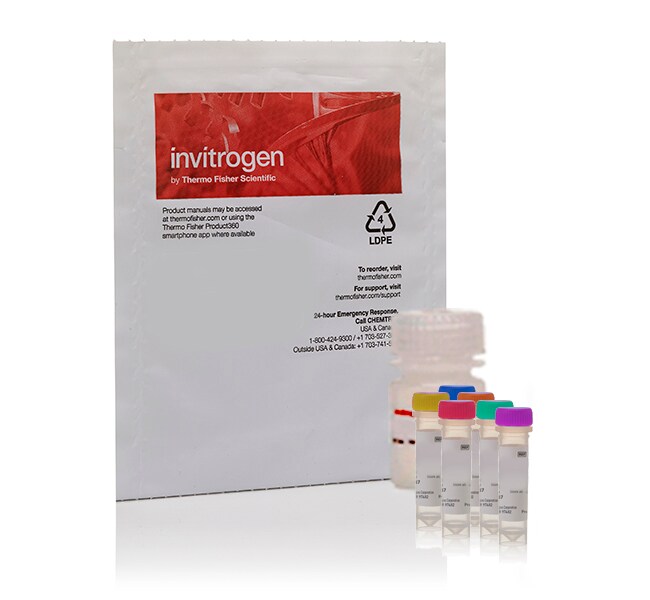
EnzChek™ 半胱天冬酶-3 活性检测试剂盒
使用 EnzChek 半胱天冬酶-3 活性检测试剂盒以及 Z-DEVD-AMC 底物或 Z-DEVD-R110 底物,检测细胞提取物和纯化酶制剂中的细胞凋亡情况。
Have Questions?
更改视图

| 货号 | 标签或染料 |
|---|---|
| E13184 | 罗丹明 110 |
| E13183 | AMC(7-氨基-4-甲基香豆素) |
货号 E13184
价格(CNY)
7,583.00
Each
标签或染料:
罗丹明 110
价格(CNY)
7,583.00
Each
使用 EnzChek 半胱天冬酶-3 活性检测试剂盒,能够简单可靠地检测半胱天冬酶-3 活性介导的细胞凋亡,该试剂盒利用了经过特殊设计的底物,这些底物经半胱天冬酶-3 酶切割后可发出荧光。EnzChek 半胱天冬酶-3 活性检测试剂盒可与 Z-DEVD-AMC 或 Z-DEVD-R110 底物一起使用,这些底物经半胱天冬酶 3/7 蛋白水解切割后产生明亮的荧光产物。
EnzChek 半胱天冬酶-3 活性检测试剂盒通过提供一种简单可靠的半胱天冬酶-3/7 活性检测方法来检测细胞凋亡情况。通过荧光计或荧光微孔板读数仪,该试剂盒可用于连续测定细胞提取物和纯化酶制剂中的半胱天冬酶-3/7 活性。
EnzChek 半胱天冬酶-3 活性检测试剂盒的主要特点包括:
• 使用标准荧光素 (FITC) 激发/发射设置进行荧光检测
• 使用该规格可连续测定细胞提取物中的半胱天冬酶-3/7 活性
• 含有荧光和酶对照品
EnzChek 半胱天冬酶-3 活性检测试剂盒中包含的氨基甲基香豆素 (AMC)-衍生底物(Z-天冬氨酸-谷氨酸-缬氨酸-天冬氨酸 (DEVD)-AMC)在紫外范围内会发出微弱荧光(最大激发/发射波长 ˜330/390 nm),蛋白水解后可产生明亮的蓝色荧光产物(最大激发/发射波长 ˜342/441 nm)。通过荧光计或荧光微孔板读数仪,该试剂盒可用于连续测定细胞提取物和纯化酶制剂中的半胱天冬酶-3 及密切相关的蛋白酶的活性。
EnzChek 半胱天冬酶-3 活性检测试剂盒中使用的罗丹明 110 衍生底物 (Z-DEVD-R110) 是一种非荧光双酰胺化合物,可在两步法过程中通过酶促切割转化为荧光单酰胺,然后再转化为具有更强荧光的 R110 产物。这两种水解产物的光谱特性与荧光素相似,峰值激发和发射波长分别为 496 nm 和 520 nm。
除底物外,EnzChek 半胱天冬酶活性检测试剂盒还含有可逆醛抑制剂 Ac-DEVD-CHO 以及一种 AMC 或 R110 参考标准品。Ac-DEVD-CHO 抑制剂证实,诱导细胞群和对照细胞群中的荧光信号均归因于半胱天冬酶-3/7 蛋白酶的活性。使用参考标准品可定量测定反应中释放的 AMC 或 R110 含量。
EnzChek 半胱天冬酶-3 活性检测试剂盒的主要特点包括:
• 使用标准荧光素 (FITC) 激发/发射设置进行荧光检测
• 使用该规格可连续测定细胞提取物中的半胱天冬酶-3/7 活性
• 含有荧光和酶对照品
EnzChek 半胱天冬酶-3 活性检测试剂盒中包含的氨基甲基香豆素 (AMC)-衍生底物(Z-天冬氨酸-谷氨酸-缬氨酸-天冬氨酸 (DEVD)-AMC)在紫外范围内会发出微弱荧光(最大激发/发射波长 ˜330/390 nm),蛋白水解后可产生明亮的蓝色荧光产物(最大激发/发射波长 ˜342/441 nm)。通过荧光计或荧光微孔板读数仪,该试剂盒可用于连续测定细胞提取物和纯化酶制剂中的半胱天冬酶-3 及密切相关的蛋白酶的活性。
EnzChek 半胱天冬酶-3 活性检测试剂盒中使用的罗丹明 110 衍生底物 (Z-DEVD-R110) 是一种非荧光双酰胺化合物,可在两步法过程中通过酶促切割转化为荧光单酰胺,然后再转化为具有更强荧光的 R110 产物。这两种水解产物的光谱特性与荧光素相似,峰值激发和发射波长分别为 496 nm 和 520 nm。
除底物外,EnzChek 半胱天冬酶活性检测试剂盒还含有可逆醛抑制剂 Ac-DEVD-CHO 以及一种 AMC 或 R110 参考标准品。Ac-DEVD-CHO 抑制剂证实,诱导细胞群和对照细胞群中的荧光信号均归因于半胱天冬酶-3/7 蛋白酶的活性。使用参考标准品可定量测定反应中释放的 AMC 或 R110 含量。
仅供科研使用。不可用于诊断程序。
规格
描述EnzChek 半胱天冬酶-3 检测试剂盒 #2,Z-DEVD-R110 底物
激发/发射496/520(切割底物)
适用于(应用)Apoptosis and Autophagy
适用于(设备)Fluorometer, Microplate Reader
标签类型其他标记或染料
标签或染料罗丹明 110
反应次数500 次检测(反应体积为 100 μL/检测)
产品线EnzChek
产品类型半胱天冬酶检测试剂盒
数量500 Assays
运输条件室温
检测方法荧光
发射波长范围520 nm
Excitation Wavelength Range496 nm
产品规格Cuvettes, 96-well Plate
Unit SizeEach
内容与储存
在冷冻冰箱(-5 至 -30°C)中避光储存。
常见问题解答 (FAQ)
Is the Z-DEVD-R110 substrate in the EnzChek Caspase-3 Assay Kit #2 cell permeable?
引用和文献 (12)
引用和文献
Abstract
Novel small molecule inhibitors of caspase-3 block cellular and biochemical features of apoptosis.
Journal:J Pharmacol Exp Ther
PubMed ID:12490620
'Caspase-3 is an intracellular cysteine protease, activated as part of the apoptotic response to cell injury. Its interest as a therapeutic target has led many to pursue the development of inhibitors. To date, only one series of nonpeptidic inhibitors have been described, and these have limited selectivity within the caspase
Role of the sphingosine rheostat in the regulation of cnidarian-dinoflagellate symbioses.
Journal:Biol Bull
PubMed ID:22186914
'The symbiosis between host cnidarians, such as corals and anemones, and their dinoflagellate symbionts is regulated by largely undescribed mechanisms that stabilize the symbiosis during normal conditions but lead to symbiosis breakdown, or cnidarian bleaching, during stress. Previous transcriptomic studies identified the sphingosine rheostat as a putative symbiosis regulatory pathway.
Fluorescent molecular probes V: a sensitive caspase-3 substrate for fluorometric assays.
Journal:Bioorg Med Chem Lett
PubMed ID:10576694
(Z-Asp-Glu-Val-Asp)-Rhodamine 110 [(Z-DEVD)2-Rh 110] was prepared and characterized as a sensitive fluorogenic substrate for the determination of caspase-3 activity.
Photodynamic therapy and cell death pathways.
Journal:Methods Mol Biol
PubMed ID:20552338
Photodynamic therapy (PDT) is the term used to describe the irradiation of photosensitized cells or tissue with phototoxic consequences. This process can result in the rapid initiation of not only apoptosis, an irreversible death pathway, but also autophagy. The procedures described here are designed to characterize the correlation between the
Rhodamine 110-linked amino acids and peptides as substrates to measure caspase activity upon apoptosis induction in intact cells.
Journal:Biochemistry
PubMed ID:10529236
Caspases (cysteine aspartate-specific proteases) are a structurally related group of cysteine proteases that cleave peptide bonds following specific recognition sequences. They play a central role in activating apoptosis of vertebrate cells. To measure apoptosis induced by various stimuli and at an early apoptotic stage, caspases are an ideal target. This