Search


引用和文献 (112)
Invitrogen™
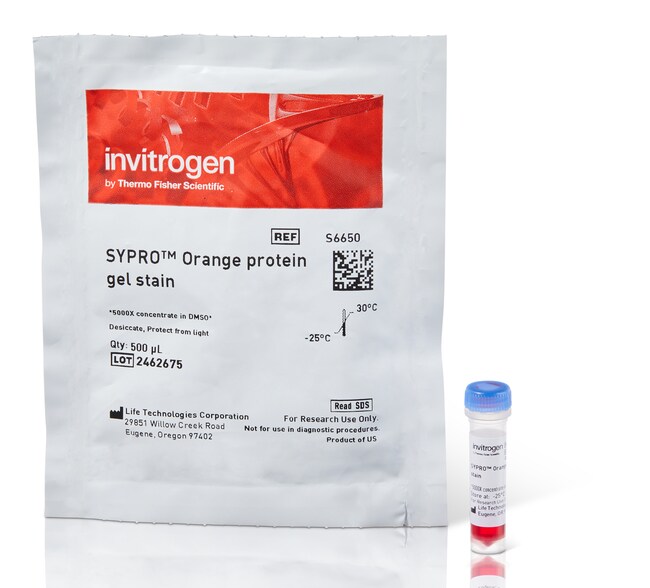
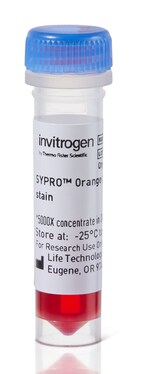
SYPRO™ Ruby 蛋白凝胶染色剂
SYPRO Ruby 蛋白凝胶染色剂是一种高度灵敏的即用型荧光染色剂,用于检测通过聚丙烯酰胺凝胶电泳 (PAGE) 分离的总蛋白。它非常适合在 1D 和 2D PAGE了解更多信息
Have Questions?
更改视图

| 货号 | 颜色 | 数量 |
|---|---|---|
| S6650 | Orange | 500 μL |
| S6651 | Orange | 10 x 50 μL |
| S12010 | Tangerine | 500 μL |
| S6653 | Red | 500 μL |
| S6654 又称 S-6654 | Red | 10 x 50 μL |
| S12001 | Ruby | 200 mL |
| S12000 | Ruby | 1 L |
| S21900 | Ruby | 5 L |
货号 S6650
价格(CNY)
4,136.00
Online exclusive
Ends: 31-Dec-2026
4,939.00共减 803.00 (16%)
Each
颜色:
Orange
数量:
500 μL
价格(CNY)
4,136.00
Online exclusive
Ends: 31-Dec-2026
4,939.00共减 803.00 (16%)
Each
SYPRO Ruby 蛋白凝胶染色剂是一种高度灵敏的即用型荧光染色剂,用于检测通过聚丙烯酰胺凝胶电泳 (PAGE) 分离的总蛋白。它非常适合在 1D 和 2D PAGE 中使用。SYPRO Ruby 凝胶染色剂的灵敏度可媲美或超过一流银染技术。染色蛋白可使用含有适当过滤器或激光的标准紫外线或蓝光透射仪或者成像设备进行观察。
特点:
•简单的染色程序—无需脱色或定时步骤
•三个数量级以上的线性定量范围
• 与质谱分析和微测序兼容
比较所有荧光染色剂 ›
特点:
•简单的染色程序—无需脱色或定时步骤
•三个数量级以上的线性定量范围
• 与质谱分析和微测序兼容
比较所有荧光染色剂 ›
仅供研究使用。
规格
最大浓度5000X,溶于 DMSO 中
检测定位凝胶内检测
检测方法荧光
激发/发射300,470/570 nm
数量500 μL
运输条件室温
靶标分子蛋白质
颜色Orange
标签或染料SYPRO Orange
产品线SYPRO
产品类型蛋白凝胶染色
Unit SizeEach
内容与储存
以溶于 DMSO 的 5000X 浓缩物形式提供。室温避光储存。
常见问题解答 (FAQ)
如果我将SYPRO Orange或SYPRO Red染色液的终浓度增加至1X以上,会增强染色蛋白质的信号吗?
经SYPRO Ruby、SYPRO Orange或SYPRO Red染色的凝胶能否干燥?
我能否使用SYPRO Orange蛋白质凝胶染料对Invitrogen凝胶进行染色?
我能否使用SYPRO Ruby、SYPRO Orange或SYPRO Red蛋白质凝胶染料对蛋白质进行预染,然后将蛋白质在凝胶上进行电泳?
If I increase the final concentration of my SYPRO Orange or SYPRO Red staining solution above 1X, can I increase the signal of my stained proteins?
引用和文献 (112)
引用和文献
Abstract
Translational regulation of prostaglandin endoperoxide H synthase-1 mRNA in megakaryocytic MEG-01 cells. Specific protein binding to a conserved 20-nucleotide CIS element in the 3'-untranslated region.
Journal:J Biol Chem
PubMed ID:12237309
Prostaglandin endoperoxide H synthase-1 (PGHS-1) is an abundant enzyme in platelets, where it plays a key role in the cascade of prostanoid formation. In platelets, the primary site of PGHS-1 synthesis is in precursor megakaryocytic cells. We have previously shown that in megakaryocytic MEG-01 cells, TPA induces an increase of
LXXLL-related motifs in Dax-1 have target specificity for the orphan nuclear receptors Ad4BP/SF-1 and LRH-1.
Journal:Mol Cell Biol
PubMed ID:12482977
The orphan receptor Ad4BP/SF-1 (NR5A1) is a constitutive activator, and its activity is repressed by another orphan receptor, Dax-1 (NR0B1). In the present study, we investigated the molecular mechanisms underlying this repression by Dax-1. Yeast two-hybrid and transient-transfection assays confirmed the necessity of three LXXLL-related motifs in Dax-1 for interaction
Type I collagen is thermally unstable at body temperature.
Journal:Proc Natl Acad Sci U S A
PubMed ID:11805290
Molecular characterization of Saccharomyces cerevisiae TFIID.
Journal:Mol Cell Biol
PubMed ID:12138208
'We previously defined Saccharomyces cerevisiae TFIID as a 15-subunit complex comprised of the TATA binding protein (TBP) and 14 distinct TBP-associated factors (TAFs). In this report we give a detailed biochemical characterization of this general transcription factor. We have shown that yeast TFIID efficiently mediates both basal and activator-dependent transcription
Mechanism of calcium-independent synaptotagmin binding to target SNAREs.
Journal:J Biol Chem
PubMed ID:12496268
'Synaptic vesicle exocytosis requires three SNARE (soluble N-ethylmaleimide-sensitive-factor attachment protein receptor) proteins: syntaxin and SNAP-25 on the plasma membrane (t-SNAREs) and synaptobrevin/VAMP on the synaptic vesicles (v-SNARE). Vesicular synaptotagmin 1 is essential for fast synchronous SNARE-mediated exocytosis and interacts with the SNAREs in brain material. To uncover the step at