Search

检测与定量抗SARS-CoV-2抗体 |
检测与定量抗SARS-CoV-2抗体
血清学检测通过分析血液(血清或血浆)中是否存在抗SARS-CoV-2抗体,帮助研究人员判断受试者是否曾感染新冠病毒(SARS-CoV-2)。抗体可检测性取决于个体免疫应答强度,并受病毒暴露剂量、症状出现后的检测时间窗、年龄、性别及健康状况等因素影响。赛默飞世尔科技(Thermo Fisher Scientific)提供高特异性与灵敏度的血清学检测方案,确保抗SARS-CoV-2抗体的精准可靠分析。

重症COVID-19患者的靶向多组学研究:从转录组到蛋白质组
加拿大西安大略大学的Douglas Fraser博士分享了利用ProcartaPlex Human Coronavirus Ig Total Panel(11因子检测面板)解析SARS-CoV-2免疫应答的研究案例。该研究通过检测重症监护室(ICU)患者入院第1、3、7及10天的血浆样本抗体水平,为制定COVID-19重症患者治疗策略提供依据。
SARS-CoV-2病毒概述
病原生物学特性
严重急性呼吸综合征冠状病毒2(SARS-CoV-2)是引发COVID-19大流行的病原体,属冠状病毒科。该病毒为包膜单链正义RNA病毒,基因组约30kb,包含编码4种结构蛋白的开放阅读框(ORFs):刺突蛋白(S)、包膜蛋白(E)、膜蛋白(M)和核衣壳蛋白(N),以及多种非结构蛋白。
解析SARS-CoV-2的病原生物学特性对开发诊断工具、疫苗及疗法至关重要。病毒通过表面刺突蛋白(S)与宿主细胞表面的血管紧张素转换酶2(ACE2)受体结合进入细胞。进入后,病毒RNA释放并作为复制与转录模板,组装新病毒颗粒并释放,导致感染扩散。
病毒复制机制与宿主细胞功能的复杂互作是研究难点——病毒通过劫持宿主细胞机制改变微环境以促进自身增殖。
宿主应答与细胞因子风暴
宿主对SARS-CoV-2感染的应答涉及广泛的信号互作网络,影响先天与适应性免疫反应,对疾病机制研究意义重大。感染可能引发细胞因子水平激增(即“细胞因子风暴”),被认为是急性呼吸窘迫综合征(ARDS)及多器官衰竭的主要诱因。细胞因子风暴(或细胞因子释放综合征,CRS)的特征是促炎因子网络失衡伴随抗炎反应不足,导致免疫稳态崩溃。
目前,SARS-CoV-2感染的治疗以支持性疗法为主,因ARDS导致的呼吸衰竭仍是主要死因[1]。最新研究表明,调控免疫介导的炎性细胞因子反应可能改善预后。重症患者的CRS常引发过度炎症、多器官衰竭甚至死亡。值得注意的是,个体免疫应答存在显著差异:部分患者因早期免疫防御较强,病情不易恶化。因此,解析先天与适应性免疫反应的细胞及生化差异,对理解无症状、轻症及重症CRS患者的病理机制至关重要[2, 3]。
了解更多 cytokine storms
SARS-CoV-2 ELISA serology assays
We provide a variety of SARS-CoV-2 ELISA kits to measure Ig antibodies, neutralization antibodies and viral-related proteins. Invitrogen ELISA kits for popular targets such as SARS-CoV-2 Spike (Trimer), RBD, Nucleocapsid etc. are listed in Table 1.
Learn more about ELISA kits and components
Popular SARS-CoV-2 protein targets and ELISA performance data
Table 1. View our ELISA kits for the following popular targets:
Ig ELISA for serum and plasma
The Human SARS-CoV-2 Spike (Trimer) Ig ELISA kits are designed to measure the amount of Ig antibodies bound to SARS-CoV-2 Spike (Trimer). A trimerized Spike protein is pre-coated in the wells of the supplied microplate. Samples and controls, including a high control that can be used as a standard, are then added into these wells and bind to the immobilized (capture) Spike protein. The wells are washed, and anti-Ig conjugated to HRP are added and will bind to any captured antibodies. The wells are washed, and a substrate solution is added that reacts with the enzyme complex to produce measurable signal. The intensity of this signal is directly proportional to the concentration of antibody present in the original specimen.
Invitrogen SARS-CoV-2 ELISA kits are highly specific and sensitive. Figure 1 shows the principle of Invitrogen Ig Antibody ELISA for SARS-CoV-2. To demonstrate the specificity and sensitivity of Ig ELISAs, we screened SARS-CoV-2 PCR (+) and PCR (–) samples using Human SARS-CoV-2 Spike (Trimer) Ig Total ELISA Kit (Figure 2) and compared the performance to other supplier’s SARS-CoV-2 ELISA (Figure 3).

Figure 1. The fundamental principle of Invitrogen Ig Antibody ELISA for SARS-CoV-2.

Click image to enlarge
Figure 2. Specificity and sensitivity of Ig ELISA assay. Human serum samples were screened with PCR and validated to minimize false positives. The Ig levels were measured in 39 PCR (+) and 160 PCR (–) (control) samples using Human SARS-CoV-2 Spike (Trimer) Ig Total ELISA Kit and calibrator cut-off level was calculated. All PCR (+) samples are above the calibrator (dotted line) while all PCR (–) are below the calibrator. Two PCR (+) samples in the lower graph showed low antibody levels and were confirmed negative using another serology assay (data not shown).

Click image to enlarge
Figure 3. Comparison of Invitrogen Human SARS-CoV-2 Spike Ig ELISA and competitor ELISA. The Ig levels were measured in PCR (+), healthy and control samples using Human SARS-CoV-2 Spike (Trimer) Ig Total ELISA Kit and other supplier’s ELISA that also measures Ig antibodies against Spike S1 subunit antigen. Borderline healthy control samples were also included. Data was compared and discrepancies were found in the competitor ELISA where a healthy sample showed a false positive and 3 PCR (+) samples showed negative or borderline (indicated with red arrows). Evidently, there was a better correlation to the expected PCR results with our Invitrogen ELISA.
Neutralizing antibody ELISA for serum and plasma
The SARS-CoV-2 Neutralizing Ab ELISA kit is designed to measure the neutralizing portion of anti-SARS-CoV-2 antibodies. A receptor binding domain (RBD) protein is pre-coated in the wells of the supplied microplate. Samples or the positive control are added into the wells. Neutralizing antibodies present in a sample that specifically bind to RBD will block any interaction with biotinylated ACE2 that is subsequently added. Signal from SA-HRP is indirectly proportional to the amount of specific neutralizing antibody present.
Figure 4 shows the principle of Invitrogen Neutralizing Antibody ELISA for SARS-CoV-2. To evaluate the assay specificity and sensitivity, SARS-CoV-2 PCR (+) and PCR (–) samples were analyzed using SARS-CoV-2 Neutralizing Ab ELISA Kit (Figure 5) and performance was compared against competitor ELISA (Figure 6).

Figure 4. The fundamental principle of Invitrogen Neutralizing Antibody ELISA for SARS-CoV-2.

Click image to enlarge
Figure 5. Specificity and sensitivity of Neutralization Ab ELISA assay. Human serum samples were screened with PCR and validated to minimize false positives. To establish a calibrator for cut-off level of 20% neutralization, ELISA was performed on 114 PCR (+) and 12 PCR (–) (control) samples using SARS-CoV-2 Neutralizing Ab ELISA Kit to determine whether all PCR (–) samples are below the calibrator cut-off level.

Click image to enlarge
Figure 6. Comparison of Invitrogen Human SARS-CoV-2 Neutralizing Ab ELISA and competitor ELISA. SARS-CoV-2 surrogate Virus Neutralization Test (sVNT) and conventional VNT were performed using SARS-CoV-2 Neutralizing Ab ELISA Kit and other supplier’s ELISA. Data shows a strong correlation (rs=0.949) of Invitrogen ELISA to competitor’s ELISA and Plaque Reduction Neutralization Test (PRNT).
SARS-CoV-2 multiplex serology assays
ProcartaPlex Ig Total (Up to 15-plex including variants)
The proteins that serve as primary antigens to stimulate an immune response producing IgA, IgM, and IgG antibodies during SARS-CoV-2 infection include the nucleocapsid (N), the spike (S) protein, and sub-regions of the spike protein such as the receptor binding domain (RBD) and the S1 regions. The Nucleocapsid (N) protein has the highest homology (90%) between SARS-CoV-1 and SARS-CoV-2 [4]. Serology test kits available during the early phase of the SARS-CoV-2 pandemic were developed to detect antibodies against the Nucleocapsid, which displayed significant cross-reactivity, and thus higher false positive readings for subjects exposed to SARS-CoV-1 [4]. The SARS-CoV spike (S) protein assembles into a trimerized structure to form a crown-like (hence corona) appearance and is composed of a S1 and S2 subunit. Within S1, the receptor binding domain (RBD), which is located in the C-terminal subdomain, has higher identity (74%) between SARS-CoV and SARS-CoV-2 than the N-terminal domain, consistent with the view that SARS-CoV-2 may use ACE2 as its receptor for entry into host cells like SARS-CoV [5]. The RBD has been identified as one of the immunodominant sites of the SARS-CoV-2 spike protein, with antibodies against the spike protein correlating well with neutralization. In addition, it is important to test serologic cross-reactivity with endemic and seasonal coronaviruses to rule out false-positive results.
The ProcartaPlex Human Coronavirus Ig Total Panel, 11plex enables screening of four SARS-CoV-2 antibodies, mainly Spike trimer, S1 subunit, RBD and Nucleocapsid (Figure 7), six coronavirus strains, viz., SARS-CoV-1, MERS and 4 common cold coronaviruses (CoV-NL63, CoV-KHU1, CoV-229E, CoV-OC43) (Figure 8), and one negative control in a single well using Luminex xMAP technology. The panel offers high correlation with SARS-CoV-2 PCR (+) and PCR (–) samples and specificity with no false positive results when tested with pre-pandemic samples (Figure 9).
In addition, four variants can be plexed with this 11-plex panel to create a 15-plex assay. The four variant proteins include the variants originating from the UK (B.1.1.7) α, South Africa (B.1.351) β, Brazil (P.1) γ, and the delta variant (B.1.617.2). Simultaneous detection of anti-SARS-CoV-2 antibodies and related coronavirus antibodies in one assay can save time to provide a complete, holistic data set using plasma or serum samples.

Click image to enlarge
Figure 7. Screening of human samples for SARS-CoV-2 antigens. Human serum samples from 39 Covid PCR (+) and 168 healthy PCR (–) (controls) were screened for four SARS-CoV-2 antigens, viz., Spike timer, S1, RBD and Nucleocapsid using ProcartaPlex Human Coronavirus Ig Total Panel, 11plex. Results indicate that the antibody levels for these four antigens corresponded to the expected results of high antibody levels for PCR (+) and low antibody levels for PCR (-) samples.

Click image to enlarge
Figure 8. Screening of human samples for common cold coronaviruses. Human serum samples from 39 Covid PCR (+) and 168 healthy PCR (–) (controls) were screened for four common cold coronaviruses, viz., CoV-NL63, CoV-HKU1, CoV-229E and CoV-OC43 using ProcartaPlex Human Coronavirus Ig Total Panel, 11plex. These results highlight the ability of this ProcartaPlex 11-plex panel to also assess the relevance of common cold coronaviruses within a single assay.

Click image to enlarge
Figure 9. Benchmark comparison of Invitrogen ProcartaPlex Human Coronavirus Ig 11-plex panel to competitors’ assays. Human serum samples from 110 healthy controls collected in 2016 and 2017 prior to the COVID-19 pandemic were screened. The Ig levels for four SARS-CoV-2 antigens, viz., Spike timer, S1, RBD and Nucleocapsid were measured using ProcartaPlex Human Coronavirus Ig Total Panel, 11plex and two different supplier’s kits. Data showed that all these control samples were below cutoff values for the 4 antigens in the panel indicating no false positives. While data from 12 of these samples were above the cutoff values in other suppliers’ assays indicating ~10% false positives (data not shown).
Neutralizing Antibody 6-plex Panel
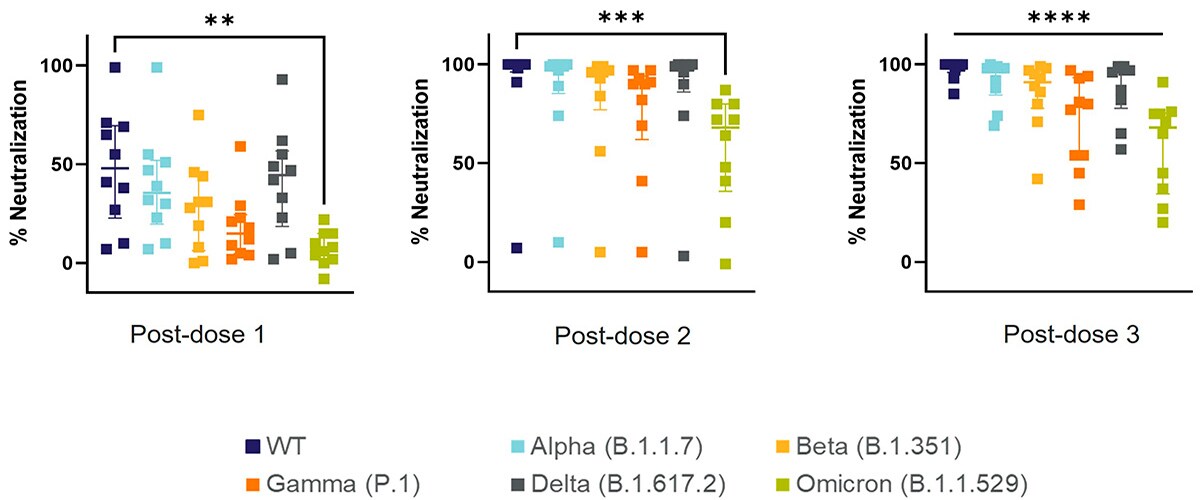
The ProcartaPlex Human SARS-CoV-2 Variants Neutralizing Antibody Panel, 6plex enables screening of six neutralizing anti-SARS-CoV-2 antibodies—original wild-type and five variants B.1.1.529 (o), B.1.617.2 (δ), P.1 (γ), B.1.351 (β), and B.1.1.7 (α) in a single well (Figure 10). This serological assay is designed with SARS-CoV-2 wild type or variant proteins conjugated to the bead. Samples or controls are added where neutralizing antibodies will bind to the proteins. This is a competitive assay where the detector antibody is a biotinylated ACE-2 that will bind to any unbound protein. Streptavidin-phycoerythrin (PE) is added and the signal is indirectly proportional to the amount of specific neutralizing antibody present. Negative controls will give the highest MFI values. Figure 11 shows screening of neutralizing antibodies against SARS-CoV-2 variants after vaccination.

Click image to enlarge
Figure 10. The fundamental principle of Invitrogen ProcartaPlex 6-plex Neutralizing Antibody panel for SARS-CoV-2.
Click image to enlarge
Figure 11. Screening of human samples for SARS-CoV-2 vaccine-induced neutralizing antibodies against SARS-CoV-2 variants. Human serum samples from SARS-CoV-2 vaccinated patients were collected after dose 1, 2 and 3. Six neutralizing antibodies against SARS-CoV-2 variants, viz., original wild-type (WT) and five variants—B.1.1.529 (o), B.1.617.2 (δ), P.1 (γ), B.1.351 (β), and B.1.1.7 (α) were measured in a single well using ProcartaPlex Human SARS-CoV-2 Variants Neutralizing Antibody Panel, 6plex
Omicron (B.1.1.529)
In addition to the Neutralizing Antibody 6-Plex panel, we also offer SARS-CoV-2 Spike Omicron (B.1.1.529) Neutralizing Antibody Human ProcartaPlex Simplex Kit. This assay enables the measurement of the neutralizing potential of antibodies towards the variant B.1.1.529 (o) in plasma and serum.
SARS-CoV-2病毒概述
病原生物学特性
严重急性呼吸综合征冠状病毒2(SARS-CoV-2)是引发COVID-19大流行的病原体,属冠状病毒科。该病毒为包膜单链正义RNA病毒,基因组约30kb,包含编码4种结构蛋白的开放阅读框(ORFs):刺突蛋白(S)、包膜蛋白(E)、膜蛋白(M)和核衣壳蛋白(N),以及多种非结构蛋白。
解析SARS-CoV-2的病原生物学特性对开发诊断工具、疫苗及疗法至关重要。病毒通过表面刺突蛋白(S)与宿主细胞表面的血管紧张素转换酶2(ACE2)受体结合进入细胞。进入后,病毒RNA释放并作为复制与转录模板,组装新病毒颗粒并释放,导致感染扩散。
病毒复制机制与宿主细胞功能的复杂互作是研究难点——病毒通过劫持宿主细胞机制改变微环境以促进自身增殖。
宿主应答与细胞因子风暴
宿主对SARS-CoV-2感染的应答涉及广泛的信号互作网络,影响先天与适应性免疫反应,对疾病机制研究意义重大。感染可能引发细胞因子水平激增(即“细胞因子风暴”),被认为是急性呼吸窘迫综合征(ARDS)及多器官衰竭的主要诱因。细胞因子风暴(或细胞因子释放综合征,CRS)的特征是促炎因子网络失衡伴随抗炎反应不足,导致免疫稳态崩溃。
目前,SARS-CoV-2感染的治疗以支持性疗法为主,因ARDS导致的呼吸衰竭仍是主要死因[1]。最新研究表明,调控免疫介导的炎性细胞因子反应可能改善预后。重症患者的CRS常引发过度炎症、多器官衰竭甚至死亡。值得注意的是,个体免疫应答存在显著差异:部分患者因早期免疫防御较强,病情不易恶化。因此,解析先天与适应性免疫反应的细胞及生化差异,对理解无症状、轻症及重症CRS患者的病理机制至关重要[2, 3]。
了解更多 cytokine storms
SARS-CoV-2 ELISA serology assays
We provide a variety of SARS-CoV-2 ELISA kits to measure Ig antibodies, neutralization antibodies and viral-related proteins. Invitrogen ELISA kits for popular targets such as SARS-CoV-2 Spike (Trimer), RBD, Nucleocapsid etc. are listed in Table 1.
Learn more about ELISA kits and components
Popular SARS-CoV-2 protein targets and ELISA performance data
Table 1. View our ELISA kits for the following popular targets:
Ig ELISA for serum and plasma
The Human SARS-CoV-2 Spike (Trimer) Ig ELISA kits are designed to measure the amount of Ig antibodies bound to SARS-CoV-2 Spike (Trimer). A trimerized Spike protein is pre-coated in the wells of the supplied microplate. Samples and controls, including a high control that can be used as a standard, are then added into these wells and bind to the immobilized (capture) Spike protein. The wells are washed, and anti-Ig conjugated to HRP are added and will bind to any captured antibodies. The wells are washed, and a substrate solution is added that reacts with the enzyme complex to produce measurable signal. The intensity of this signal is directly proportional to the concentration of antibody present in the original specimen.
Invitrogen SARS-CoV-2 ELISA kits are highly specific and sensitive. Figure 1 shows the principle of Invitrogen Ig Antibody ELISA for SARS-CoV-2. To demonstrate the specificity and sensitivity of Ig ELISAs, we screened SARS-CoV-2 PCR (+) and PCR (–) samples using Human SARS-CoV-2 Spike (Trimer) Ig Total ELISA Kit (Figure 2) and compared the performance to other supplier’s SARS-CoV-2 ELISA (Figure 3).
Figure 1. The fundamental principle of Invitrogen Ig Antibody ELISA for SARS-CoV-2.
Click image to enlarge
Figure 2. Specificity and sensitivity of Ig ELISA assay. Human serum samples were screened with PCR and validated to minimize false positives. The Ig levels were measured in 39 PCR (+) and 160 PCR (–) (control) samples using Human SARS-CoV-2 Spike (Trimer) Ig Total ELISA Kit and calibrator cut-off level was calculated. All PCR (+) samples are above the calibrator (dotted line) while all PCR (–) are below the calibrator. Two PCR (+) samples in the lower graph showed low antibody levels and were confirmed negative using another serology assay (data not shown).
Click image to enlarge
Figure 3. Comparison of Invitrogen Human SARS-CoV-2 Spike Ig ELISA and competitor ELISA. The Ig levels were measured in PCR (+), healthy and control samples using Human SARS-CoV-2 Spike (Trimer) Ig Total ELISA Kit and other supplier’s ELISA that also measures Ig antibodies against Spike S1 subunit antigen. Borderline healthy control samples were also included. Data was compared and discrepancies were found in the competitor ELISA where a healthy sample showed a false positive and 3 PCR (+) samples showed negative or borderline (indicated with red arrows). Evidently, there was a better correlation to the expected PCR results with our Invitrogen ELISA.
Neutralizing antibody ELISA for serum and plasma
The SARS-CoV-2 Neutralizing Ab ELISA kit is designed to measure the neutralizing portion of anti-SARS-CoV-2 antibodies. A receptor binding domain (RBD) protein is pre-coated in the wells of the supplied microplate. Samples or the positive control are added into the wells. Neutralizing antibodies present in a sample that specifically bind to RBD will block any interaction with biotinylated ACE2 that is subsequently added. Signal from SA-HRP is indirectly proportional to the amount of specific neutralizing antibody present.
Figure 4 shows the principle of Invitrogen Neutralizing Antibody ELISA for SARS-CoV-2. To evaluate the assay specificity and sensitivity, SARS-CoV-2 PCR (+) and PCR (–) samples were analyzed using SARS-CoV-2 Neutralizing Ab ELISA Kit (Figure 5) and performance was compared against competitor ELISA (Figure 6).
Figure 4. The fundamental principle of Invitrogen Neutralizing Antibody ELISA for SARS-CoV-2.
Click image to enlarge
Figure 5. Specificity and sensitivity of Neutralization Ab ELISA assay. Human serum samples were screened with PCR and validated to minimize false positives. To establish a calibrator for cut-off level of 20% neutralization, ELISA was performed on 114 PCR (+) and 12 PCR (–) (control) samples using SARS-CoV-2 Neutralizing Ab ELISA Kit to determine whether all PCR (–) samples are below the calibrator cut-off level.
Click image to enlarge
Figure 6. Comparison of Invitrogen Human SARS-CoV-2 Neutralizing Ab ELISA and competitor ELISA. SARS-CoV-2 surrogate Virus Neutralization Test (sVNT) and conventional VNT were performed using SARS-CoV-2 Neutralizing Ab ELISA Kit and other supplier’s ELISA. Data shows a strong correlation (rs=0.949) of Invitrogen ELISA to competitor’s ELISA and Plaque Reduction Neutralization Test (PRNT).
SARS-CoV-2 multiplex serology assays
ProcartaPlex Ig Total (Up to 15-plex including variants)
The proteins that serve as primary antigens to stimulate an immune response producing IgA, IgM, and IgG antibodies during SARS-CoV-2 infection include the nucleocapsid (N), the spike (S) protein, and sub-regions of the spike protein such as the receptor binding domain (RBD) and the S1 regions. The Nucleocapsid (N) protein has the highest homology (90%) between SARS-CoV-1 and SARS-CoV-2 [4]. Serology test kits available during the early phase of the SARS-CoV-2 pandemic were developed to detect antibodies against the Nucleocapsid, which displayed significant cross-reactivity, and thus higher false positive readings for subjects exposed to SARS-CoV-1 [4]. The SARS-CoV spike (S) protein assembles into a trimerized structure to form a crown-like (hence corona) appearance and is composed of a S1 and S2 subunit. Within S1, the receptor binding domain (RBD), which is located in the C-terminal subdomain, has higher identity (74%) between SARS-CoV and SARS-CoV-2 than the N-terminal domain, consistent with the view that SARS-CoV-2 may use ACE2 as its receptor for entry into host cells like SARS-CoV [5]. The RBD has been identified as one of the immunodominant sites of the SARS-CoV-2 spike protein, with antibodies against the spike protein correlating well with neutralization. In addition, it is important to test serologic cross-reactivity with endemic and seasonal coronaviruses to rule out false-positive results.
The ProcartaPlex Human Coronavirus Ig Total Panel, 11plex enables screening of four SARS-CoV-2 antibodies, mainly Spike trimer, S1 subunit, RBD and Nucleocapsid (Figure 7), six coronavirus strains, viz., SARS-CoV-1, MERS and 4 common cold coronaviruses (CoV-NL63, CoV-KHU1, CoV-229E, CoV-OC43) (Figure 8), and one negative control in a single well using Luminex xMAP technology. The panel offers high correlation with SARS-CoV-2 PCR (+) and PCR (–) samples and specificity with no false positive results when tested with pre-pandemic samples (Figure 9).
In addition, four variants can be plexed with this 11-plex panel to create a 15-plex assay. The four variant proteins include the variants originating from the UK (B.1.1.7) α, South Africa (B.1.351) β, Brazil (P.1) γ, and the delta variant (B.1.617.2). Simultaneous detection of anti-SARS-CoV-2 antibodies and related coronavirus antibodies in one assay can save time to provide a complete, holistic data set using plasma or serum samples.
Click image to enlarge
Figure 7. Screening of human samples for SARS-CoV-2 antigens. Human serum samples from 39 Covid PCR (+) and 168 healthy PCR (–) (controls) were screened for four SARS-CoV-2 antigens, viz., Spike timer, S1, RBD and Nucleocapsid using ProcartaPlex Human Coronavirus Ig Total Panel, 11plex. Results indicate that the antibody levels for these four antigens corresponded to the expected results of high antibody levels for PCR (+) and low antibody levels for PCR (-) samples.
Click image to enlarge
Figure 8. Screening of human samples for common cold coronaviruses. Human serum samples from 39 Covid PCR (+) and 168 healthy PCR (–) (controls) were screened for four common cold coronaviruses, viz., CoV-NL63, CoV-HKU1, CoV-229E and CoV-OC43 using ProcartaPlex Human Coronavirus Ig Total Panel, 11plex. These results highlight the ability of this ProcartaPlex 11-plex panel to also assess the relevance of common cold coronaviruses within a single assay.
Click image to enlarge
Figure 9. Benchmark comparison of Invitrogen ProcartaPlex Human Coronavirus Ig 11-plex panel to competitors’ assays. Human serum samples from 110 healthy controls collected in 2016 and 2017 prior to the COVID-19 pandemic were screened. The Ig levels for four SARS-CoV-2 antigens, viz., Spike timer, S1, RBD and Nucleocapsid were measured using ProcartaPlex Human Coronavirus Ig Total Panel, 11plex and two different supplier’s kits. Data showed that all these control samples were below cutoff values for the 4 antigens in the panel indicating no false positives. While data from 12 of these samples were above the cutoff values in other suppliers’ assays indicating ~10% false positives (data not shown).
Neutralizing Antibody 6-plex Panel
The ProcartaPlex Human SARS-CoV-2 Variants Neutralizing Antibody Panel, 6plex enables screening of six neutralizing anti-SARS-CoV-2 antibodies—original wild-type and five variants B.1.1.529 (o), B.1.617.2 (δ), P.1 (γ), B.1.351 (β), and B.1.1.7 (α) in a single well (Figure 10). This serological assay is designed with SARS-CoV-2 wild type or variant proteins conjugated to the bead. Samples or controls are added where neutralizing antibodies will bind to the proteins. This is a competitive assay where the detector antibody is a biotinylated ACE-2 that will bind to any unbound protein. Streptavidin-phycoerythrin (PE) is added and the signal is indirectly proportional to the amount of specific neutralizing antibody present. Negative controls will give the highest MFI values. Figure 11 shows screening of neutralizing antibodies against SARS-CoV-2 variants after vaccination.
Click image to enlarge
Figure 10. The fundamental principle of Invitrogen ProcartaPlex 6-plex Neutralizing Antibody panel for SARS-CoV-2.
Click image to enlarge
Figure 11. Screening of human samples for SARS-CoV-2 vaccine-induced neutralizing antibodies against SARS-CoV-2 variants. Human serum samples from SARS-CoV-2 vaccinated patients were collected after dose 1, 2 and 3. Six neutralizing antibodies against SARS-CoV-2 variants, viz., original wild-type (WT) and five variants—B.1.1.529 (o), B.1.617.2 (δ), P.1 (γ), B.1.351 (β), and B.1.1.7 (α) were measured in a single well using ProcartaPlex Human SARS-CoV-2 Variants Neutralizing Antibody Panel, 6plex
Omicron (B.1.1.529)
In addition to the Neutralizing Antibody 6-Plex panel, we also offer SARS-CoV-2 Spike Omicron (B.1.1.529) Neutralizing Antibody Human ProcartaPlex Simplex Kit. This assay enables the measurement of the neutralizing potential of antibodies towards the variant B.1.1.529 (o) in plasma and serum.
更多SARS-CoV-2 免疫资源


参考文献
- Mehta P., McAuley D.F., Brown M., et. Al. COVID-19: consider cytokine storm syndromes and immunosuppression. Lancet, 2020. 395(10229): 1033-1034.
- Huang C., Wang Y., Li X., et. al. Clinical features of patients infected with 2019 novel coronavirus in Wuhan, China. Lancet, 2020. 395(10223): 497-506.
- Wang D, Hu B, Hu C, Zhu F, Liu X, Zhang J, Wang B, Xiang H, Cheng Z, Xiong Y, Zhao Y, Li Y, Wang X, Peng Z. Clinical Characteristics of 138 Hospitalized Patients With 2019 Novel Coronavirus-Infected Pneumonia in Wuhan, China. JAM,. 2020. 323(11): 1061-1069.
- Okba N.M.A., Müller M.A., Li W., et. al. Severe Acute Respiratory Syndrome Coronavirus 2-Specific Antibody Responses in Coronavirus Disease Patients. Emerg Infect Dis, 2020. 26(7): 1478-1488.
- Jaimes J.A., André N.M., Chappie J.S., et. al. Phylogenetic Analysis and Structural Modeling of SARS-CoV-2 Spike Protein Reveals an Evolutionary Distinct and Proteolytically Sensitive Activation Loop. J Mol Biol, 2020. 432(10): 3309-3325.
仅供科研使用,不可用于诊断目的。
Stylesheet for Classic Wide Template adjustments
Hero banner dark gradient overlay