Search


引用和文献 (7)
Thermo Scientific™
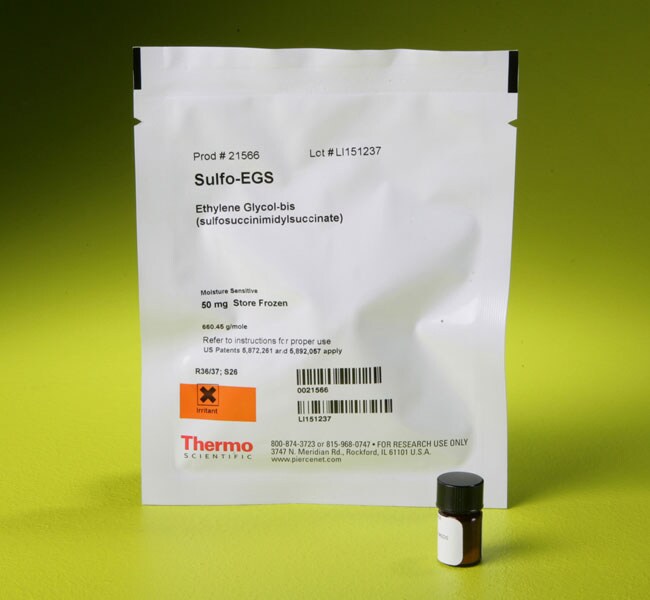
Sulfo--EGS(乙二醇双(磺基琥珀酰亚胺琥珀酸酯))
Thermo Scientific Pierce Sulfo-EGS 是一种水溶性交联剂,含有位于 12 原子间隔臂周围的胺反应性 sulfo-NHS 酯末端,其可通过在 pH了解更多信息
| 货号 | 数量 |
|---|---|
| 21566 | 50 mg |
货号 21566
价格(CNY)
3,529.00
Each
数量:
50 mg
价格(CNY)
3,529.00
Each
Thermo Scientific Pierce Sulfo-EGS 是一种水溶性交联剂,含有位于 12 原子间隔臂周围的胺反应性 sulfo-NHS 酯末端,其可通过在 pH 值 8.5 时使用羟胺处理进行裂解。
Sulfo-EGS 的特点:
•反应性基团:sulfo-NHS 酯(两端)
•可与以下基团发生反应:氨基(伯胺)
•水溶性;与 EGS 具有可比性
•膜不渗透性,可进行细胞表面标记
•在 pH 值为 8.5 时于 37°C 下使用羟胺处理持续 3 至 6 小时,形成的交联是可逆的
•乳糖脱氢酶在与 EGS 可逆交联后保持 60% 的活性
产品参考:
交联剂应用指南 - 检索本产品的最新参考文献
相关产品
Sulfo-EGS(乙二醇双(磺基琥珀酰亚胺琥珀酸酯))
Sulfo-EGS 的特点:
•反应性基团:sulfo-NHS 酯(两端)
•可与以下基团发生反应:氨基(伯胺)
•水溶性;与 EGS 具有可比性
•膜不渗透性,可进行细胞表面标记
•在 pH 值为 8.5 时于 37°C 下使用羟胺处理持续 3 至 6 小时,形成的交联是可逆的
•乳糖脱氢酶在与 EGS 可逆交联后保持 60% 的活性
产品参考:
交联剂应用指南 - 检索本产品的最新参考文献
相关产品
Sulfo-EGS(乙二醇双(磺基琥珀酰亚胺琥珀酸酯))
仅供科研使用。不可用于诊断程序。
规格
细胞渗透性否
描述Sulfo-EGS
形式粉末
标记方法化学标记
分子量660.45
聚乙二醇化否
产品线Pierce
数量50 mg
反应一部分Sulfo-NHS 酯
运输条件环境
溶解度水
间隔臂长16.1 Å
水溶性是
化学反应性胺-胺
可裂解通过羟胺
交联剂类型同型双功能团试剂
产品规格标准
产品类型交联剂
间隔子中等(10 至 30 Å)
Unit SizeEach
内容与储存
接收后在 -20°C 下干燥储存。
常见问题解答 (FAQ)
Can you provide the shelf-life for Sulfo-EGS (ethylene glycol bis(sulfosuccinimidyl succinate))?
引用和文献 (7)
引用和文献
Abstract
Role of TRIM5a RING domain E3 ubiquitin ligase activity in capsid disassembly, reverse transcription blockade, and restriction of simian immunodeficiency virus.
Journal:J Virol
PubMed ID:21680520
'The mammalian tripartite motif protein, TRIM5a, recognizes retroviral capsids entering the cytoplasm and blocks virus infection. Depending on the particular TRIM5a protein and retrovirus, complete disruption of the TRIM5a RING domain decreases virus-restricting activity to various degrees. TRIM5a exhibits RING domain-dependent E3 ubiquitin ligase activity, but the specific role of
A novel C-terminal mutation resulting in constitutive activation of the Listeria monocytogenes central virulence regulatory factor PrfA.
Journal:Microbiology
PubMed ID:21835879
'The environmental bacterium Listeria monocytogenes survives and replicates in a variety of diverse ecological niches that range from the soil to the cytosol of infected mammalian cells. The ability of L. monocytogenes to replicate within an infected host requires the expression of a number of secreted bacterial gene products whose
Raf kinase inhibitor protein (RKIP) dimer formation controls its target switch from Raf1 to G protein-coupled receptor kinase (GRK) 2.
Journal:J Biol Chem
PubMed ID:22610096
'Proteins controlling cellular networks have evolved distinct mechanisms to ensure specificity in protein-protein interactions. Raf kinase inhibitor protein (RKIP) is a multifaceted kinase modulator, but it is not well understood how this small protein (21 kDa) can coordinate its diverse signaling functions. Raf1 and G protein-coupled receptor kinase (GRK) 2
Syk-dependent phosphorylation of CLEC-2: a novel mechanism of hem-immunoreceptor tyrosine-based activation motif signaling.
Journal:J Biol Chem
PubMed ID:21098033
The C-type lectin-like receptor CLEC-2 signals via phosphorylation of a single cytoplasmic YXXL sequence known as a hem-immunoreceptor tyrosine-based activation motif (hemITAM). In this study, we show that phosphorylation of CLEC-2 by the snake toxin rhodocytin is abolished in the absence of the tyrosine kinase Syk but is not altered
Structural basis of molecular recognition of the Leishmania small hydrophilic endoplasmic reticulum-associated protein (SHERP) at membrane surfaces.
Journal:J Biol Chem
PubMed ID:21106528
The 57-residue small hydrophilic endoplasmic reticulum-associated protein (SHERP) shows highly specific, stage-regulated expression in the non-replicative vector-transmitted stages of the kinetoplastid parasite, Leishmania major, the causative agent of human cutaneous leishmaniasis. Previous studies have demonstrated that SHERP localizes as a peripheral membrane protein on the cytosolic face of the endoplasmic