Search


引用和文献 (3)
Thermo Scientific™
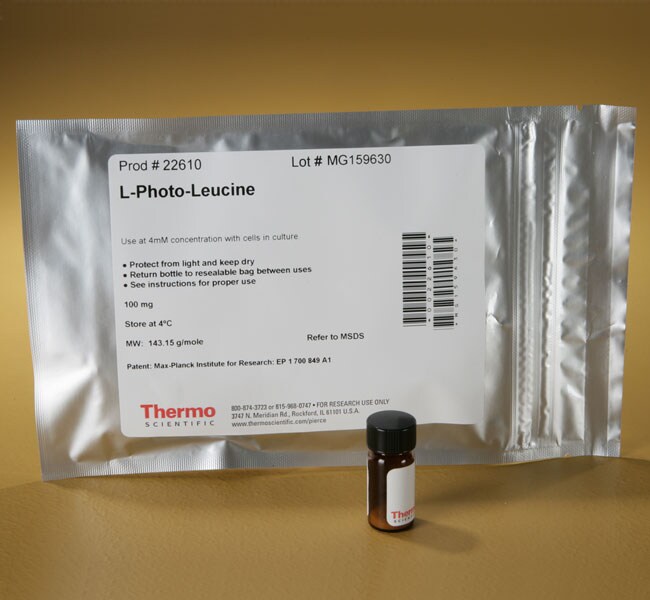
L-光反应-亮氨酸
Thermo Scientific Pierce L-Photo-Leucine is an analog of L-leucine that can be incorporated into proteins during synthesis and then light-activated了解更多信息
| 货号 | 数量 |
|---|---|
| 22610 | 100 mg |
货号 22610
价格(CNY)
6,343.00
Each
数量:
100 mg
价格(CNY)
6,343.00
Each
Thermo Scientific Pierce L-Photo-Leucine is an analog of L-leucine that can be incorporated into proteins during synthesis and then light-activated to covalently crosslink interacting proteins in cells.
Features of L-Photo-Leucine:
• In vivo labeling—incorporate photo-reactive group into proteins using normal cellular machinery of live cells
• In vivo crosslinking—find interacting proteins in the native cellular environment
• Increased specificity—crosslink interacting proteins correctly positioned at their interfaces within protein interaction domains
• Efficient recovery—90% protein recovery in cell lysates after crosslinking
• Compatible—crosslink proteins expressed in a wide variety of cell lines, including HeLa, 293T, COS7, U2OS, A549, A431, HepG2, NIH 3T3 and C6
• Easy to use—reagents are photo-stable under normal laboratory lighting, eliminating the need to work in the dark
Thermo Scientific L-Photo-Leucine is an analog of L-leucine that can be endogenously incorporated into the primary sequence of proteins during synthesis and then ultraviolet light (UV)-activated to covalently crosslink proteins within protein-protein interaction domains in their native environment within live cells. The powerful method enables both stable and transient protein interactions in cells to be studied and characterized without the use of completely foreign chemical crosslinkers and associated reagent solvents during the interaction experiment that can adversely aspects of the cell biology being studied.
When used in combination with specially formulated limiting media that is devoid of leucine, the photo-activatable derivative is treated like a naturally occurring amino acid by the protein synthesis machinery within the cell. As a result, it can be substituted for leucine in the primary sequence of proteins during catabolism and growth. Photo-leucine derivatives contain diazirine rings that activate when exposed to UV light to become reactive intermediates that form covalent bonds with nearby protein side chains and backbones. Naturally associating binding partners within the cell can be instantly trapped by photoactivation of the diazirine-containing proteins in the cultured cells. Crosslinked protein complexes can be detected by decreased mobility on SDS-PAGE followed by western blot detection, size exclusion chromatography, sucrose density gradient sedimentation or mass spectrometry.
Resources:
Photoreactive Amino Acid FAQ
Related Products
L-Photo-Methionine
Dulbecco's Modified Eagle's Limiting Medium (DMEM-LM)
Features of L-Photo-Leucine:
• In vivo labeling—incorporate photo-reactive group into proteins using normal cellular machinery of live cells
• In vivo crosslinking—find interacting proteins in the native cellular environment
• Increased specificity—crosslink interacting proteins correctly positioned at their interfaces within protein interaction domains
• Efficient recovery—90% protein recovery in cell lysates after crosslinking
• Compatible—crosslink proteins expressed in a wide variety of cell lines, including HeLa, 293T, COS7, U2OS, A549, A431, HepG2, NIH 3T3 and C6
• Easy to use—reagents are photo-stable under normal laboratory lighting, eliminating the need to work in the dark
Thermo Scientific L-Photo-Leucine is an analog of L-leucine that can be endogenously incorporated into the primary sequence of proteins during synthesis and then ultraviolet light (UV)-activated to covalently crosslink proteins within protein-protein interaction domains in their native environment within live cells. The powerful method enables both stable and transient protein interactions in cells to be studied and characterized without the use of completely foreign chemical crosslinkers and associated reagent solvents during the interaction experiment that can adversely aspects of the cell biology being studied.
When used in combination with specially formulated limiting media that is devoid of leucine, the photo-activatable derivative is treated like a naturally occurring amino acid by the protein synthesis machinery within the cell. As a result, it can be substituted for leucine in the primary sequence of proteins during catabolism and growth. Photo-leucine derivatives contain diazirine rings that activate when exposed to UV light to become reactive intermediates that form covalent bonds with nearby protein side chains and backbones. Naturally associating binding partners within the cell can be instantly trapped by photoactivation of the diazirine-containing proteins in the cultured cells. Crosslinked protein complexes can be detected by decreased mobility on SDS-PAGE followed by western blot detection, size exclusion chromatography, sucrose density gradient sedimentation or mass spectrometry.
Resources:
Photoreactive Amino Acid FAQ
Related Products
L-Photo-Methionine
Dulbecco's Modified Eagle's Limiting Medium (DMEM-LM)
仅供科研使用。不可用于诊断程序。
规格
细胞渗透性是
描述L-光反应-亮氨酸
形式实心
标记方法化学标记、代谢标记
分子量143.15
聚乙二醇化否
产品线Pierce
数量100 mg
反应一部分双吖丙啶
运输条件环境
溶解度水
间隔臂长0.0 Å
水溶性是
化学反应性非选择性-NA (代谢标记)
可裂解否
交联剂类型异型双功能团试剂
产品规格标准
产品类型交联剂
间隔子短 (<10 Å)
Unit SizeEach
内容与储存
接收后,在 4°C 下避光储存。
常见问题解答 (FAQ)
Apart from proteins, will the Photoreactive Amino Acids crosslink to other molecules?
How stable are the Photoreactive Amino Acids in DMEM-LM?
How long do I need to incubate the Photoreactive Amino Acids with my cells?
My cells will not grow in DMEM, what other type of culture media can be used with the Photoreactive Amino Acids?
Can I use the Photoreactive Amino Acids to crosslink peptides?
引用和文献 (3)
引用和文献
Abstract
Mass spectrometry of laser-initiated carbene reactions for protein topographic analysis.
Journal:Anal Chem
PubMed ID:21425771
'We report a protein labeling method using nonselective carbene reactions of sufficiently high efficiency to permit detection by mass spectrometric methods. The approach uses a diazirine-modified amino acid (l-2-amino-4,4''-azipentanoic acid, "photoleucine") as a label source, which is converted to a highly reactive carbene by pulsed laser photolysis at 355 nm.
The copper binding domain of SPARC mediates cell survival in vitro via interaction with integrin beta1 and activation of integrin-linked kinase.
Journal:J Biol Chem
PubMed ID:18503049
'Secreted protein acidic and rich in cysteine (SPARC) is important for the normal growth and maintenance of the murine lens. SPARC-null animals develop cataracts associated with a derangement of the lens capsule basement membrane and alterations in lens fiber morphology. Cellular stress and disregulation of apoptotic pathways within lens epithelial
Inhibition of calcineurin-mediated endocytosis and alpha-amino-3-hydroxy-5-methyl-4-isoxazolepropionic acid (AMPA) receptors prevents amyloid beta oligomer-induced synaptic disruption.
Journal:J Biol Chem
PubMed ID:20032460
Synaptic degeneration, including impairment of synaptic plasticity and loss of synapses, is an important feature of Alzheimer disease pathogenesis. Increasing evidence suggests that these degenerative synaptic changes are associated with an accumulation of soluble oligomeric assemblies of amyloid beta (Abeta) known as ADDLs. In primary hippocampal cultures ADDLs bind to