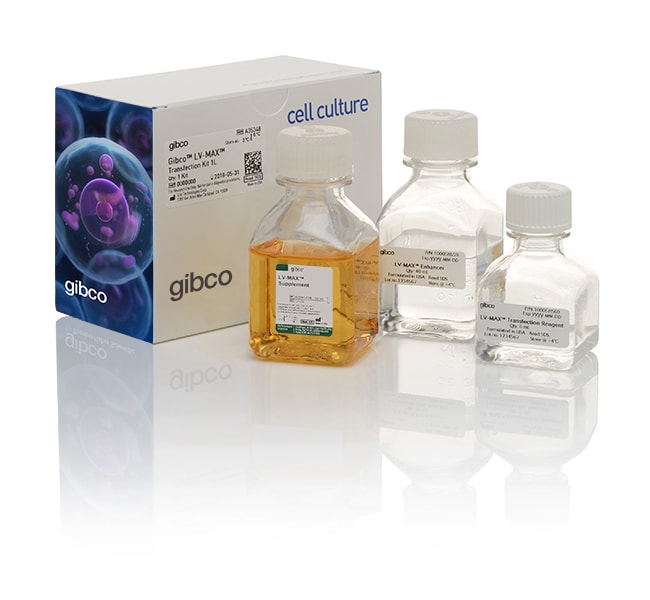
LV-MAX™ Transfection Kit
Invitrogen17万+抗体限时买二赠一,靶点广,灵活用!
LV-MAX™ Transfection Kit
Gibco™

LV-MAX™ Transfection Kit

TheLV- MAX Transfection Kit is an essential component of the LV-MAX Lentiviral Production System.
Have Questions?
Catalog NumberQuantity
A353481 L
Catalog number A35348
Price (CNY)
17,183.00
Online Exclusive
Ends: 31-Dec-2025
24,010.00
Save 6,827.00 (28%)
Each
Add to cart
Quantity:
1 L
Price (CNY)
17,183.00
Online Exclusive
Ends: 31-Dec-2025
24,010.00
Save 6,827.00 (28%)
Each
Add to cart

The Gibco LV-MAX Transfection Kit is a vital component of the LV-MAX Lentiviral Production System, specifically designed for the transient transfection of high-density suspension-adapted Viral Production Cells (human embryonic kidney (HEK) 293-derived cells). This kit is designed to maximize lentiviral particle production, ensuring high yields and reproducibility.

Key features of the LV-MAX Transfection Kit

  • High LV yields—achieves functional titers up to 1 x 10⁸ TU/mL (unconcentrated)
  • High-density growth—supports growth of Viral Production Cells at densities greater than 1 x 10⁷ cells/mL for maximum vector output
  • AOF formulation—chemically defined, serum-free, and animal-origin-free medium ensures consistent performance by eliminating variability from undefined components
  • Ready-to-use—no media supplementation required; simplifies workflows and provides reliable, lot-to-lot reproducibility in lentivirus production
  • Expression system compatible—fully compatible with the LV-MAX Lentiviral Production System for seamless integration into end-to-end lentivirus manufacturing processes
  • Scalable and reproducible transfection and production—validated from 96–well plates to multi‐liter bioreactors, enabling easy scale-up without sacrificing cell yields.
  • Easy and robust culture and transfection protocols, seamlessly integrating into any transient production workflow

Kit components

  • LV-MAX Transfection Reagent—a high-efficiency, cationic, lipid-based reagent uniquely formulated for co-transfecting multiple plasmids into high-density Viral Production Cell cultures. This reagent ensures high transfection efficiency with minimal toxicity.
  • LV-MAX Supplement—an optimized, chemically defined, serum-free, protein-free, animal origin-free formulation designed to suppress cell growth during transfection. It enhances lentiviral vector production without compromising cell viability or interfering with the production process.
  • LV-MAX Enhancer—a proprietary, animal origin-free formulation that significantly boosts lentiviral vector production

The LV-MAX Transfection Kit is designed to deliver superior performance in lentiviral production workflows, providing researchers with reliable and scalable transfection solutions.

Applications

  • Gene therapy—ideal for the production of lentiviral vectors for gene therapy research and development
  • Cell therapy—supports the generation of lentiviral vectors for cell therapy applications, facilitating seamless transition from bench to clinic
  • Research and development—provides a reliable and scalable solution for viral vector production in various research settings

Available in RUO or CTS

Offered as both a Research Use Only version and a GMP-compliant Cell Therapy Systems (CTS) version (Cat. No. A4132602) to support translational and clinical-scale applications.

For Research Use Only. Not for use in diagnostic procedures.
Specifications
Cell LineEstablished Cell Lines
ClassificationAnimal Origin-Free, Chemically Defined, Protein-Free, Serum-Free
For Use With (Application)Transfection
Product LineLV-MAX™
Product TypeTransfection Kit
Quantity1 L
Serum CompatibleYes
Shipping ConditionWet Ice
Cell Type293-derived Cells
Sample TypePlasmid DNA
Transfection TechniqueLipid-based Transfection
Unit SizeEach
Contents & Storage
• 50 mL LV-MAX Supplement
• 6 mL LV-MAX Transfection Reagent
• 40 mL LV-MAX Enhancer

Sufficient for 1 L LV production 

Store at 2–8°C, protect from light.

Frequently asked questions (FAQs)

What are the major differences between LV-MAX and CTS LV- MAX products?

The LV-MAX and CTS LV- MAX products have equivalent performance. In contrast to the research use only LV-MAX products, CTS LV-MAX products have an additional intended use for cell and gene therapy applications, and are complemented with a more robust regulatory support package to enable clinical therapeutic applications. This means that to the best of our ability, we keep our CTS product specifications and release requirements up-to-date in accordance with the latest regulatory guidance specific for this intended use.

What is the intended use claim for your LV-MAX and CTS LV-MAX products?

Our LV-MAX products are intended for research use only while our CTS LV- MAX products are intended for research use or manufacture of cell, gene or tissue based products. Please refer to the individual products for further details on the intended use claim.

Do you offer a lentivirus production service?

Yes. Please provide your details here (https://www.thermofisher.com/us/en/home/global/forms/life-science/lentiviral-vector-production-get-info.html) and mention your interest in our lentivirus production services. A member of our services team will contact you shortly.

Find additional tips, troubleshooting help, and resources within our Transfection Support Center.

With the LV-MAX Production System, are the lentiviral particles stable in packaging media?

Lentiviral particles packaged in our LV-MAX Production Medium will be stable at 4 degrees C for 24 hours and will then begin to lose activity. For long-term storage, we recommend storing at –80 degrees C.

With the LV-MAX Production System, can I use cell lines besides HT1080 for titering my lentivirus?

We strongly recommend the human fibrosarcoma line HT1080 (ATCC, Cat. No. CCL-121) as the “gold standard” for reproducibly titering lentivirus. However, you may wish to use the same mammalian cell line to titer your lentiviral stocks as you will use to perform your expression studies (e.g., if you are performing expression studies in a dividing cell line or a non-primary cell line). If you have more than one lentiviral construct, we recommend that you titer all of the lentiviral constructs using the same mammalian cell line.