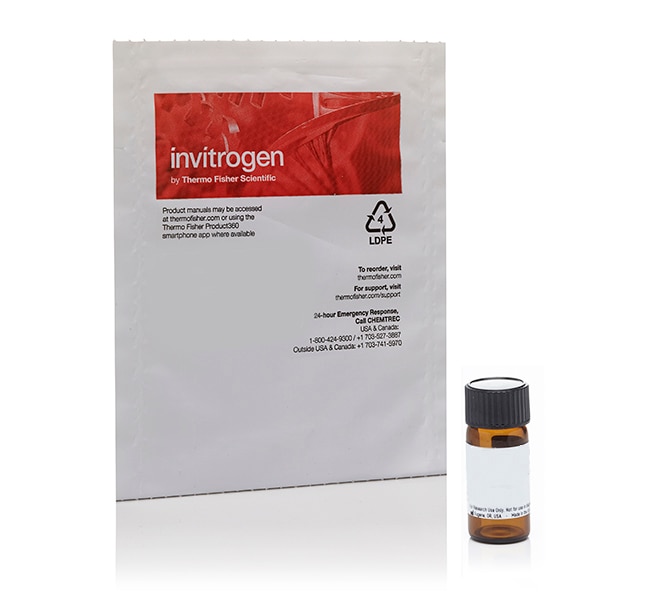
DiR'; DiIC18(7) (1,1'-Dioctadecyl-3,3,3',3'-Tetramethylindotricarbocyanine Iodide)
Invitrogen17万+抗体限时买二赠一,靶点广,灵活用!
DiR'; DiIC<sub>18</sub>(7) (1,1'-Dioctadecyl-3,3,3',3'-Tetramethylindotricarbocyanine Iodide)
Invitrogen™

DiR'; DiIC18(7) (1,1'-Dioctadecyl-3,3,3',3'-Tetramethylindotricarbocyanine Iodide)

The near IR fluorescent, lipophilic carbocyanine DiOC18(7) ('DiR') is weakly fluorescent in water but highly fluorescent and quite photostable whenRead more
Have Questions?
Catalog NumberQuantity
D1273110 mg
Catalog number D12731
Price (CNY)
3,198.00
Online Exclusive
Ends: 31-Dec-2025
4,334.00
Save 1,136.00 (26%)
Each
Add to cart
Quantity:
10 mg
Price (CNY)
3,198.00
Online Exclusive
Ends: 31-Dec-2025
4,334.00
Save 1,136.00 (26%)
Each
Add to cart

The near IR fluorescent, lipophilic carbocyanine DiOC18(7) ('DiR') is weakly fluorescent in water but highly fluorescent and quite photostable when incorporated into membranes. The sulfonate groups incorporated into this DiI analog improves water solubility. It has an extremely high extinction coefficient and short excited-state lifetimes (∼1 nanosecond) in lipid environments. Once applied to cells, the dye diffuses laterally within the plasma membrane.

Prepare stock solutions of lipophilic tracers in dimethyl formamide (DMF), dimethylsulfoxide (DMSO), or ethanol at 1 to 2.5 mg/mL.

For Research Use Only. Not for use in diagnostic procedures.
Specifications
ColorInfrared
Detection MethodFluorescence
For Use With (Equipment)Fluorescence Microscope
Quantity10 mg
Shipping ConditionRoom Temperature
Product TypeLiphophilic Tracer
SubCellular LocalizationCell Membranes, Lipids, Plasma Membrane
Unit SizeEach
Contents & Storage
Store at room temperature and protect from light.

Frequently asked questions (FAQs)

I need to look at live cell morphology deformation over the course of a few hours. What sort of membrane dye would be useful for this?

Lipophilic cyanine dyes, such as DiI (Cat. No. D282), DiO (Cat. No. D275), DiD (Cat. No. D7757) or DiR (Cat. No. D12731), are commonly used. The longer the alkyl chain on the dye, the better the retention in lipophilic environments.

Find additional tips, troubleshooting help, and resources within our Cell Analysis Support Center.

Why do I lose all signal from my neuronal tracer when I do a methanol fixation on my cells?

If the tracer you chose is a lipophilic dye and fix with methanol, the lipids are lost with the methanol. If you have to use methanol fixation then choose a tracer that will covalently bind to proteins in the neurons.

Find additional tips, troubleshooting help, and resources within our Cell Analysis Support Center.

I stained my cells with a lipophilic cyanine dye, like DiI, but the signal was lost when I tried to follow up with antibody labeling. Why?

Since these dyes insert into lipid membranes, any disruption of the membranes leads to loss of the dye. This includes permeabilization with detergents like Triton X-100 or organic solvents like methanol. Permeabilization is necessary for intracellular antibody labeling, leading to loss of the dye. Instead, a reactive dye such as CFDA SE should be used to allow for covalent attachment to cellular components, thus providing for better retention upon fixation and permeabilization.

Find additional tips, troubleshooting help, and resources within our Cell Analysis Support Center.

I labeled my neurons with DiI and then fixed and permeabilized and now I have no signal. What did I do wrong?

DiI is a lipophilic dye that resides mostly in lipids in the cell, when cells are permeabilized with detergent or fixed using alcohol this strips away the lipid and the dye. If permeabilization is required CM-DiI can be used because this binds covalently to proteins in the membrane; some signal is lost upon fixation/permeabilization, but enough signal should be retained to make detection possible.

Find additional tips, troubleshooting help, and resources within our Cell Analysis Support Center.

How long does it take for lipophlic tracers to transport along the membrane? How much faster are the FAST lipophilic dyes?

The transport is fairly slow, around 6 mm/day in live tissue and slower in fixed tissue, so diffusion of lipophilic carbocyanine tracers from the point of their application to the terminus of a neuron can take several days to weeks The FAST DiO and DiI analogs (which have unsaturated alkyl tails) can improve transport rate by around 50%.

Find additional tips, troubleshooting help, and resources within our Cell Analysis Support Center.

Citations & References (26)

Citations & References
Abstract
Microenvironmental contaminations induced by fluorescent lipophilic dyes used for noninvasive in vitro and in vivo cell tracking.
Authors:Lassailly F, Griessinger E, Bonnet D,
Journal:Blood
PubMed ID:20215639
'Determining how normal and leukemic stem cells behave in vivo, in a dynamic and noninvasive way, remains a major challenge. Most optical tracking technologies rely on the use of fluorescent or bioluminescent reporter genes, which need to be stably expressed in the cells of interest. Because gene transfer in primary ... More
Myeloid cell microsomal prostaglandin E synthase-1 fosters atherogenesis in mice.
Authors:Chen L, Yang G, Monslow J, Todd L, Cormode DP, Tang J, Grant GR, DeLong JH, Tang SY, Lawson JA, Pure E, Fitzgerald GA
Journal:
PubMed ID:24753592
'Microsomal prostaglandin E synthase-1 (mPGES-1) in myeloid and vascular cells differentially regulates the response to vascular injury, reflecting distinct effects of mPGES-1-derived PGE2 in these cell types on discrete cellular components of the vasculature. The cell selective roles of mPGES-1 in atherogenesis are unknown. Mice lacking mPGES-1 conditionally in myeloid ... More
Use of lipophilic near-infrared dye in whole-body optical imaging of hematopoietic cell homing.
Authors:Kalchenko V, Shivtiel S, Malina V, Lapid K, Haramati S, Lapidot T, Brill A, Harmelin A
Journal:J Biomed Opt
PubMed ID:17092148
'We develop an optical whole-body imaging technique for monitoring normal and leukemic hematopoietic cell homing in vivo. A recently developed near-infrared (NIR) lipophilic carbocyanine dye 1,1''-dioctadecyl-3,3,3'',3''-tetramethylindotricarbocyanine iodide (DiR) is used to safely and directly label the membranes of human leukemic Pre-B ALL G2 cell lines as well as primary murine ... More
Ligand conjugated low-density lipoprotein nanoparticles for enhanced optical cancer imaging in vivo.
Authors:Chen J, Corbin IR, Li H, Cao W, Glickson JD, Zheng G
Journal:J Am Chem Soc
PubMed ID:17428054
Dynamic tracking of stem cells in an acute liver failure model.
Authors:Ezzat T, Dhar DK, Malago M, Olde Damink SW,
Journal:World J Gastroenterol
PubMed ID:22363116
To investigate a dual labeling technique, which would enable real-time monitoring of transplanted embryonic stem cell (ESC) kinetics, as well as long-term tracking. Liver damage was induced in C57/BL6 male mice (n = 40) by acetaminophen (APAP) 300 mg/kg administered intraperitoneally. Green fluorescence protein (GFP) positive C57/BL6 mouse ESCs were ... More