Search

Platinum II Taq 热启动 DNA 聚合酶资源 |
热启动 PCR 是传统聚合酶链式反应(PCR)技术的一种改良版本,它通过减少非特异性扩增来提高反应的特异性和灵敏度。在热启动 PCR 中,由于存在抑制剂或酶经过修饰,聚合酶在较低温度下会保持失活状态,从而防止引物在低温下进行延伸。当温度升高时,抑制剂会被释放,扩增反应随即启动。
观看关于传统 PCR 扩增中常见问题以及如何利用热启动 PCR 解决这些问题的视频。
Platinum II Taq 热启动 DNA 聚合酶的亮点
- 通用引物退火温度 (60°C)——减少了繁琐的 PCR 优化步骤,并可实现对不同 PCR 反应同时进行扩增
- 4倍快速 DNA 合成——合成速率高于传统 Taq 聚合酶
- 高抑制剂耐受性——采用经工程改造的 Taq 聚合酶,稳定性极强
- Platinum 热启动技术——可提供优异的特异性、灵敏度及产量;并可实现在室温条件下配制反应体系
- 绿色缓冲液——可实现 PCR 产物直接凝胶上样电泳,有助于减少移液错误
Platinum II Taq 热启动 DNA 聚合酶的优势
创新的 Platinum II PCR 缓冲液通过稳定引物 - 模板双链结构,实现了通用的引物退火方案。使用 Platinum II Taq DNA 聚合酶进行扩增时,任何引物对都可采用 60°C 这一通用退火温度。

图 1. Platinum II PCR 缓冲液与标准 PCR 缓冲液的等稳定化效应对比。
观看通用退火功能的优势。
Platinum II Taq 热启动 DNA 聚合酶的速度是传统 Taq DNA 聚合酶的四倍。观看视频。
Platinum II Taq 热启动 DNA 聚合酶对常见的 PCR 抑制剂具有耐受性。观看视频。
绿色缓冲液选项支持直接上样,有助于减少移液误差。两种染料在电泳过程中清晰可见,便于追踪 DNA 的迁移情况。

图 2. 直接凝胶上样简化了从 PCR 到电泳的操作流程。
创新的 Platinum II PCR 缓冲液通过稳定引物 - 模板双链结构,实现了通用的引物退火方案。使用 Platinum II Taq DNA 聚合酶进行扩增时,任何引物对都可采用 60°C 这一通用退火温度。
图 1. Platinum II PCR 缓冲液与标准 PCR 缓冲液的等稳定化效应对比。
观看通用退火功能的优势。
Platinum II Taq 热启动 DNA 聚合酶的速度是传统 Taq DNA 聚合酶的四倍。观看视频。
Platinum II Taq 热启动 DNA 聚合酶对常见的 PCR 抑制剂具有耐受性。观看视频。
绿色缓冲液选项支持直接上样,有助于减少移液误差。两种染料在电泳过程中清晰可见,便于追踪 DNA 的迁移情况。
图 2. 直接凝胶上样简化了从 PCR 到电泳的操作流程。
Platinum Taq DNA polymerases: Selection guide
Platinum II Taq Hot-Start DNA Polymerase |
Platinum Taq DNA Polymerase | |
|---|---|---|
| Universal annealing protocol | Yes | No |
| Speed | 15 sec/kb | 1 min/kb |
| Flexible extension step* | Yes | No |
| Inhibitor tolerance | Yes | No |
| Target length | Up to 5 kb | Up to 5 kb |
| Hot-start modification | Antibody-mediated | Antibody-mediated |
| Fidelity versus Taq DNA Polymerase | 1x | 1x |
| Amplicon overhangs | 3’A | 3’A |
| Benchtop stability of assembled PCR reactions | 24 h | 24 h |
| GC-rich amplification | Yes | Yes |
| Certified low level of residual human and bacterial DNA‡ | Yes (≤1 copy of bacterial | No |
| Master mix formats | Colorless Green** | Colorless Green** |
| Stand-alone enzyme formats | Colorless† | Colorless Green** |


*The extension step can be extended up to 60 sec/kb without the effect on specificity.
**Direct gel loading with green buffer options.
†Green buffer available as separate item for use with stand-alone enzyme for direct loading gel.
‡During manufacturing of Platinum II Taq Hot-Start DNA Polymerase, strict measures are taken to control and verify by qPCR that no more than one copy of residual bacterial genomic DNA is present per unit of the polymerase.
Benchmarking data on Platinum II Taq Hot-Start DNA Polymerase
Engineered Platinum II Taq Hot-Start DNA Polymerase enables fast cycling of assays in as few as 30 minutes. The universal primer annealing temperature enables cycling of shorter and longer amplicons together using the same protocol.

Figure 3. Time saving enabled by assay co-cycling. PCR assays using conventional PCR reagents require specific protocols for amplification of each DNA fragment because of the different primer annealing temperatures and extension steps. Therefore, with traditional PCR reagents, multiple targets often cannot be amplified together in the same PCR run. With Platinum II Taq Hot-Start DNA Polymerase, different PCR assays can be cycled together using one protocol with a universal primer annealing temperature and the extension step selected for the longest fragment to be amplified. Moreover, Platinum II Taq Hot-Start DNA Polymerase is a fast DNA polymerase, delivering PCR results in as little as 30 minutes.

Figure 4. Platinum II Taq Hot-Start DNA Polymerase enables cycling of shorter and longer amplicons together. 132 bp, 251 bp, 1,005 bp, and 3.9 kb fragments were amplified from 50 ng of human genomic DNA in 50 μL reactions using Platinum II Taq Hot-Start DNA Polymerase or other hot-start DNA polymerases: The same protocol was used for all four targets with the annealing and extension settings indicated. The size marker used is Thermo Scientific ZipRuler Express DNA Ladder 2.
The higher synthesis rate of Platinum II Taq Hot-Start DNA Polymerase allows 2 times faster PCR results compared to other hot-start Taq DNA polymerases.

Figure 5. Fast cycling reduces PCR run time. Amplification of a 529 bp fragment from 50 ng of human genomic DNA in 50 μL reactions for 35 cycles was carried out using Platinum II Taq Hot-Start DNA Polymerase and hot-start DNA polymerases from other suppliers: Cycling times for each polymerase are shown in purple, while ramping times on the ProFlex PCR System (6°C/sec peak block ramp rate) are shown in red. PCR product analysis in 1% TAE agarose gels is presented below the graph. The size marker used is the ZipRuler Express DNA Ladder 2.
The sensitivity of Platinum II Taq Hot-Start DNA Polymerase enables successful amplification of specific product in experiments where there is a limited amount of starting material, or the target DNA is in low concentration. .

Figure 6. High sensitivity and reliable amplification from low amounts of input DNA. Amplification of a 529 bp fragment from 0 (no template control); 0.016; 0.08; 0.4; 2; 10; 50; 250 ng of human genomic DNA were amplified in 50 μL PCR reactions using Platinum II Taq Hot-Start DNA Polymerase or competitor DNA polymerases. The estimated copy number is ~5 copies per 0.016 ng of human genomic DNA. The molecular weight marker is ZipRuler Express DNA Ladder 2.
Platinum II Taq Hot-Start DNA Polymerase exhibits resistance to inhibitors and helps enable successful amplification of samples with suboptimal purity.

Figure 7. Resistance to inhibitors. Amplification of a 1 kb fragment from human genomic DNA using Platinum II Taq Hot-Start DNA Polymerase or competitor DNA polymerases in reaction mixtures containing: 1: humic acid (up to final concentration of 1.3 µg/mL), 2: hemin (up to final concentration of 6 µM), 3: xylan (up to final concentration of 0.26 mg/mL), or 4: no inhibitor control. The molecular weight marker used is ZipRuler Express DNA Ladder 2.

Figure 8. Amplification of DNA extracted from FFPE tissue samples. Amplification of a 527 bp fragment from varying amounts of DNA extracted from mouse FFPE tissue samples using Platinum II Taq Hot-Start DNA polymerase. RecoverAll Total Nucleic Acid Isolation Kit for FFPE was used for DNA extraction. NTC: no template control. PC: positive control from 1 ng of purified mouse genomic DNA. The molecular weight marker used is ZipRuler Express DNA Ladder 2.
The formulation of Platinum II Taq Hot-Start DNA Polymerase and 2X Master Mixes allows for amplification of versatile range of targets, from AT-rich to GC-rich. A separate vial of Platinum GC Enhancer is provided for specific amplification and improved yields of targets with high-GC content.
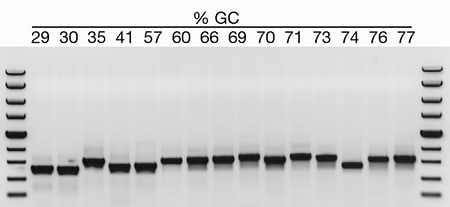
Figure 9. Robust amplification of AT-rich and GC-rich targets. Various DNA fragments of increasing GC content (indicated above the corresponding lanes) were amplified from 100 ng of human genomic DNA in 50 µL PCR reactions. Platinum GC Enhancer was used for targets with >65% GC. The molecular weight marker used is ZipRuler Express DNA Ladder 2.
PCR fragments generated by Platinum II Taq Hot-Start DNA Polymerase work well for Sanger sequencing. The enzyme’s superior performance, universal primer annealing, and fast synthesis enable generation of PCR amplicons for Sanger sequencing, with ease and simplicity.

Figure 10. High-quality Sanger sequencing results. A 1.6 kb PCR fragment amplified by Platinum II Taq Hot-Start DNA Polymerase was Sanger sequenced using Applied Biosystems 3130xl Genetic Analyzer. Data reported by the KB basecaller of the built-in sequencing analysis software is shown. Clear range read length (CRL) is defined as the longest uninterrupted segment of bases at a given Quality Value (QV). QV20 corresponds to 1% probability of a base call error and QV30 corresponds to 0.1%. QV>20 is considered high quality and acceptable in most cases.
Engineered Platinum II Taq Hot-Start DNA Polymerase enables fast cycling of assays in as few as 30 minutes. The universal primer annealing temperature enables cycling of shorter and longer amplicons together using the same protocol.
Figure 3. Time saving enabled by assay co-cycling. PCR assays using conventional PCR reagents require specific protocols for amplification of each DNA fragment because of the different primer annealing temperatures and extension steps. Therefore, with traditional PCR reagents, multiple targets often cannot be amplified together in the same PCR run. With Platinum II Taq Hot-Start DNA Polymerase, different PCR assays can be cycled together using one protocol with a universal primer annealing temperature and the extension step selected for the longest fragment to be amplified. Moreover, Platinum II Taq Hot-Start DNA Polymerase is a fast DNA polymerase, delivering PCR results in as little as 30 minutes.
Figure 4. Platinum II Taq Hot-Start DNA Polymerase enables cycling of shorter and longer amplicons together. 132 bp, 251 bp, 1,005 bp, and 3.9 kb fragments were amplified from 50 ng of human genomic DNA in 50 μL reactions using Platinum II Taq Hot-Start DNA Polymerase or other hot-start DNA polymerases: The same protocol was used for all four targets with the annealing and extension settings indicated. The size marker used is Thermo Scientific ZipRuler Express DNA Ladder 2.
The higher synthesis rate of Platinum II Taq Hot-Start DNA Polymerase allows 2 times faster PCR results compared to other hot-start Taq DNA polymerases.
Figure 5. Fast cycling reduces PCR run time. Amplification of a 529 bp fragment from 50 ng of human genomic DNA in 50 μL reactions for 35 cycles was carried out using Platinum II Taq Hot-Start DNA Polymerase and hot-start DNA polymerases from other suppliers: Cycling times for each polymerase are shown in purple, while ramping times on the ProFlex PCR System (6°C/sec peak block ramp rate) are shown in red. PCR product analysis in 1% TAE agarose gels is presented below the graph. The size marker used is the ZipRuler Express DNA Ladder 2.
The sensitivity of Platinum II Taq Hot-Start DNA Polymerase enables successful amplification of specific product in experiments where there is a limited amount of starting material, or the target DNA is in low concentration. .
Figure 6. High sensitivity and reliable amplification from low amounts of input DNA. Amplification of a 529 bp fragment from 0 (no template control); 0.016; 0.08; 0.4; 2; 10; 50; 250 ng of human genomic DNA were amplified in 50 μL PCR reactions using Platinum II Taq Hot-Start DNA Polymerase or competitor DNA polymerases. The estimated copy number is ~5 copies per 0.016 ng of human genomic DNA. The molecular weight marker is ZipRuler Express DNA Ladder 2.
Platinum II Taq Hot-Start DNA Polymerase exhibits resistance to inhibitors and helps enable successful amplification of samples with suboptimal purity.
Figure 7. Resistance to inhibitors. Amplification of a 1 kb fragment from human genomic DNA using Platinum II Taq Hot-Start DNA Polymerase or competitor DNA polymerases in reaction mixtures containing: 1: humic acid (up to final concentration of 1.3 µg/mL), 2: hemin (up to final concentration of 6 µM), 3: xylan (up to final concentration of 0.26 mg/mL), or 4: no inhibitor control. The molecular weight marker used is ZipRuler Express DNA Ladder 2.
Figure 8. Amplification of DNA extracted from FFPE tissue samples. Amplification of a 527 bp fragment from varying amounts of DNA extracted from mouse FFPE tissue samples using Platinum II Taq Hot-Start DNA polymerase. RecoverAll Total Nucleic Acid Isolation Kit for FFPE was used for DNA extraction. NTC: no template control. PC: positive control from 1 ng of purified mouse genomic DNA. The molecular weight marker used is ZipRuler Express DNA Ladder 2.
The formulation of Platinum II Taq Hot-Start DNA Polymerase and 2X Master Mixes allows for amplification of versatile range of targets, from AT-rich to GC-rich. A separate vial of Platinum GC Enhancer is provided for specific amplification and improved yields of targets with high-GC content.
Figure 9. Robust amplification of AT-rich and GC-rich targets. Various DNA fragments of increasing GC content (indicated above the corresponding lanes) were amplified from 100 ng of human genomic DNA in 50 µL PCR reactions. Platinum GC Enhancer was used for targets with >65% GC. The molecular weight marker used is ZipRuler Express DNA Ladder 2.
PCR fragments generated by Platinum II Taq Hot-Start DNA Polymerase work well for Sanger sequencing. The enzyme’s superior performance, universal primer annealing, and fast synthesis enable generation of PCR amplicons for Sanger sequencing, with ease and simplicity.
Figure 10. High-quality Sanger sequencing results. A 1.6 kb PCR fragment amplified by Platinum II Taq Hot-Start DNA Polymerase was Sanger sequenced using Applied Biosystems 3130xl Genetic Analyzer. Data reported by the KB basecaller of the built-in sequencing analysis software is shown. Clear range read length (CRL) is defined as the longest uninterrupted segment of bases at a given Quality Value (QV). QV20 corresponds to 1% probability of a base call error and QV30 corresponds to 0.1%. QV>20 is considered high quality and acceptable in most cases.
Platinum II Taq Hot-Start DNA Polymerase: Cited and quoted
Platinum Taq Hot-Start DNA Polymerases are highly cited in the several peer reviewed research publications. In five years, between 2019 and 2024, it has been cited in more than 5,000 publications.
Agriculture and aquaculture
| Use | Reference |
|---|---|
| Amplify viral targets from pig tissue samples. Samples were examined by agarose gel electrophoresis and Sanger sequencing. | Faustini G, Tucciarone CM, Legnardi M et al. (2023) Into the backyard: Multiple detections of PCV-2e in rural pig farms of Northern Italy. An unexpected ecological niche? Prev Vet Med 216:105943. doi: 10.1016/j.prevetmed.2023.105943 PMID: 37216841 |
| Amplify DNA to create A overhangs for cloning and sequencing. | Schneider HM, Lor VS, Zhang X et al. (2023) Transcription factor bHLH121 regulates root cortical aerenchyma formation in maize. Proc Natl Acad Sci U S A 120(12):e2219668120. doi: 10.1073/pnas.2219668120 PMID: 36927156 |
| Amplify DNA isolated from bacterial genomic DNA from microalgae. | Lim JY, Yeoh YK, Canepa M et al. (2024) The early life microbiome of giant grouper (Epinephelus lanceolatus) larvae in a commercial hatchery is influenced by microorganisms in feed. Anim Microbiome 6(1):51. doi: 10.1186/s42523-024-00339-y PMID: 39289751 |
| Clone the synthetic promoters. | Reza MAN, Harvey TN, Regmi A et al. (2024) Exploring the use of alternative promoters for enhanced transgene and sgRNA expression in Atlantic salmon cells. Mar Biotechnol (NY) 26(6):1143–1154. doi: 10.1007/s10126-024-10362-4 PMID: 39212852 |
Cancer and human health
| Research Area | Use | Reference |
|---|---|---|
| Cancer | Amplify gDNA from melanoma cells; the PCR product was Sanger sequenced. | Ruffini F, Ceci C, Atzori MG et al. (2023) Targeting of PDGF-C/NRP-1 autocrine loop as a new strategy for counteracting the invasiveness of melanoma resistant to BRAF inhibitors. Pharmacol Res 192:106782. doi: 10.1016/j.phrs.2023.106782 PMID: 37127213 |
| Cancer | Amplify disulfate treated DNA for methylation analysis. | Achilla C, Chorti A, Papavramidis T et al. (2024) Genetic and epigenetic association of FOXP3 with papillary thyroid cancer predisposition. Int J Mol Sci 25(13):7161. doi: 10.3390/ijms25137161 PMID: 39000267 |
| Neuroscience | Amplify cDNA reverse transcribed from RNA from human brain tissues. | Heberle AB, Brandon JA, Page ML et al. (2024) Mapping medically relevant RNA isoform diversity in the aged human frontal cortex with deep long-read RNA-seq. Nat Biotechnol. doi: 10.1038/s41587-024-02245-9 PMID: 38778214 |
| Neuroscience | Amplify cDNA to confirm gene expression in stem cells. | Yanick C, Maciel R, Jacobs E et al. (2024) Generation of 3 patient induced pluripotent stem cell lines containing SORD mutations linked to a recessive neuropathy. Stem Cell Res 78:103449. doi: 10.1016/j.scr.2024.103449 PMID: 38796985 |
| Rare diseases | Genotype iPSC lines derived from three patients diagnosed with Charcot-Marie-Tooth disease Type 4B3. | Jacobs EH, Schatzman Raposo J, Scardamaglia A et al. (2024) Establishment and characterization of three human pluripotent stem cell lines from Charcot-Marie-Tooth disease type 4B3 patients bearing mutations in MTMR5/Sbf1 gene. Stem Cell Res 81:103599. doi: 10.1016/j.scr.2024.103599 PMID: 39461113 |
Ecology and evolution
| Research Area | Use | Reference |
|---|---|---|
| Ecology | Analyze blood samples of ungulates for Plasmodium; perform nested PCR with blood spots samples on filter paper. | Ulloa GM, Greenwood AD, Cornejo OE et al. (2024) Phylogenetic congruence of Plasmodium spp. and wild ungulate hosts in the Peruvian Amazon. Infect Genet Evol 118:105554. doi: 10.1016/j.meegid.2024.105554 PMID: 38246398 |
| Ecology | Amplify viral DNA obtained from tissue samples and FTA® cards from beached dolphins. | Si H, Tucciarone CM, Cecchinato M et al. (2023) Comparison between sampling techniques for virological molecular analyses: Dolphin morbillivirus and herpesvirus detection from FTA® card and frozen tissue. Viruses 15(12):2422. doi: 10.3390/v15122422 PMID: 38140663 |
| Ecology | Amplify DNA from cDNA synthesized from RNA of snake venom. PCR was used to add ends to facilitate cloning. Cloned fragments were Sanger sequenced. | Torrejón D, Cárdenas J, Juárez D et al. (2023) Comparison of four methods of RNA extraction and cDNA synthesis from the venom of Peruvian snakes of the genus Bothrops of clinical importance. Int J Mol Sci 24(13):11161. doi: 10.3390/ijms241311161 PMID: 37446341 |
| Evolution | Amplify DNA fragments of housefly larvae for the preparation of probes for FISH. | Li X, Visser S, Son JH et al. (2024) Divergent evolution of male-determining loci on proto-Y chromosomes of the housefly. Nat Commun 15(1):5984. doi: 10.1038/s41467-024-50390-1 PMID: 39013946 |
Infectious diseases
| Research Area | Use | Reference |
|---|---|---|
| Virology | Amplify Hepatitis D virus from patient samples after reverse transcription; amplified DNA was analyzed by agarose gel electrophoresis and Sanger sequencing. | Anolli MP, Renteria SU, Degasperi E et al. (2024) Quantification of serum HDV RNA by Robogene 2.0 in HDV patients is significantly influenced by the extraction methods. Liver Int 44(3):831–837. doi: 10.1111/liv.15795 PMID: 38247385 |
| Dermatology | Amplify DNA from infected toenail samples. | Gupta AK, Cooper EA, Wang T et al. (2023) Detection of squalene epoxidase mutations in United States patients with onychomycosis: Implications for management. J Invest Dermatol 143(12):2476–2483.e7. doi: 10.1016/j.jid.2023.04.032 PMID: 37236595 |
| Virology | Amplify cDNA synthesized from RNA isolated from EIV-infected MDCK cells. | Kleij L, Bruder E, Raoux-Barbot D et al. (2024) Genomic characterization of equine influenza A subtype H3N8 viruses by long read sequencing and functional analyses of the PB1-F2 virulence factor of A/equine/Paris/1/2018. Vet Res 55(1):36. doi: 10.1186/s13567-024-01289-8 PMID: 38520035 |
| Genomics | Amplify libraries for NGS on an Illumina system. | Shaw TM, Huey D, Mousa-Makky M et al. (2024) The neonatal Fc receptor (FcRn) is a pan-arterivirus receptor. Nat Commun 15(1):6726. doi: 10.1038/s41467-024-51142-x PMID: 39112502 |
| Virology | Amplify RSV cDNA; amplification product was confirmed via agarose gel electrophoresis then Sanger sequenced. | Panatto D, Domnich A, Lai PL et al. (2023) Epidemiology and molecular characteristics of respiratory syncytial virus (RSV) among Italian community-dwelling adults, 2021/22 season. BMC Infect Dis 23(1):134. doi: 10.1186/s12879-023-08100-7 PMID: 36882698 |
Agriculture and aquaculture
| Use | Reference |
|---|---|
| Amplify viral targets from pig tissue samples. Samples were examined by agarose gel electrophoresis and Sanger sequencing. | Faustini G, Tucciarone CM, Legnardi M et al. (2023) Into the backyard: Multiple detections of PCV-2e in rural pig farms of Northern Italy. An unexpected ecological niche? Prev Vet Med 216:105943. doi: 10.1016/j.prevetmed.2023.105943 PMID: 37216841 |
| Amplify DNA to create A overhangs for cloning and sequencing. | Schneider HM, Lor VS, Zhang X et al. (2023) Transcription factor bHLH121 regulates root cortical aerenchyma formation in maize. Proc Natl Acad Sci U S A 120(12):e2219668120. doi: 10.1073/pnas.2219668120 PMID: 36927156 |
| Amplify DNA isolated from bacterial genomic DNA from microalgae. | Lim JY, Yeoh YK, Canepa M et al. (2024) The early life microbiome of giant grouper (Epinephelus lanceolatus) larvae in a commercial hatchery is influenced by microorganisms in feed. Anim Microbiome 6(1):51. doi: 10.1186/s42523-024-00339-y PMID: 39289751 |
| Clone the synthetic promoters. | Reza MAN, Harvey TN, Regmi A et al. (2024) Exploring the use of alternative promoters for enhanced transgene and sgRNA expression in Atlantic salmon cells. Mar Biotechnol (NY) 26(6):1143–1154. doi: 10.1007/s10126-024-10362-4 PMID: 39212852 |
Cancer and human health
| Research Area | Use | Reference |
|---|---|---|
| Cancer | Amplify gDNA from melanoma cells; the PCR product was Sanger sequenced. | Ruffini F, Ceci C, Atzori MG et al. (2023) Targeting of PDGF-C/NRP-1 autocrine loop as a new strategy for counteracting the invasiveness of melanoma resistant to BRAF inhibitors. Pharmacol Res 192:106782. doi: 10.1016/j.phrs.2023.106782 PMID: 37127213 |
| Cancer | Amplify disulfate treated DNA for methylation analysis. | Achilla C, Chorti A, Papavramidis T et al. (2024) Genetic and epigenetic association of FOXP3 with papillary thyroid cancer predisposition. Int J Mol Sci 25(13):7161. doi: 10.3390/ijms25137161 PMID: 39000267 |
| Neuroscience | Amplify cDNA reverse transcribed from RNA from human brain tissues. | Heberle AB, Brandon JA, Page ML et al. (2024) Mapping medically relevant RNA isoform diversity in the aged human frontal cortex with deep long-read RNA-seq. Nat Biotechnol. doi: 10.1038/s41587-024-02245-9 PMID: 38778214 |
| Neuroscience | Amplify cDNA to confirm gene expression in stem cells. | Yanick C, Maciel R, Jacobs E et al. (2024) Generation of 3 patient induced pluripotent stem cell lines containing SORD mutations linked to a recessive neuropathy. Stem Cell Res 78:103449. doi: 10.1016/j.scr.2024.103449 PMID: 38796985 |
| Rare diseases | Genotype iPSC lines derived from three patients diagnosed with Charcot-Marie-Tooth disease Type 4B3. | Jacobs EH, Schatzman Raposo J, Scardamaglia A et al. (2024) Establishment and characterization of three human pluripotent stem cell lines from Charcot-Marie-Tooth disease type 4B3 patients bearing mutations in MTMR5/Sbf1 gene. Stem Cell Res 81:103599. doi: 10.1016/j.scr.2024.103599 PMID: 39461113 |
Ecology and evolution
| Research Area | Use | Reference |
|---|---|---|
| Ecology | Analyze blood samples of ungulates for Plasmodium; perform nested PCR with blood spots samples on filter paper. | Ulloa GM, Greenwood AD, Cornejo OE et al. (2024) Phylogenetic congruence of Plasmodium spp. and wild ungulate hosts in the Peruvian Amazon. Infect Genet Evol 118:105554. doi: 10.1016/j.meegid.2024.105554 PMID: 38246398 |
| Ecology | Amplify viral DNA obtained from tissue samples and FTA® cards from beached dolphins. | Si H, Tucciarone CM, Cecchinato M et al. (2023) Comparison between sampling techniques for virological molecular analyses: Dolphin morbillivirus and herpesvirus detection from FTA® card and frozen tissue. Viruses 15(12):2422. doi: 10.3390/v15122422 PMID: 38140663 |
| Ecology | Amplify DNA from cDNA synthesized from RNA of snake venom. PCR was used to add ends to facilitate cloning. Cloned fragments were Sanger sequenced. | Torrejón D, Cárdenas J, Juárez D et al. (2023) Comparison of four methods of RNA extraction and cDNA synthesis from the venom of Peruvian snakes of the genus Bothrops of clinical importance. Int J Mol Sci 24(13):11161. doi: 10.3390/ijms241311161 PMID: 37446341 |
| Evolution | Amplify DNA fragments of housefly larvae for the preparation of probes for FISH. | Li X, Visser S, Son JH et al. (2024) Divergent evolution of male-determining loci on proto-Y chromosomes of the housefly. Nat Commun 15(1):5984. doi: 10.1038/s41467-024-50390-1 PMID: 39013946 |
Infectious diseases
| Research Area | Use | Reference |
|---|---|---|
| Virology | Amplify Hepatitis D virus from patient samples after reverse transcription; amplified DNA was analyzed by agarose gel electrophoresis and Sanger sequencing. | Anolli MP, Renteria SU, Degasperi E et al. (2024) Quantification of serum HDV RNA by Robogene 2.0 in HDV patients is significantly influenced by the extraction methods. Liver Int 44(3):831–837. doi: 10.1111/liv.15795 PMID: 38247385 |
| Dermatology | Amplify DNA from infected toenail samples. | Gupta AK, Cooper EA, Wang T et al. (2023) Detection of squalene epoxidase mutations in United States patients with onychomycosis: Implications for management. J Invest Dermatol 143(12):2476–2483.e7. doi: 10.1016/j.jid.2023.04.032 PMID: 37236595 |
| Virology | Amplify cDNA synthesized from RNA isolated from EIV-infected MDCK cells. | Kleij L, Bruder E, Raoux-Barbot D et al. (2024) Genomic characterization of equine influenza A subtype H3N8 viruses by long read sequencing and functional analyses of the PB1-F2 virulence factor of A/equine/Paris/1/2018. Vet Res 55(1):36. doi: 10.1186/s13567-024-01289-8 PMID: 38520035 |
| Genomics | Amplify libraries for NGS on an Illumina system. | Shaw TM, Huey D, Mousa-Makky M et al. (2024) The neonatal Fc receptor (FcRn) is a pan-arterivirus receptor. Nat Commun 15(1):6726. doi: 10.1038/s41467-024-51142-x PMID: 39112502 |
| Virology | Amplify RSV cDNA; amplification product was confirmed via agarose gel electrophoresis then Sanger sequenced. | Panatto D, Domnich A, Lai PL et al. (2023) Epidemiology and molecular characteristics of respiratory syncytial virus (RSV) among Italian community-dwelling adults, 2021/22 season. BMC Infect Dis 23(1):134. doi: 10.1186/s12879-023-08100-7 PMID: 36882698 |
What is hot-start PCR?
参考文献
(微)生物群
癌症研究
Developmental biology
| Usage | Publications |
|---|---|
| Two-step RT-PCR with human and mouse pluripotent stem cells | Esseltine JL, Brooks CR, Edwards NA et al. (2020) Dynamic regulation of connexins in stem cell pluripotency. Stem Cells 38:52–66. |
| MicroRNA-binding site cloning of bovine DNA | Shen X, Tang J, Ru W et al. (2021) CircINSR regulates fetal bovine muscle and fat development. Front Cell Dev Bio 8:615638. |
疾病模型
基因调控
系统基因组学
植物生物学
病毒研究
(微)生物群
癌症研究
Developmental biology
| Usage | Publications |
|---|---|
| Two-step RT-PCR with human and mouse pluripotent stem cells | Esseltine JL, Brooks CR, Edwards NA et al. (2020) Dynamic regulation of connexins in stem cell pluripotency. Stem Cells 38:52–66. |
| MicroRNA-binding site cloning of bovine DNA | Shen X, Tang J, Ru W et al. (2021) CircINSR regulates fetal bovine muscle and fat development. Front Cell Dev Bio 8:615638. |
疾病模型
基因调控
系统基因组学
植物生物学
病毒研究
“We had a very troublesome genotyping primer set that gave us bands in the NTC. Then we tried the Platinum II Taq [DNA Polymerase] and it worked the first time! We also save a ton of time on the PCR for this primer set since we no longer have to do two step PCR!”
—Research Associate
Large research university, US
部分参考文献
Resources for Platinum II Taq Hot-Start DNA Polymerase
Flyers
Manuals/Protocols
Spotlight article
Application and technical notes
Technical references
OEM & customized PCR solutions
Discover customizable manufacturing solutions, product labeling, and packaging capabilities for your specific requirements.
OEM 和定制的 PCR 解决方案
了解可满足您特定要求的定制生产解决方案、产品标签和包装能力。仅供科研使用,不可用于诊断目的。
 | PCR学习资源 |
| 获取 PCR 学习资源 —— 涵盖 PCR 所有相关知识的知识库。 | |
 | 分子生物学网络研讨会 |
| 查看我们的网络研讨会(含最新日期),深入了解分子生物学相关主题。 | |
 | PCR 酶相关视频 |
| 探索产品特性及优化 PCR 实验的技巧。 | |
 | 支持中心 |
| 查找终点 PCR 和 cDNA 应用相关的技巧、故障排除帮助及资源。 | |
 | 联系我们 |
| 若有关于 PCR 酶和预混液的问题,可通过邮件或电话咨询我们的技术应用科学家。 | |
 | OEM和定制PCR产品 |
| 探索为您量身定制的生产解决方案、产品标签及包装服务。 | |
Stylesheet for Classic Wide Template adjustments
仅供科研使用,不可用于诊断目的。