Magnetic beads protein purification uses tiny, paramagnetic particles coupled with specific ligands that bind to target proteins. This technology is remarkable due to its efficiency, specificity, and ease of use. They are used to isolate and purify proteins from complex mixtures through magnetic separation, a faster alternative to centrifugation or filtration. Protein purification is essential in biotechnology and molecular biology, enabling researchers to isolate specific proteins for applications such as drug development and diagnostic testing. The most effective method of protein purification varies depending on the specific protein and application. Techniques such as affinity chromatography, ion exchange chromatography, and magnetic bead-based purification are commonly used.

This guide explores various protein purification techniques, with a focus on magnetic bead-based methods. We address key questions such as the advantages of magnetic beads, the most effective purification methods, and practical applications of these technologies.


Accelerate proteomics throughput (HTS) using magnetic separation

Speed and sample purity are major concerns for proteomics researchers, and strategies to achieve higher throughput for sample-handling and data-processing are desired. Magnetic particles are a solid support designed to be convenient for a variety of assays and procedures based on affinity purification. Paramagnetic beads are especially well-suited for automated procedures because instrumentation exists to easily mix, incubate, and separate the particles in 96-well plates without columns or centrifugation. Such ease of manipulation enables rapid processing of many samples and easy integration and compatibility with entire workflows.

Whether you’re isolating a recombinant fusion protein, enriching a target from lysate, or preparing samples for downstream analysis, the Thermo Scientific Magnetic Bead Technology Handbook shows how modern labs are moving beyond traditional chromatography to magnetic bead–based purification.

If you express, enrich, or isolate proteins, this handbook is for you.

Download the handbook

Automated protein purification workflow


Automated magnetic protein purification selection guide

Magnetic beads for protein purification are highly effective. They help provide a rapid, efficient, and scalable method for isolating proteins with high specificity and purity, making them suitable for both manual and automated workflows.

 Magnetic beads
(ng to μg binding capacity)
Magnetic agarose beads
(mg capacity)
IP-MSProtein A/G
Streptavidin
 
IP/co-IPProtein A/G
Protein A
Protein G
 
Biotin IPStreptavidin 
ChIPProtein A/G
Protein A
Protein G
 
Epitope tagAnti-HA
Anti-c-Myc
Glutathione
Anti-DYKDDDDK
Antibody purificationProtein A/G
Protein A
Protein G
Protein L
Protein A/G
Protein A, alkali stable
IMACNi-NTANi-NTA
Ni-IMAC (EDTA-compatible)
Surface reactive

NHS


View non-magnetic affinity purification resin and kits


Kingfisher software protocols for automated protein purification

The table below includes Kingfisher software protocols for automated protein purification based on magnetic bead, affinity target, kit used, and binding strategy. Pierce magnetic beads are small, 1 μm particles that allow for high-throughput screening, purification, and immunoprecipitation with ng–μg protein yields. Alternatively, Pierce magnetic agarose beads consist of significantly larger, 10–40 μm particles and are used for high-capacity protein purification at mg–g scales. Both Pierce bead types can be automated on KingFisher instruments or used in a manual format with magnetic stands.

Magnetic beadAffinity targetMagnetic bead kitsBinding strategyKingFisher software protocols
Anti-HAHA-tagged fusion proteinsHA-Tag Magnetic IP/Co-IP kitDirect
Anti-c-MycMyc-tagged fusion proteinsMyc-Tag Magnetic IP/Co-IP kitDirect
Ni-NTAHis-tagged fusion proteins Direct
NHS esterCovalent immobilization of primary amine molecules
(proteins, peptides, etc.) for affinity purification
Direct Magnetic IP kitDirect

IP protocol

Coupling protocol

Protein A/GAntibodies (IgG containing Fc)Classic Magnetic IP kit
Crosslink Magnetic IP kit
Indirect
Protein AAntibodies (IgG containing Fc) Indirect
Protein GAntibodies (IgG containing Fc) Indirect
Protein LAntibodies (Ig containing kappa light chains) Indirect
StreptavidinBiotin or desthiobiotin Indirect

Flex Instrument

Magnetic agarose beadAffinity targetBinding strategyKingFisher instrument protocols
Anti-DYKDDDDKDYKDDDDK-tagged fusion proteins 

Acid elution

Peptide elution

Protein A, Alkali StablemAbs and a subpopulation of scFv’s and Fab fragments containing a VH3 domain 
GlutathioneGlutathione S-transferase (GST) fusion proteins 
Ni-NTAHis-tagged fusion proteinsDirect
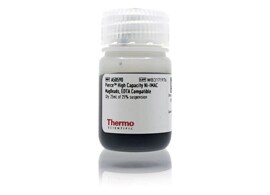
Ni-IMACHis-tagged fusion proteins, EDTA compatible

Direct

(EDTA compatible chemistry)

Protein A/GAntibodies (IgG containing Fc)Indirect

Magnetic agarose beads consist of highly crosslinked agarose encapsulating a ferrimagnetic core. The beads are 10 to 40 µM in size and have higher binding capacity than traditional magnetic beads. We offer a variety of ligands for immunoprecipitation (IP), co-immunoprecipitation (co-IP), pull-down, and other high throughput affinity screening applications, utilizing immobilized Protein A/G, Ni-NTA, Ni-IMAC (EDTA Compatible), Glutathione, and Anti-FLAG. The beads are removed from the solution manually using a magnetic stand or by automation using an instrument such as the Thermo Scientific KingFisher Flex Magnetic Particle Processor. Automated instruments are especially useful for higher throughput purification and screening of purification conditions.

Choose the right protein purification strategy using magnetic agarose beads

 Pierce High-Capacity Protein A MagBeads, alkali stablePierce Protein A/G Magnetic Agarose BeadsPierce Ni-NTA Magnetic Agarose BeadsPierce High Capacity Ni-IMAC MagBeads, EDTA compatiblePierce Glutathione Magnetic Agarose BeadsPierce Anti-DYKDDDDK (FLAG) Magnetic Agarose Beads
Binding targetAntibodiesAntibodiesHis-tagged proteinsHis-tagged proteins, EDTA compatibleGST-tagged proteinsFLAG-tagged proteins
Binding capacity≥40 mg/mL≥40 mg/mL≥70 mg/mL80 mg/mL≥12 mg/mL≥3 mg/mL
Order productsA53035
A53036
A53037
A53038
7860978605A5058878601A36797
Magnetic beadAffinity targetMagnetic bead kitsBinding strategyKingFisher software protocols
Anti-HAHA-tagged fusion proteinsHA-Tag Magnetic IP/Co-IP kitDirect
Anti-c-MycMyc-tagged fusion proteinsMyc-Tag Magnetic IP/Co-IP kitDirect
Ni-NTAHis-tagged fusion proteins Direct
NHS esterCovalent immobilization of primary amine molecules
(proteins, peptides, etc.) for affinity purification
Direct Magnetic IP kitDirect

IP protocol

Coupling protocol

Protein A/GAntibodies (IgG containing Fc)Classic Magnetic IP kit
Crosslink Magnetic IP kit
Indirect
Protein AAntibodies (IgG containing Fc) Indirect
Protein GAntibodies (IgG containing Fc) Indirect
Protein LAntibodies (Ig containing kappa light chains) Indirect
StreptavidinBiotin or desthiobiotin Indirect

Flex Instrument

Magnetic agarose beadAffinity targetBinding strategyKingFisher instrument protocols
Anti-DYKDDDDKDYKDDDDK-tagged fusion proteins 

Acid elution

Peptide elution

Protein A, Alkali StablemAbs and a subpopulation of scFv’s and Fab fragments containing a VH3 domain 
GlutathioneGlutathione S-transferase (GST) fusion proteins 
Ni-NTAHis-tagged fusion proteinsDirect
Ni-IMACHis-tagged fusion proteins, EDTA compatible

Direct

(EDTA compatible chemistry)

Protein A/GAntibodies (IgG containing Fc)Indirect

Magnetic agarose beads consist of highly crosslinked agarose encapsulating a ferrimagnetic core. The beads are 10 to 40 µM in size and have higher binding capacity than traditional magnetic beads. We offer a variety of ligands for immunoprecipitation (IP), co-immunoprecipitation (co-IP), pull-down, and other high throughput affinity screening applications, utilizing immobilized Protein A/G, Ni-NTA, Ni-IMAC (EDTA Compatible), Glutathione, and Anti-FLAG. The beads are removed from the solution manually using a magnetic stand or by automation using an instrument such as the Thermo Scientific KingFisher Flex Magnetic Particle Processor. Automated instruments are especially useful for higher throughput purification and screening of purification conditions.

Choose the right protein purification strategy using magnetic agarose beads

 Pierce High-Capacity Protein A MagBeads, alkali stablePierce Protein A/G Magnetic Agarose BeadsPierce Ni-NTA Magnetic Agarose BeadsPierce High Capacity Ni-IMAC MagBeads, EDTA compatiblePierce Glutathione Magnetic Agarose BeadsPierce Anti-DYKDDDDK (FLAG) Magnetic Agarose Beads
Binding targetAntibodiesAntibodiesHis-tagged proteinsHis-tagged proteins, EDTA compatibleGST-tagged proteinsFLAG-tagged proteins
Binding capacity≥40 mg/mL≥40 mg/mL≥70 mg/mL80 mg/mL≥12 mg/mL≥3 mg/mL
Order productsA53035
A53036
A53037
A53038
7860978605A5058878601A36797

Figure 1. Comparison of protein purification results between Pierce Anti-DYKDDDDK magnetic agarose and another supplier. C-terminal DYKDDDDK-tagged Green Renilla Luciferase protein was expressed using the Thermo Scientific 1-Step Human High-Yield Maxi IVT Kit and immunoprecipitated using Pierce Anti-DYKDDDDK Magnetic Agarose or Sigma-Aldrich Anti-FLAG™ M2 Magnetic Beads using the KingFisher Flex Purification System. Tagged proteins were competitively eluted with Pierce 3x DYKDDDDK peptide and analyzed by western blot (A), Pierce Renilla Luciferase Glow Assay (B), and silver staining (C). Comparison of the starting lysate (L), elutions (E), and bead boiled samples (BB) show effective capture and elution of DYKDDDDK-tagged proteins with no background. Correlation of protein and activity levels indicate that a high level of Green Renilla luciferase activity is maintained after purification and competitive peptide elution.

Figure 2. Excellent performance of Pierce High-Capacity Ni-IMAC MagBeads, EDTA Compatible compared to magnetic beads from supplier C when purifying proteins from cell culture supernatant. Cell culture supernatant (Expi293) containing over-expressed His-tagged EPO (40 mg total protein) was applied to Pierce High-Capacity Ni-IMAC MagBeads, EDTA Compatible as well as Competitor C. Beads were processed using protocols with buffers recommended by the manufacturers. Binding was performed with all samples for 30 minutes. The beads were collected on a magnetic stand and the flow-through (unbound) fractions were saved for analysis. The beads were then washed twice, and bound protein was eluted with a 15-minute incubation in Elution Buffer. The eluates were resolved on an SDS-PAGE gel and stained with GelCode Blue Safe Protein Stain. Gel lanes were normalized by volume. M = MW marker, L = lysate load, FT = flow-through, W = wash, and E = elution.
*HC = High-capacity.

Figure 3. Exceptional capacity of Pierce High-Capacity Ni-IMAC MagBeads, EDTA Compatible compared to magnetic beads from Competitor C, on the Kingfisher Flex. Purified over-expressed 6xHis-GFP was applied to Pierce High-Capacity Ni-IMAC MagBeads, EDTA Compatible as well as Competitor C (0–100 mg GFP per 10 µL settled beads). Beads were processed using protocols with buffers recommended by the manufacturers on the Kingfisher Flex instrument. Binding was performed with all samples for 30 minutes. The beads were collected, and the flow-through (unbound) fractions were saved for analysis. The beads were then washed twice, and bound protein was eluted with a 15-minute incubation in Elution Buffer.
*HC = High-capacity

Protein yield comparison for 6xHis-tagged BirA using Pierce Ni-NTA Magnetic Agarose and other suppliers' beads
Figure 4. Comparison of protein yields between Pierce Ni-NTA Magnetic Agarose and products from other suppliers. Samples (0.5 mL) of 6xHis-tagged BirA protein were diluted with 0.5 mL binding buffer and purified manually with 25 mL settled beads. Respective suppliers’ protocols were followed for their buffer compositions and volumes. Pierce Ni-NTA Magnetic Agarose Beads had the highest yield compared to beads from the other suppliers.
Comparison of GST-RalGDS protein yields using Pierce Glutathione Magnetic Agarose Beads versus other suppliers' beads
Figure 5. Comparison of protein yields between Pierce Glutathione Magnetic Agarose Beads and products from other suppliers. Samples (0.25 mL) of GST-RalGDS were diluted with 0.25 mL binding buffer and purified manually with 25 μL settled beads. Respective suppliers’ protocols were followed for their buffer compositions and volumes. Pierce Glutathione Magnetic Agarose Beads had the highest yield compared to beads from the other suppliers.
Comparison of IgG purification yields using Thermo Scientific Pierce Protein A/G Magnetic Agarose Beads with other suppliers’ beads
Figure 6. Thermo Scientific Pierce Protein A/G Magnetic Agarose Beads enable higher purification yields than other commercially available magnetic beads. IgG purification was performed with the Pierce Protein A/G Magnetic Agarose Beads, GE Healthcare™ Protein A Mag Sepharose Xtra beads, GE Healthcare Protein G Mag Sepharose Xtra beads, Promega™ Magne™ Protein A beads, Promega Magne Protein G beads, GenScript™ Protein A/G MagBeads, BioVision™ Protein A/G Magnetic Beads, and Pierce Protein A/G Magnetic Beads. Mouse and human sera (50 μL) were diluted with binding buffer according to the manufacturers’ protocols and added to magnetic agarose beads. IgG was purified following the manufacturers’ protocols. IgG yield was estimated by absorbance of IgG at 280 nm. All purifications were done in duplicate.

Figure 1. Comparison of protein purification results between Pierce Anti-DYKDDDDK magnetic agarose and another supplier. C-terminal DYKDDDDK-tagged Green Renilla Luciferase protein was expressed using the Thermo Scientific 1-Step Human High-Yield Maxi IVT Kit and immunoprecipitated using Pierce Anti-DYKDDDDK Magnetic Agarose or Sigma-Aldrich Anti-FLAG™ M2 Magnetic Beads using the KingFisher Flex Purification System. Tagged proteins were competitively eluted with Pierce 3x DYKDDDDK peptide and analyzed by western blot (A), Pierce Renilla Luciferase Glow Assay (B), and silver staining (C). Comparison of the starting lysate (L), elutions (E), and bead boiled samples (BB) show effective capture and elution of DYKDDDDK-tagged proteins with no background. Correlation of protein and activity levels indicate that a high level of Green Renilla luciferase activity is maintained after purification and competitive peptide elution.

Figure 2. Excellent performance of Pierce High-Capacity Ni-IMAC MagBeads, EDTA Compatible compared to magnetic beads from supplier C when purifying proteins from cell culture supernatant. Cell culture supernatant (Expi293) containing over-expressed His-tagged EPO (40 mg total protein) was applied to Pierce High-Capacity Ni-IMAC MagBeads, EDTA Compatible as well as Competitor C. Beads were processed using protocols with buffers recommended by the manufacturers. Binding was performed with all samples for 30 minutes. The beads were collected on a magnetic stand and the flow-through (unbound) fractions were saved for analysis. The beads were then washed twice, and bound protein was eluted with a 15-minute incubation in Elution Buffer. The eluates were resolved on an SDS-PAGE gel and stained with GelCode Blue Safe Protein Stain. Gel lanes were normalized by volume. M = MW marker, L = lysate load, FT = flow-through, W = wash, and E = elution.
*HC = High-capacity.

Figure 3. Exceptional capacity of Pierce High-Capacity Ni-IMAC MagBeads, EDTA Compatible compared to magnetic beads from Competitor C, on the Kingfisher Flex. Purified over-expressed 6xHis-GFP was applied to Pierce High-Capacity Ni-IMAC MagBeads, EDTA Compatible as well as Competitor C (0–100 mg GFP per 10 µL settled beads). Beads were processed using protocols with buffers recommended by the manufacturers on the Kingfisher Flex instrument. Binding was performed with all samples for 30 minutes. The beads were collected, and the flow-through (unbound) fractions were saved for analysis. The beads were then washed twice, and bound protein was eluted with a 15-minute incubation in Elution Buffer.
*HC = High-capacity

Protein yield comparison for 6xHis-tagged BirA using Pierce Ni-NTA Magnetic Agarose and other suppliers' beads
Figure 4. Comparison of protein yields between Pierce Ni-NTA Magnetic Agarose and products from other suppliers. Samples (0.5 mL) of 6xHis-tagged BirA protein were diluted with 0.5 mL binding buffer and purified manually with 25 mL settled beads. Respective suppliers’ protocols were followed for their buffer compositions and volumes. Pierce Ni-NTA Magnetic Agarose Beads had the highest yield compared to beads from the other suppliers.
Comparison of GST-RalGDS protein yields using Pierce Glutathione Magnetic Agarose Beads versus other suppliers' beads
Figure 5. Comparison of protein yields between Pierce Glutathione Magnetic Agarose Beads and products from other suppliers. Samples (0.25 mL) of GST-RalGDS were diluted with 0.25 mL binding buffer and purified manually with 25 μL settled beads. Respective suppliers’ protocols were followed for their buffer compositions and volumes. Pierce Glutathione Magnetic Agarose Beads had the highest yield compared to beads from the other suppliers.
Comparison of IgG purification yields using Thermo Scientific Pierce Protein A/G Magnetic Agarose Beads with other suppliers’ beads
Figure 6. Thermo Scientific Pierce Protein A/G Magnetic Agarose Beads enable higher purification yields than other commercially available magnetic beads. IgG purification was performed with the Pierce Protein A/G Magnetic Agarose Beads, GE Healthcare™ Protein A Mag Sepharose Xtra beads, GE Healthcare Protein G Mag Sepharose Xtra beads, Promega™ Magne™ Protein A beads, Promega Magne Protein G beads, GenScript™ Protein A/G MagBeads, BioVision™ Protein A/G Magnetic Beads, and Pierce Protein A/G Magnetic Beads. Mouse and human sera (50 μL) were diluted with binding buffer according to the manufacturers’ protocols and added to magnetic agarose beads. IgG was purified following the manufacturers’ protocols. IgG yield was estimated by absorbance of IgG at 280 nm. All purifications were done in duplicate.

KingFisher magnetic particle processors

Prepare samples efficiently from a variety of materials with Thermo Scientific KingFisher Purification Systems, which offer highly versatile, automated magnetic-particle processing for DNA/RNA, protein, or cell purification from virtually any source. Using innovative magnetic particle separation technology, these systems help provide excellent reproducibility and quality. Thermo Scientific BindIt Software helps provides integrated or remote control of KingFisher instruments. Ready-to-use BindIt Software protocols (.bdz files) are available for a variety of applications with Pierce magnetic beads.

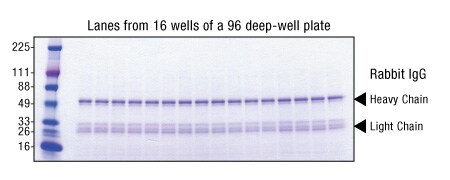
IgG purified from rabbit serum using Pierce Protein A Magnetic Beads and KingFisher Instrument. SDS-PAGE results show consistent heavy- and light-chain bands across all wells
Figure 7. Highly reproducible IgG purification. Pierce Protein A Magnetic Beads and a KingFisher instrument were used to purify IgG from rabbit serum in 16 wells of a 96 deep-well plate. Reducing SDS-PAGE results in separate heavy- and light-chain bands of purified IgG. Yield and purity are identical across all wells, confirming the high quality and reproducibility of the beads and instrument.

Figure 8. Consistency of Pierce High-Capacity Ni-IMAC MagBeads, EDTA Compatible purifications performed on the KingFisher Flex instument. Cell culture supernatant (Expi293) containing over-expressed His-tagged HSA (50 mg total protein) was applied to Pierce High-Capacity Ni-IMAC MagBeads, EDTA-Compatible (10 µL settled beads) in a 96-well plate. Beads were processed using the KingFisher Flex instrument. Binding was performed with all samples for 30 minutes. The beads were then washed twice, and bound protein was eluted with a 15-minute incubation in Elution Buffer. The eluates were resolved on an SDS-PAGE gel and stained with GelCode Blue Safe Protein Stain. Gel lanes were normalized to equivalent volume.
M = MW marker, L = lysate load, 1-12 = corresponding elution from plate row. CV’s <10%

Purification of His-tagged HSA from cell culture supernatant using Pierce High-Capacity Ni-IMAC MagBeads on KingFisher Flex. SDS-PAGE gel shows uniform bands, confirming consistent yield and purity

Easily search and download automated protocols for Pierce magnetic agarose beads using BindIt PC software included with all KingFisher automated purification systems.

KingFisher purification instruments

Automated isolation, extraction, and purification of DNA, RNA, proteins, and cells. Applied Biosystems MagMAX
optimized kits and reagents provide easy-to-use protocols that remove manual steps and help save time.

Learn more


KingFisher sample preparation systems for automated magnetic protein purification

Kingfisher Apex System

KingFisher Apex System

The KingFisher Apex System is similar in specifications to the KingFisher Flex System, but redesigned with additional capabilities for peak performance, adaptability, and usability such as a barcode scanner, a cooling block, and a UV decontamination lamp.

Kingfisher Duo Prime System

KingFisher Duo Prime System

The KingFisher Duo Prime System (low/medium throughput), meant for small labs and individual researchers, processes up to 12 samples per run.

Kingfisher Flex System

KingFisher Flex System

The KingFisher Flex System (medium/high throughput), the standalone laboratory workhorse, processes up to 96 samples per run and is excellent for high-throughput applications and processes 24 and 96 samples per run.

Hero banner dark gradient overlay
Stylesheet for Classic Wide Template adjustments

For Research Use Only. Not for use in diagnostic procedures.